Keep Your Deposit: 3 Renter Safe Ways to Mount a TV in Apartments
Keep Your Deposit: 3 Renter Safe Ways to Mount a TV in Apartments
Yes, in most apartments you can mount a TV and keep your full deposit. A stud-mounted bracket is the safest bet when your lease allows drilling, and a freestanding stand or tension-pole mount works if it doesn’t. Get written permission first, use the right anchors for your wall type, and patch the holes before you move out.
TL;DR:
- Mounting a TV with a stud bracket is safest if your lease permits drilling, but patching and obtaining written landlord approval are essential to protect your deposit.
- Avoid using small plastic drywall anchors for heavy TVs, and always match fasteners to wall material, especially in plaster, masonry, or metal stud walls.
- No-drill options like floor stands, tension poles, or leaning mounts offer safe alternatives but may limit size, weight capacity, or viewing flexibility.
- Professional installation ensures proper anchors, cable routing, and wall repair documentation, reducing the risk of damage and deposit disputes.
- Building-specific rules or HOA restrictions may limit wall penetrations, especially on shared or exterior walls, regardless of lease permissions.
Table of Contents
- Three Renter-Safe Paths for TV Mounting in Apartments
- How Do You Get Permission to Mount a TV in a Rental?
- How Do You Choose the Right Anchors for Your Wall Type?
- No-Drill Alternatives: How Far Can You Get Without a Single Hole?
- Hiding Cables and Repairing Walls Before You Move Out
- When Should You Hire a Professional TV Mounting Service?
- Do Apartment Building Rules Affect TV Mounting Beyond the Lease?
- Does Mounting a TV Affect Your Renter’s Insurance or Liability?
- How Do You Mount a TV in a Small Apartment for the Best View?
- What Renters Consistently Get Wrong About TV Mounting
- Fixmovehaul Makes Renter-Friendly TV Mounting Simple
- Sources
- FAQ
Three Renter-Safe Paths for TV Mounting in Apartments
Every renter mounting a TV lands in one of three lanes: drill into studs, skip drilling entirely, or hand it to someone else. Each has a real tradeoff between looks, cost, and risk to your deposit.
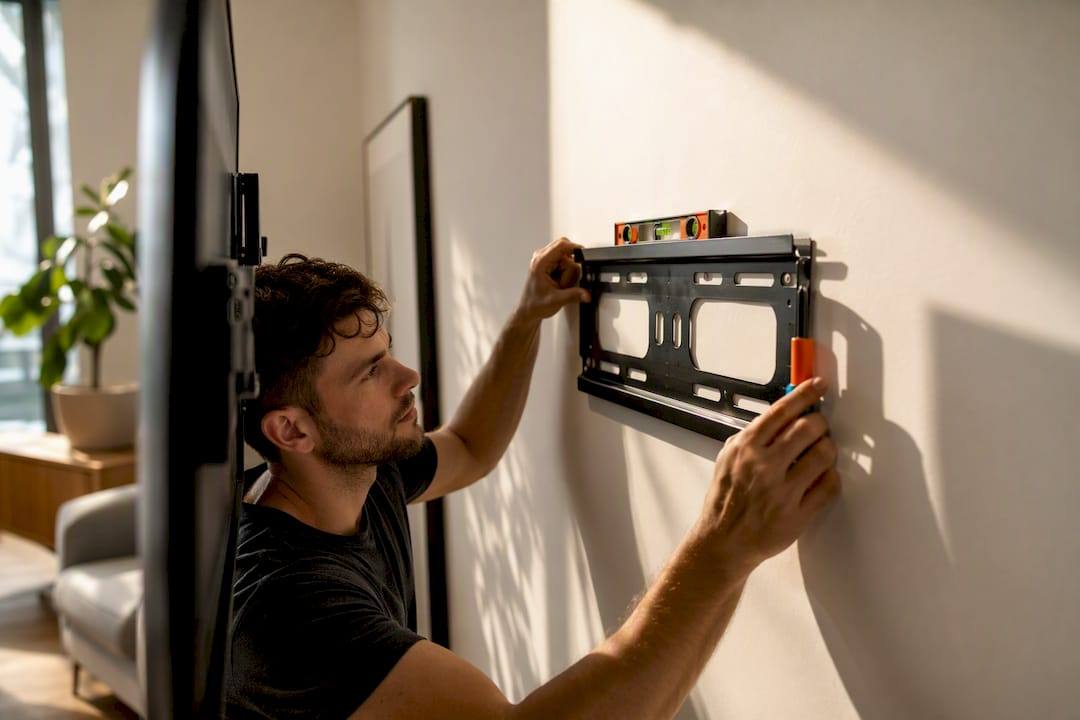
Stud-mounted bracket. These are the gold standard for TV mounting in apartments. When the bracket’s bolts go into a wood or metal stud rather than just drywall, you get a mount that can hold real weight without sagging or pulling loose. The catch is drilling itself, but the holes are small. A typical install uses four to six lag-bolt holes, and those patch to nearly invisible with filler and touch-up paint once you move out.
Freestanding stand or tension-pole mount. If your lease bans drilling outright, or you just don’t want to deal with anchors, a floor stand or ceiling-to-floor tension pole gets your TV to eye level with zero wall penetration. Before buying one, check two numbers: the mount’s VESA pattern (the bolt spacing on the back of your TV) and its rated weight capacity. A stand rated for 50 pounds will not safely hold a 65-inch TV that weighs 40 pounds plus a soundbar and accessories.
Hire a pro or concierge installer. This makes sense the moment you’re unsure what’s behind your wall, you’re working with concrete or metal studs, or your TV is large enough that a mistake becomes expensive. A professional installer brings a stud finder, the right anchors, and, ideally, a plan for patching the wall when you leave. This is also the fastest route if you want the job done same day without buying tools you’ll use once.
- Stud mount: most stable, smallest patch job, requires drilling
- Freestanding stand: no wall damage, fully portable, limited by floor space and stand rating
- Professional install: best for unknown wall types or heavy TVs, includes documented repair plan
How Do You Get Permission to Mount a TV in a Rental?
Start with the lease itself, not a guess. Look for a section titled “Alterations,” “Fixtures,” or “Modifications to the Premises.” Most leases don’t ban small screw holes outright; they ban unrepaired damage. Language like “tenant may not alter the premises without written consent” usually still permits small, reversible installations like a wall-mounted TV bracket, as long as you ask first and fix any holes before handing back the keys.
If the lease is vague or silent on the topic, send a short, specific email rather than asking verbally. Verbal “sure, go ahead” conversations are exactly what turn into disputes at move-out inspection, since neither side has proof of what was agreed.
Your email should cover three things:
- What you plan to do (mount a TV using a stud-anchored bracket, not adhesive strips)
- Confirmation that you or a professional installer will patch and paint-match any holes before move-out
- A request for written confirmation, even just a one-line reply
Framing the request as professional work, rather than a casual DIY project, tends to improve approval odds because it signals the landlord won’t be left with a repair problem. See more here. Property managers care far less about the drilling itself than about who’s on the hook for fixing it.
Once you get a reply, save it. Keep the email thread, take photos of the wall before you start and after you patch, and hold onto any receipts if you paid for professional installation or repair work. If a dispute ever comes up over your security deposit, that paper trail is your entire case.
Pro Tip: Save the original mounting hardware and bolts with your TV box when you move. If a future landlord or the same one wants proof the mount can come off cleanly, having the exact parts on hand makes reinstallation (or removal) a five-minute job instead of a scavenger hunt.
How Do You Choose the Right Anchors for Your Wall Type?
Guessing at wall material is the single most common mistake renters make before mounting a TV, and it’s the one that causes actual damage. Wood studs, metal studs, plaster, and masonry each need a different fastener, and using the wrong one either fails to hold the TV or tears a much bigger hole than necessary.
1. Identify what’s behind the wall. Tap the wall and listen: a hollow sound usually means drywall between studs, a duller thud means you’ve found a stud or blocking. A magnetic stud finder or an electronic one will confirm stud location and spacing (typically every 16 or 24 inches in wood-framed apartments). Older buildings, especially anything built before the 1950s, are more likely to have plaster over wood lath instead of drywall. Concrete block or brick construction is common in ground-floor units and some Florida-style apartment buildings, and it feels rock solid when you knock on it.
2. Match the anchor to the material.
- Wood studs: Drill a small pilot hole, then drive quarter-inch lag bolts into the stud. This is the strongest, most reliable connection for any wall-mounted TV bracket.
- Metal studs: Standard lag bolts won’t grip thin metal the way they grip wood. Use snap toggles or zip-it style toggle anchors rated for metal stud construction, or better, attach a plywood blocking plate across two studs first for a wider load path. Metal stud mounting requires more precision than wood, since the stud gauge affects how much weight it can hold.
- Plaster walls: Pre-drill to avoid cracking the plaster coat, then use wood screws directly into the lath or toggle anchors if you land between lath strips. Plaster is more brittle than drywall, so slow, steady drilling matters more here than anywhere else.
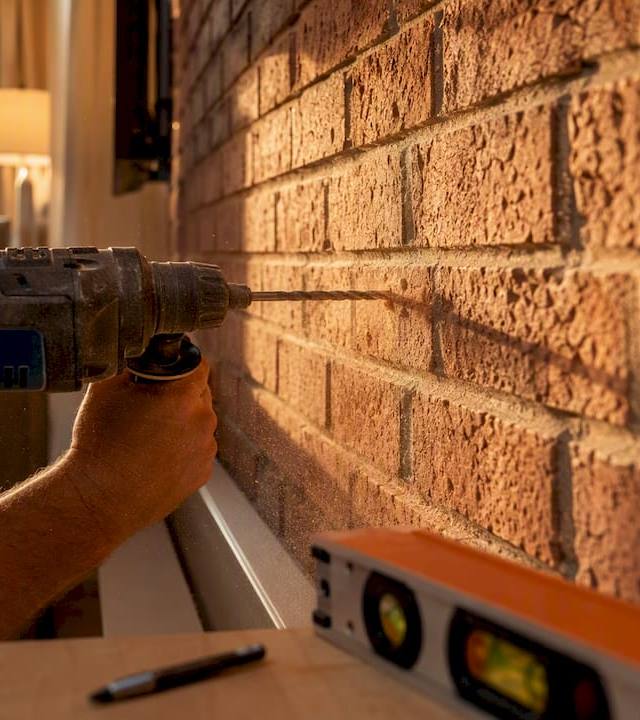
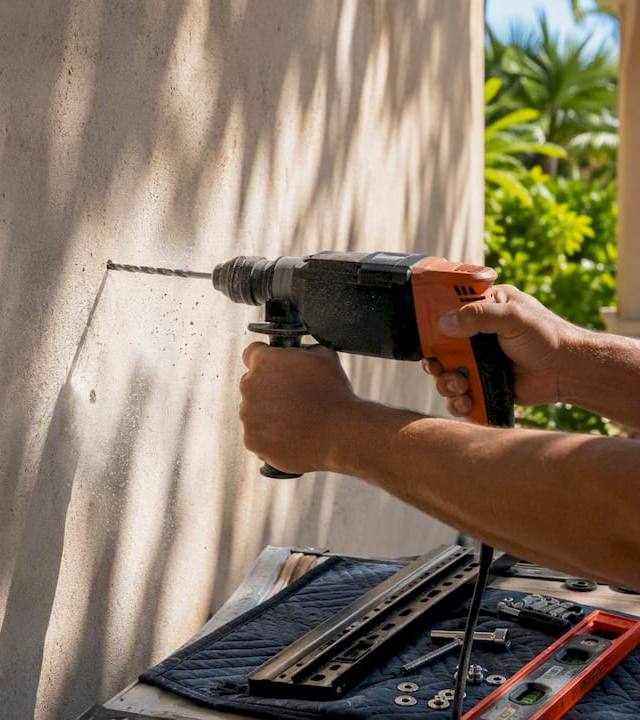
- Masonry, concrete, or brick: Use a hammer drill with a masonry bit, then install masonry sleeve anchors or concrete screws. This is heavier-duty work, and it’s where a lot of renters either give up or overdo it. If you’ve never used a hammer drill, mounting on concrete or mounting on brick is a reasonable place to bring in a professional.
3. Skip small plastic drywall anchors for anything beyond a very light TV. They’re rated for picture frames, not 40-pound televisions with cable boxes hanging off the back. Undersized anchors are the reason TVs pull out of walls, and the holes they leave when they fail are far bigger than a clean stud-bolt hole.
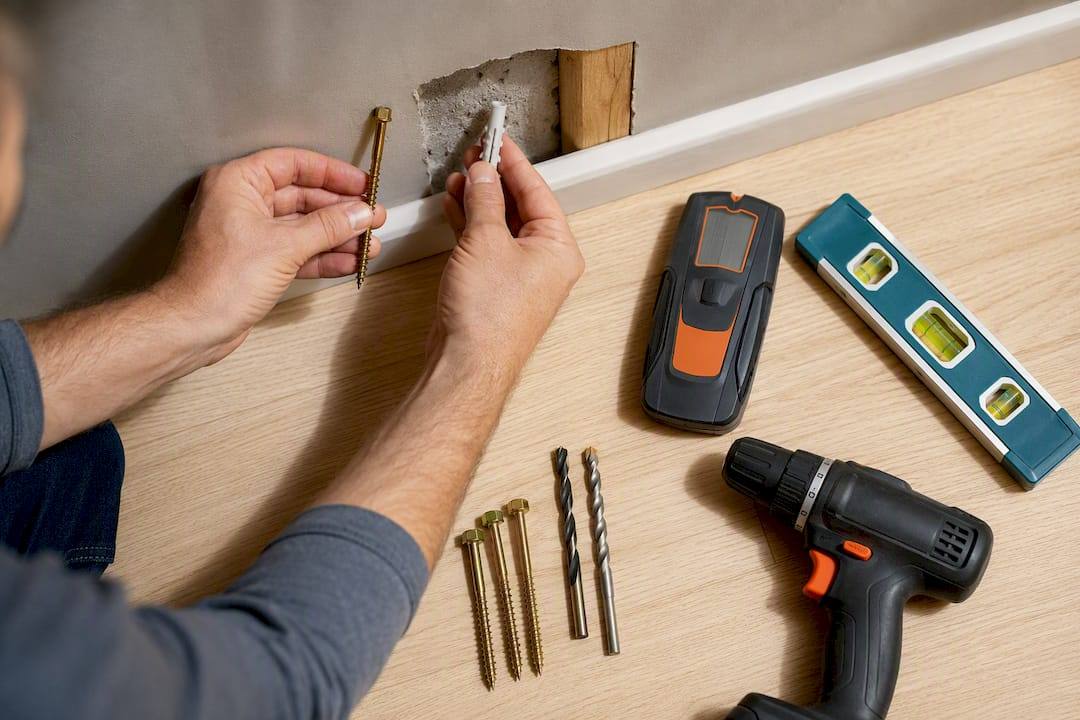
A basic tool kit covers almost every apartment scenario: a stud finder, a torpedo level, a drill with both wood and masonry bits, and torque-rated lag bolts sized to your bracket’s specs. That’s the whole list. Nothing exotic, nothing that costs more than a weekend project should.
No-Drill Alternatives: How Far Can You Get Without a Single Hole?
If your lease says no drilling, period, you still have real options for TV mounting in apartments, they just come with different limits.
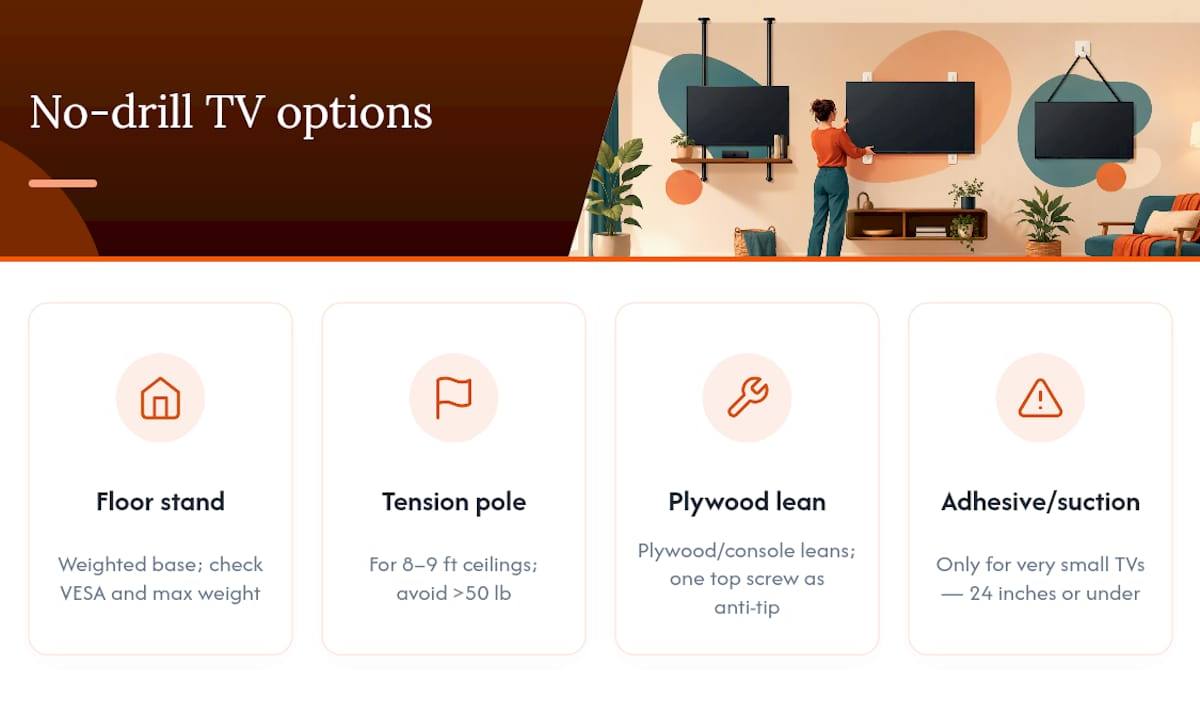
Floor-standing TV mounts hold the television at eye level on a weighted base, similar to a mount you’d see in a showroom. Check two specs before buying: VESA compatibility (the bolt pattern on your TV’s back panel) and the stand’s maximum rated weight, since freestanding options consistently outperform adhesive mounts for anything heavier than a small bedroom TV. Look for a wide base or an anti-tip strap if you have kids or pets in the apartment.
Tension-pole mounts run from floor to ceiling and clamp the TV bracket somewhere along the pole. They work well in apartments with standard eight or nine-foot ceilings, but check the pole’s adjustable range against your actual ceiling height, and confirm its weight rating before hanging anything above 50 pounds.
Plywood-backed leaning mounts are a middle-ground option: a piece of plywood or a slim console leans against the wall with the TV bracket attached to the board instead of the drywall. One small screw at the top, into a stud if possible, acts as an anti-tip safety strap rather than the primary support. It’s not fully zero-hole, but it’s about as close as you can get while still meeting basic safety standards.
Adhesive or suction mounts should stay a last resort, and only for very small TVs (think 24 inches or under, like a kitchen or bathroom screen). They’re not built to hold the weight or the wobble of a living-room-sized television, and a failed adhesive mount is a broken TV, not just a wall problem.
Hiding Cables and Repairing Walls Before You Move Out
Nobody wants a tangle of cords hanging under a mounted TV, but how you hide them matters for your deposit.
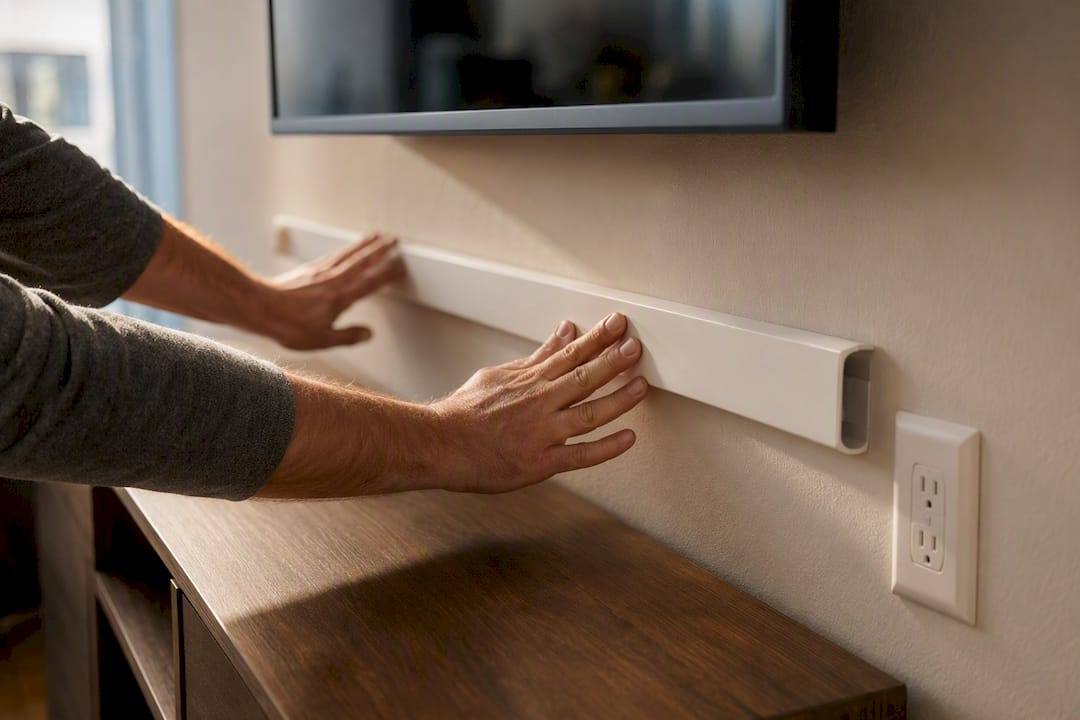
Surface raceways are the renter-friendly answer. These are paintable plastic channels that stick to the wall’s surface and route your cables from the TV down to an outlet or media console. They peel off cleanly at move-out, and installers consistently recommend them over cutting into drywall. You can find code-safe options for hiding TV wires that don’t require any wall surgery at all.
In-wall cable and power runs are a different story. Running a standard extension cord inside a wall violates the National Electrical Code (NFPA 70), which restricts non-rated cords from being enclosed inside wall cavities. If you want that clean, no-cord look, it takes a code-compliant in-wall power kit, and you need landlord approval before cutting into any wall for it. Don’t attempt this without sign-off.
When it’s time to move, the repair sequence is short:
- Remove the bracket and back out the lag bolts.
- Fill the holes with spackle or lightweight filler.
- Sand smooth once dry, usually within an hour or two.
- Touch up with matching paint.
Small stud-bolt holes from a proper mount are quick fixes, a few minutes of spackle and a dab of paint, because the holes are typically just a quarter inch across. Compare that to the larger, jagged damage from an oversized drywall anchor that pulled loose under weight; those often need a full drywall patch, mesh tape, and a longer drying time before paint. The size of the original hole, more than anything else, determines how much move-out repair actually costs you.
When Should You Hire a Professional TV Mounting Service?
Some situations aren’t worth the DIY risk. If you genuinely don’t know what’s behind your wall, you’re dealing with concrete, brick, or metal stud construction, or your TV is 65 inches and up, bringing in a professional installer is the cheaper choice in the long run, cheaper than a failed mount, a cracked wall, or a broken television.
A good installer does more than hang the TV. Before drilling anything, they should check stud layout and spacing, confirm the anchor type that matches your specific wall, plan the cable routing (raceway versus in-wall), and agree with you upfront on how the wall gets restored when you eventually move out. That last part is the piece renters most often skip when they DIY, and it’s the one that actually protects your deposit.
- Ask what anchor type they plan to use before they start drilling
- Ask whether they document the install (photos, stud locations) for your records
- Ask what the move-out patching process looks like and whether it’s included
A professional TV mounting service can handle on-demand mounting in various Southwest Florida locations, sometimes even offering same-day availability. Expert installers use appropriate anchors based on the wall type, such as wood studs or concrete block, and may route cables through surface raceways rather than cutting into the wall. Pricing is typically provided upfront to avoid unexpected charges for the installation service.
Pro Tip: If you’re renting and nervous about the install, ask the installer to text or email you a quick summary of what they did (stud locations, anchor type, hole count) right after the job. That note becomes your documentation if a move-out dispute ever comes up.
Do Apartment Building Rules Affect TV Mounting Beyond the Lease?
Your lease isn’t always the last word. Buildings with a homeowners association, a condo board, or a property management company covering multiple buildings often layer additional rules on top of what your individual lease says, especially in shared-wall apartment buildings and condo-style rentals common across Florida.
These building-level rules typically focus on structural concerns rather than cosmetic ones. Some buildings restrict drilling into any wall that’s shared with a neighboring unit, since a shared wall may carry plumbing, electrical conduit, or structural elements that aren’t obvious from your side. Others limit total wall penetrations per unit or require that any installation be performed by a licensed contractor, particularly in older buildings where the walls may contain asbestos-era materials that shouldn’t be disturbed casually.
HOA and condo association rules also sometimes address exterior-facing walls differently than interior ones, since exterior walls in Florida buildings often have hurricane-rated construction or moisture barriers that a stray drill bit can compromise.
Before you assume your lease covers everything, check whether your building has a separate resident handbook, HOA bylaws, or a property management addendum. If one exists, it usually sits alongside the lease rather than replacing it, and it can be stricter. When in doubt, ask your property manager directly whether any building-wide rules apply on top of your individual lease, since a landlord’s personal approval doesn’t override an HOA restriction if one exists.
Does Mounting a TV Affect Your Renter’s Insurance or Liability?
Mounting a TV yourself introduces a liability question most renters never think about until something goes wrong. If a bracket fails and the TV falls, causing injury to a person or damage to the unit below (in a multi-story building), the question of who pays often comes down to whether the installation was done properly and with permission.
Most renter’s insurance policies cover personal property, including a damaged TV, under standard perils like fire or theft, but liability coverage is the part that matters here. If a poorly secured mount causes an injury or property damage, your policy’s liability section may cover the claim, but insurers can push back if the installation clearly violated manufacturer instructions or ignored basic safety standards, like using a lightweight anchor for a heavy TV.
Landlords carry their own liability policies for the building, but those typically don’t extend to damage caused by a tenant’s unauthorized modification. That’s part of why written permission matters beyond just deposit protection: it establishes that the installation was known and approved, which matters if a dispute or claim ever comes up.
If you hire a professional installer, ask whether the company carries liability insurance for the work performed; for more on benefits of expert help, see Why choose professional installation. A licensed, insured installer shifts a meaningful amount of that risk away from you personally, which matters more than most renters realize until they’re the one filing a claim.
How Do You Mount a TV in a Small Apartment for the Best View?
Small apartments create a different problem than wall material: there’s often no ideal spot that isn’t too close, too high, or crammed into a corner. A few adjustments make a real difference.
Mount height matters more in small rooms because seating distance is short. The center of the screen should land roughly at eye level when you’re seated, which in most apartments means lower than people instinctively place it. A TV mounted too high in a small living room forces you to look up for hours, which gets uncomfortable fast.
In studio apartments or combined living and sleeping spaces, a full-motion articulating arm mount earns its cost. It lets you pull the TV out and swivel it toward the bed or a different seating angle, which matters when one room has to serve two purposes. A fixed mount only works if you have one consistent viewing spot.
Corner mounts solve a specific small-apartment problem: wasted corner space that’s otherwise dead space anyway. A corner-rated bracket angles the TV toward the room’s main seating area instead of pointing it straight out from a flat wall you don’t actually have.
If floor space is tight, a floor stand can still work, but look for a slim-profile base that doesn’t eat into walking paths. In a studio or one-bedroom, a few inches of reclaimed floor space around a TV stand adds up over a full room.
What Renters Consistently Get Wrong About TV Mounting
The instinct most renters have is to treat any drilling as risky and any no-drill option as automatically safer. That’s backwards more often than not. A properly stud-mounted TV with four small lag-bolt holes is objectively less risky to your deposit than an oversized drywall anchor that fails under weight, or an adhesive mount that peels a chunk of paint off when it finally gives out.
My actual rule of thumb: reach for a stud mount whenever your lease allows it and you’re staying long enough to justify the setup, and reach for a freestanding stand or tension mount when you’re in a short-term lease, an unusual wall type, or a building where you genuinely can’t get clear permission. Aesthetics tip the decision only when both options are equally available to you. A mounted TV looks better in almost every living room, but a smart-looking freestanding setup beats a mount you weren’t actually cleared to install.
I’ve walked through enough Southwest Florida apartments to know that landlords rarely object to the drilling itself. They object to surprises. Get it in writing, even if it’s just one sentence in a text message thread, before you pick up a drill.
— Mark
Fixmovehaul Makes Renter-Friendly TV Mounting Simple
Fixmovehaul is the on-demand alternative to guessing your way through a DIY install or waiting weeks for a national chain’s next opening. We show up with the right anchors already sorted for your wall type, mount the bracket into studs when the wall allows it, route cables through a paintable raceway instead of cutting into drywall, and handle the patching and touch-up paint when it’s time to move out.

Technicians may serve various Southwest Florida areas and often offer timely appointments, with pricing provided before the job starts. If you’re also dealing with a new TV stand that needs assembly, or you need help sourcing mounting hardware from a nearby store, our shopping and pickup service covers that too. For a straightforward, deposit-safe install on your schedule, book your TV mounting appointment in Southwest Florida and skip the guesswork entirely.
Sources
For deeper reading on renter-safe installation and lease considerations, see Apartment List’s guide to mounting TVs in rentals, Apartment Guide’s breakdown of lease permissions, Express Mounting’s wall-damage prevention tips, and Pew Research’s data on U.S. renters versus homeowners.
- Can You Mount a TV in an Apartment?
- Can You Mount a TV in an Apartment? — ApartmentGuide
- How to Mount a TV in an Apartment Without Damaging Walls — Express Mounting
FAQ
Can You Typically Mount a TV in an Apartment?
Yes. Most leases allow small screw holes for hanging items, so a stud-mounted TV bracket is usually permitted once you get written landlord permission and agree to patch the holes at move-out.
Are You Allowed to Mount a TV in a Rental Apartment Without Asking First?
Not safely. Even when your lease seems to allow small holes, getting written confirmation from your landlord before drilling protects your deposit if a dispute ever comes up.
Is There a Renter-Friendly Way to Mount a TV Without Drilling?
Yes. Freestanding floor stands and tension-pole mounts hold a TV at viewing height with zero wall penetration, though you need to check the stand’s weight rating and VESA compatibility before buying one.
Can I Get Evicted for Mounting a TV in My Apartment?
Eviction over a TV mount alone is extremely rare and would typically require significant, unrepaired damage or a clear lease violation ignored after a warning. Getting written permission and patching holes before you move out avoids that risk entirely.
When Should I Hire a Professional Instead of Mounting It Myself?
Hire a professional installer, such as Fixmovehaul, when you’re unsure of your wall’s construction, dealing with concrete or metal studs, mounting a large TV, or when you want documented, deposit-safe patching handled for you.