30 Minute Heat Test: How Homeowners Know if TV Above Fireplace Works
30 Minute Heat Test: How Homeowners Know if TV Above Fireplace Works
Mounting a TV above a fireplace works when three things line up: the fireplace runs cool (electric or sealed gas, not an active wood burner), the mantel puts the screen center within a few inches of comfortable eye level, and a heat test confirms the wall stays within safe range. Skip any of those checks and you’re looking at neck strain, a shortened TV lifespan, or both. Run the tests in the sections below before you buy a mount.
TL;DR:
- Heat exposure from active wood-burning fireplaces can damage TVs mounted above if a heat test is not conducted beforehand.
- Professional installation is highly recommended for masonry surrounds, large TVs, or when routing in-wall power to ensure safety and compliance.
- Mounting a TV 65 inches or higher above eye level causes neck strain, unless a pull-down or tilting mount is used to bring the screen to eye level.
- Running an infrared thermometer test for 30 minutes helps determine whether the wall surface remains within the safe heating range of 95°F to 104°F.
- Proper planning, including wiring, mount choice, and heat testing, can prevent common frustrations like dim screens, poor sound, or wiring visibility.
Table of Contents
- TV Above Fireplace Pros and Cons: Why So Many Homeowners Choose It Anyway
- Why Do Some Homeowners Regret Mounting Their TV Over the Fireplace?
- Does Your Fireplace Type Change Whether This Is Safe?
- What Height Should the TV Be, and Which Mount Fixes It?
- How Do You Test Wall Heat Before Mounting a TV?
- Anchors, Wiring, and Power: What the Installation Actually Involves
- What If Above the Fireplace Isn’t the Right Spot?
- What Installers See on Every TV-Above-Fireplace Job
- Does Mounting Above the Fireplace Change How the TV Sounds?
- Prioritize Comfort or Aesthetics? My Take
- How Fixmovehaul Handles TV Mounting Over a Fireplace
- Sources
- FAQ
TV Above Fireplace Pros and Cons: Why So Many Homeowners Choose It Anyway
The appeal is obvious the moment you walk into a living room built around it: one wall, one focal point, and no second furniture arrangement competing for attention. That’s the entire case for mounting a TV above the fireplace, and it’s a real one, not just a design trend. It’s also why the debate over TV above fireplace pros and cons keeps coming up in renovation forums and design blogs. It remains a popular layout choice for consolidating a room’s focal point, especially in smaller living spaces where floor space for a media console and separate seating arrangement simply doesn’t exist, according to Livingetc.
Here’s what you actually gain when the layout works:
- Space efficiency. No credenza, no floating shelf, no second wall claimed by electronics. In a 250 square foot living room, that matters more than in a great room.
- A single sightline. Everyone in the seating area looks the same direction, which is genuinely useful for open-concept homes where the fireplace already anchors the layout.
- Cleaner cable management. When wiring is planned before the drywall goes back up, you get a wall with no visible cords at all, not even to a soundbar or streaming box.
- Design cohesion. A tiled or stone surround with a flush-mounted TV reads as one architectural element instead of two competing ones.
That last point deserves more attention than it usually gets. A TV that “disappears” into the room, through frame-style bezels, matching paint, or a surround that continues the mantel’s material up the wall, solves the biggest aesthetic objection people have to this layout: the black rectangle problem. Pair that with symmetrical bookshelves or wall art flanking the fireplace and the whole wall starts to look designed rather than accidental. If you’re weighing what goes around the screen itself, guidance on hanging wall art over a fireplace mantel is worth a look before you commit to a layout, since the TV’s position changes where art can realistically go.
None of this works, though, if the mount is an afterthought bolted on after the fact. The homeowners who end up happy with this setup planned the wiring, the mount type, and the height before the TV went up, not after. That’s the dividing line between the pros people brag about and the cons covered next.
Why Do Some Homeowners Regret Mounting Their TV Over the Fireplace?
The complaints are consistent enough that they show up in nearly every design forum thread on the topic: sore necks, a TV that looks dimmer than it should, and wiring that turns into a bigger project than expected. None of these are hypothetical. They’re the predictable result of prioritizing the look of a wall over how it actually gets used.
Neck and eye strain top the list. Fireplace mantels generally sit at a height that places a TV centered above one well above seated eye level, leading to potential neck strain during viewing. Watch a two-hour movie at that angle and your neck knows it the next morning. This is less of an issue for a TV that plays background news for ten minutes a day and a serious problem for anyone who watches full seasons on a Saturday.
Heat exposure is the quieter risk, and the more expensive one. Most manufacturers list a safe operating temperature range of roughly 95°F to 104°F, and repeatedly exceeding that ceiling can shorten a TV’s usable lifespan. Wood-burning fireplaces are the worst offender here because they push convective heat straight up the chimney breast, right into whatever’s mounted above it. Soot buildup on the screen and housing is a secondary issue nobody mentions until it’s their TV.
The gap most homeowners miss: a room can look completely intentional, symmetrical mantel, flush-mounted screen, coordinated finishes, and still be miserable to actually watch TV in. Stewart Milne Homes calls this a conflict of use, and it’s the single biggest reason people redo this layout within a year or two.
Add to that a shorter list of everyday annoyances:
- Glare from windows or overhead lighting hits a high-mounted screen differently than one at eye level, often worse.
- Wiring that wasn’t planned in advance means surface-mounted cord covers or, worse, a visible power strip on the mantel.
- Sound quality suffers when the TV’s built-in speakers fire downward past a mantel edge instead of straight at the seating area.
- Reaching the TV for cleaning, HDMI swaps, or a stuck app becomes a two-person job with a ladder.
None of these problems are dealbreakers on their own. Stacked together, they’re why “should I put my TV over the fireplace” keeps generating so much second-guessing after the fact, rather than before.
Does Your Fireplace Type Change Whether This Is Safe?
Yes, more than almost anything else on this list. The fireplace itself is the single biggest variable in whether mounting a TV above it is a smart move or a slow-motion mistake, and it splits cleanly into three categories.
Electric fireplaces are the safest bet. They produce minimal upward heat at the wall, which makes them usually the easiest candidate for an above-mantel installation, according to Rock Paper TV. Many electric inserts and linear units built with a TV niche in mind come with manufacturer clearance specs that make the installation close to plug-and-play when followed. If you’re building a media wall from scratch, this is the category to design around.
Gas fireplaces usually work, with a caveat. Sealed or direct-vent gas units, where the flame is behind glass and combustion air is ducted from outside, run cooler at the mantel face than an open unit. They’re typically fine for above-mantel TVs as long as mantel depth is adequate and you’ve confirmed the model’s clearance rating. Older gas fireplaces without a sealed firebox behave more like wood burners and need the same scrutiny.
Wood-burning fireplaces carry the highest risk. Active use pushes real heat up the chimney breast for hours at a time, and that heat doesn’t stop cleanly at the mantel line. If you’re set on mounting above a wood-burning fireplace, don’t skip the heat test in the next section. It’s the difference between an educated decision and a guess.
Mantel depth and ceiling height do a lot of quiet work here too. A mantel that projects 4 to 8 inches from the wall gives some real standoff distance and airflow between the firebox and the TV above it. A flush or shallow mantel offers almost none. Combine a shallow mantel with a low ceiling and you’ve also compounded the ergonomics problem from the previous section, since there’s less room to add height without the screen brushing the ceiling line.
A rough way to think about it by fireplace type:
- Electric insert: low heat risk, straightforward install, best candidate overall.
- Sealed or direct-vent gas: moderate risk, generally fine with adequate mantel depth and confirmed clearances.
- Open-hearth or older gas unit: treat like wood burning until proven otherwise.
- Wood-burning, actively used: highest risk, test thoroughly or choose an alternative wall.
None of this replaces an actual temperature reading. It just tells you how worried to be before you take one.
What Height Should the TV Be, and Which Mount Fixes It?
The ergonomics answer is more specific than “eye level,” and it’s worth knowing the actual number before you argue with a contractor about mount height. Seated eye level for most adults lands somewhere between 42 and 48 inches off the floor. A TV whose screen center sits at that height is comfortable for hours. A TV whose screen center sits at 65 or 70 inches, which is common with above-mantel installs, forces your neck into extension for as long as you’re watching.
Screen size and seating distance matter just as much as height. A 65-inch TV viewed from 8 feet away sits inside the commonly recommended distance range for that size, but stack that same screen 20 inches higher than eye level and the comfortable distance shrinks, or the strain increases at the same distance. Bigger screens mounted higher need more room to work, not less.
Three mount types solve this problem in different ways:
- Tilting mounts angle the screen downward, which helps with viewing angle but does nothing about actual seated eye level. Cheapest option, smallest fix.
- Full-motion articulating mounts let you pull the screen out and swivel it, useful for rooms with seating off to one side, but they don’t lower the screen’s resting height either.
- Pull-down or drop mounts, sometimes marketed as MantelMount-style systems, physically lower the TV from its mantel position to closer to eye level for viewing, then retract it back up when you’re done. This is the only mount category that actually solves the height problem rather than compensating for it. A tilting mount reduces neck strain versus a fixed bracket, but a pull-down mount goes further by changing the screen’s actual position, according to PW Decor.
Pull-down systems aren’t free of tradeoffs. They add real weight and leverage to whatever they’re anchored to, and that often means blocking or header reinforcement behind the wall to handle the load safely, which is a bigger project than a fixed bracket. Budget and structural review belong in the conversation before you fall in love with one online.
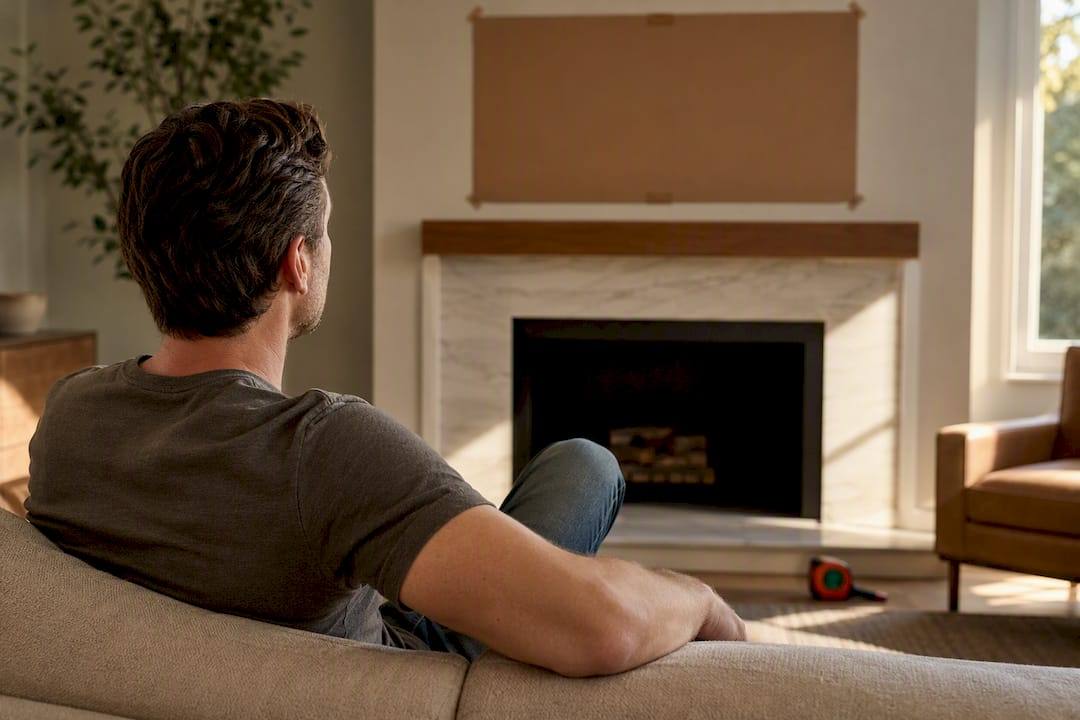
Pro Tip: Before you buy anything, cut a piece of cardboard to your TV’s exact dimensions and tape it to the wall at the height you’re considering. Sit in your usual spot for a full episode of something. This “cardboard test,” a method designers use to preview real-world comfort, according to Stewart Milne Homes, costs nothing and it will tell you more than any online height calculator.
If you want the exact math for your room’s screen size and seating distance, a TV mounting height guide walks through the measurements in more detail than a single article can cover here.
How Do You Test Wall Heat Before Mounting a TV?
Run the test before you drill a single hole, not after you’ve already hung the mount. It takes about half an hour and costs the price of an infrared thermometer, which you can find for under $20 at most hardware stores.
Here’s the method installers actually use:
- Light the fireplace and run it at maximum output for a full 30 minutes. Don’t test on a low or medium setting. You want to know what the wall does under worst-case use, not average use.
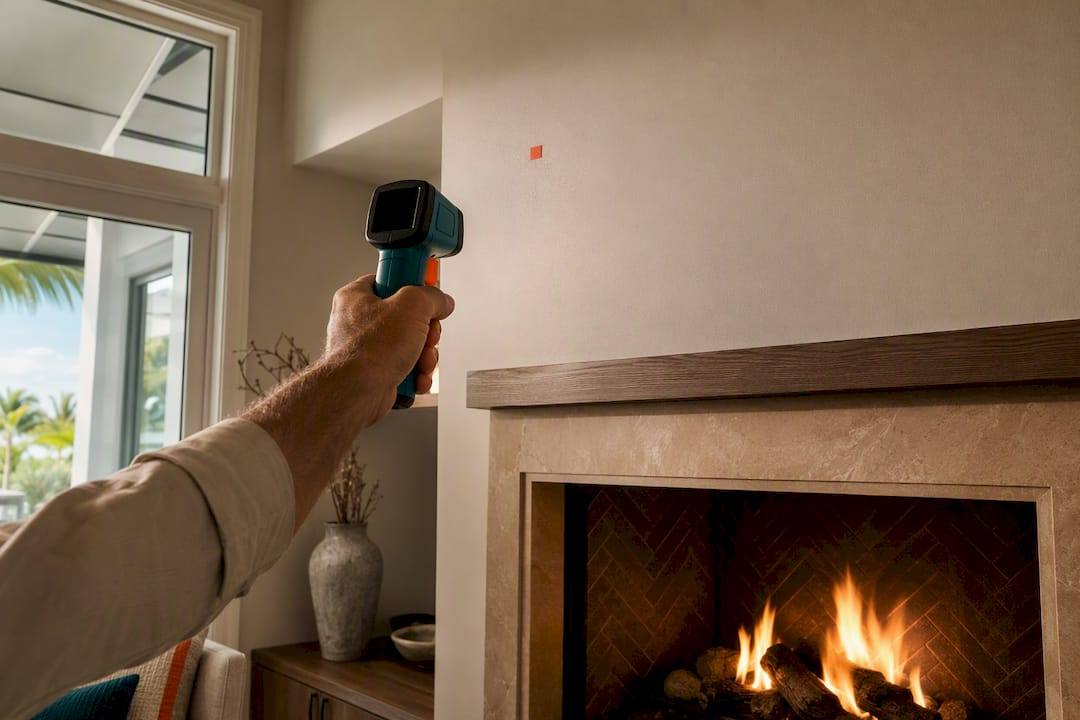
- Measure three points on the wall with an infrared thermometer: the exact spot where the TV’s center will sit, the lower edge closest to the mantel, and a point near where the mount’s wall plate will attach.
- Compare those readings against the manufacturer’s operating range, typically 95°F to 104°F for most consumer TVs. If any of your three readings exceeds that range, or comes close to it, that location isn’t safe for a permanent mount without changes.
- Repeat once more on a different day if your first test happened during unusually cold or warm weather, since ambient room temperature shifts the baseline.
This exact approach, a 30-minute maximum burn followed by three-point infrared readings, is what Stewart Milne Homes recommends before committing to a mounting location, and it’s the single most useful test in this entire article. It turns a guess into a measurement.
If your readings come back high, you have options short of abandoning the layout entirely:
- Add a metal heat deflector behind the mantel to redirect rising heat away from the wall surface above it.
- Increase the standoff distance with a deeper mantel extension, giving more air gap between firebox and TV.
- Switch to an electric insert if the fireplace is a secondary heat source and you’re open to replacing it.
- Move the TV to an adjacent wall if the numbers simply don’t work, covered in more detail below.
Professional installers also lean on two other checkpoints that catch problems before they become service calls: confirming the mount is rated for at least 1.5 times the TV’s weight, and verifying real stud engagement rather than relying on drywall anchors alone. Those two items, plus a post-install temperature check, prevent most of the issues that bring people back for a second visit.
Get a pro inspection before mounting anything heavy on masonry, before running new electrical for an in-wall kit, or if your fireplace surround shows any existing cracking or heat discoloration. Those aren’t jobs to learn on.
Anchors, Wiring, and Power: What the Installation Actually Involves
The wall surface behind your fireplace determines almost everything about how the installation goes, and it’s worth knowing before you price out a mount online.
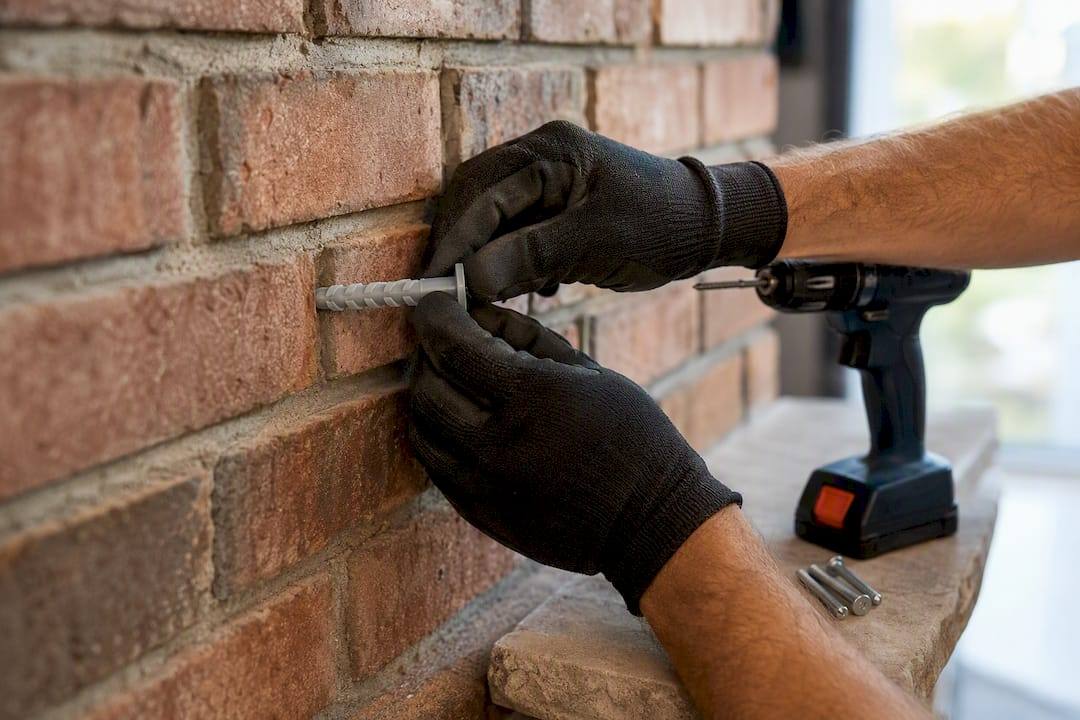
Masonry surfaces need different hardware than drywall. Brick, stone, and stucco surrounds typically require masonry anchors, sleeve anchors, or Tapcon-style concrete screws driven with a diamond-tipped bit, not the toggle bolts or stud finders that work on a framed wall. According to Rock Paper TV, masonry jobs generally take more time and different tools than a standard drywall install over studs. Stone-faced surrounds add another wrinkle: an uneven face can force shimming behind the mount bracket to get it flush, and hitting a mortar joint versus solid brick changes which anchor actually holds.
Standard TV power cords should never run inside a finished wall. Most electrical codes prohibit it, and it’s a real fire risk regardless of code. The fix is an in-wall power kit, often described as PowerBridge-style, which installs a recessed outlet behind the TV connected through code-compliant, low-voltage-rated conduit to an outlet lower on the wall or nearby. PW Decor recommends this approach specifically because it gets you a clean, cordless look without violating electrical code, which a raw extension cord tucked behind drywall cannot do safely.
Cable concealment options split by wall type:
- Drywall walls can usually accommodate an in-wall power kit and a low-voltage cable pass-through cleanly, since you’re cutting into standard framing.
- Brick and stone surrounds often can’t take an in-wall kit at all without significant masonry work, which pushes many homeowners toward a paintable surface raceway matched to the mortar color instead.
- Mixed surrounds, drywall above a stone hearth surround, sometimes allow a hybrid: in-wall power above the stone line, raceway below it.
If brick or stone is what you’re dealing with, a full walkthrough on mounting a TV on brick covers the anchor types and drilling approach in more depth. For apartments or rentals where drilling into anything isn’t an option, renter-safe TV mounting methods and code-safe wire concealment without permanent holes cover workaround approaches that don’t require landlord approval.
Before hanging anything, confirm two numbers: the mount’s weight rating should be at least 1.5 times your TV’s actual weight, and the mount’s VESA hole pattern has to match your TV’s back panel exactly, not “close enough.” Get those two things wrong and you’ve got a much bigger problem than a crooked picture.
Heavier TVs, masonry surfaces, and any pull-down mount with structural implications are the three scenarios where hiring a professional stops being optional and starts being the sensible call.
What If Above the Fireplace Isn’t the Right Spot?
Plenty of rooms work better with the TV somewhere else entirely, and admitting that early saves a lot of wasted drilling.
Opposite-wall placement wins on comfort every time viewing height matters more than symmetry. Put the TV on the wall facing your seating instead of above the fireplace, and screen center lands naturally at eye level without a mount trying to compensate for it. The fireplace still functions as a secondary focal point for ambiance, just not the one competing for your attention during a movie.
Side walls and corners work well with an articulating mount. In an L-shaped living room, a corner-mounted TV on a full-motion arm can swing to face either the main seating area or a kitchen island, which a fixed above-mantel position can’t do.
Design compromises exist if you still want the fireplace wall to hold the TV. A smaller screen size mounted flush reduces both the heat exposure surface and the height-related viewing strain compared to a large-format TV in the same spot. Some newer TVs include a picture or art mode that displays artwork when not in use, softening the black-rectangle look that bothers people who otherwise love the above-mantel layout. A decorative sliding cover or barn-door style panel is a low-tech version of the same idea.
Run through this before picking a wall:
- Does your household watch TV for long stretches, or mostly background viewing? Long stretches favor eye-level placement over the mantel.
- Is the fireplace wall the only wall large enough for your preferred screen size?
- Did the heat test come back clean, or does the fireplace wall need mitigation first?
- Is there a natural opposite or side wall that solves both heat and height at once?
If your answers point away from the mantel, that’s not a design failure. It’s the test doing exactly what it’s supposed to do. If you’re building out a full media wall regardless of which surface the TV lands on, custom surround and millwork options are worth a look for tying the whole wall together.
What Installers See on Every TV-Above-Fireplace Job
After enough of these installs, a pattern shows up fast: the calls that turn into a second visit almost always trace back to one of three mistakes made before the installer ever showed up.
The most common is anchor choice. Someone bought a mount rated for a smaller TV, or used drywall anchors on a wall that needed stud engagement or masonry hardware, and the bracket started to sag within weeks. Second is mantel depth that never got measured against the TV’s actual heat output, which sometimes only surfaces months later when a customer notices their picture looks dimmer than it used to. Third, and probably the most avoidable, is in-wall power that never got planned before the drywall closed up, leaving a visible cord running down to an outlet that’s now in the wrong spot entirely.
A typical professional installation checklist runs through stud or masonry confirmation, a mount rated for at least 1.5 times the TV’s weight, an in-wall power kit routed to code rather than a surface cord, and a temperature check of the mounting surface after the fireplace has run for a while. That last step catches problems a homeowner might not think to check until the TV’s already showing signs of heat stress.
Same-day professional service tends to make more financial sense than DIY specifically when the wall is masonry, when the TV is large enough that a fall risk becomes a real liability, or when in-wall power needs to be routed through existing framing without opening up half the wall. A weekend project that turns into a return trip to the hardware store three times isn’t actually cheaper than booking it once and getting it right.
Does Mounting Above the Fireplace Change How the TV Sounds?
It does, and it’s one of the more overlooked items on this whole list. Most built-in TV speakers fire either downward or forward from the bottom edge of the screen. Mount that TV 65 or 70 inches up the wall, and the sound now has to travel down and outward past a mantel edge before it reaches anyone sitting on a couch at normal seated height. The result is audio that sounds thinner and less direct than the same TV would sound mounted at eye level on a flat wall, even though nothing about the actual speakers changed.
Wall material makes it worse in some rooms and better in others. A stone or tile fireplace surround reflects sound differently than drywall does, sometimes creating a slight echo or muddiness directly around the mantel that a flat plaster wall wouldn’t produce.
The fix is straightforward and most people end up here eventually anyway: add a soundbar. Mounting a slim soundbar just below the TV, either on its own small bracket or resting on the mantel itself, puts the audio source back down near ear level where it belongs, and it solves the reflection problem from a hard surround at the same time. If you’re already running an in-wall power kit for the TV, ask whether a second low-voltage line for a soundbar or a compact wireless speaker setup makes sense while the wall is open. Doing that wiring in one pass costs a lot less than opening the wall again in six months once the tinny sound finally becomes annoying enough to fix.
Prioritize Comfort or Aesthetics? My Take
If you watch television for real stretches, sports on Sunday, a full season over a few weekends, put comfort ahead of symmetry. A gorgeous, perfectly centered TV that gives you a stiff neck every single time isn’t a design win, it’s a design you’ll quietly resent in about four months.
If the TV in that room is genuinely secondary, background news in the morning, the occasional movie night, and the fireplace wall is the room’s real showpiece, aesthetics can reasonably win. That’s a legitimate tradeoff, not a mistake, as long as you made it on purpose.
Either way, don’t skip the heat test or the cardboard test. Both take under an hour combined and they turn a guess into an actual decision. And if your fireplace is masonry, wood-burning, or you’re eyeing a pull-down mount with real structural weight behind it, that’s the point to bring in a professional rather than find out the hard way what a drywall anchor can’t hold.
— Mark
How Fixmovehaul Handles TV Mounting Over a Fireplace
Once you’ve run the heat test and decided above-mantel makes sense for your room, the actual install is where most DIY attempts run into trouble, especially on masonry or when in-wall power needs to be routed to code. Some professional services offer direct scheduling with a local crew, no call center, no waiting days for a callback, with same-day service options when your schedule is tight.

The typical job covers stud or masonry anchoring rated to the TV’s actual weight, in-wall power kit installation so no cord runs down the wall, and setup for pull-down or tilting mounts including MantelMount-style systems if ceiling height and mantel depth call for one. Such work can be worth hiring out specifically when the wall is brick or stone, the TV is large enough that a fall risk is real, or code-compliant wiring means opening framing not advisable to guess at. Pricing is often transparent and listed upfront rather than quoted after a visit.
Get a quote through TV Mounting & Home Help, starting at $99, or check bundled options including in-wall power and mantel installs on the pricing page.
Sources
The heat-safety guidance and testing method in this article come primarily from Stewart Milne Homes, which lays out the 30-minute burn test and infrared measurement approach in detail. Manufacturer operating temperature ranges and in-wall power kit recommendations are drawn from PW Decor. Fireplace-type risk comparisons and masonry anchoring specifics come from Rock Paper TV. Design and trend framing around why homeowners choose this layout in the first place is sourced from Livingetc. Each covers a different piece of the decision, from safety testing to aesthetics, and together they back most of the specific numbers cited above.
- Should you put a TV over a fireplace? | Livingetc
- How to mount a TV above a fireplace | PW Decor
- TV placement with fireplace: options, tips, safety | Stewart Milne Homes
- TV above fireplace: height, heat, and mount guide | Rock Paper TV
FAQ
Is It a Bad Idea to Put a TV Above a Fireplace?
Not automatically. It’s a bad idea specifically when the fireplace is an actively used wood burner, the mounting height puts the screen well above comfortable eye level, or you skip the heat test before installing.
Is TV Over Fireplace Out of Style?
No. It remains a widely used layout for consolidating a room’s focal point, particularly in smaller living spaces, according to Livingetc, though pull-down and tilting mounts have become more common as homeowners try to fix the ergonomics issue rather than abandon the look.
Why Not TV Over Fireplace?
The two biggest reasons are neck strain from a screen mounted above seated eye level and heat exposure that can shorten a TV’s lifespan, especially above wood-burning fireplaces. Both are testable in advance with the cardboard test and the 30-minute heat test.
What Is the Best TV to Hang Above a Fireplace?
There’s no single best model, but a TV with strong off-angle picture quality holds up better at a high mounting position where viewers aren’t looking straight at the screen. Pairing it with a tilting or pull-down mount matters more than the specific TV you choose. If you want the mount and wiring handled professionally, TV Mounting & Home Help covers installation across mount types.
How Do I Know if My Fireplace Wall Is Too Hot for a TV?
Run the fireplace at maximum heat for 30 minutes, then check the wall with an infrared thermometer at three points where the TV and mount will sit. Compare against the manufacturer’s operating range, typically 95°F to 104°F, and reconsider the location if any reading comes close to or exceeds it.