How to Mount a TV on a Tile Wall Without Cracking It

How to Mount a TV on a Tile Wall Without Cracking It
You can mount a TV on a tile wall, but the tile will not hold it. The tile is a finish. The weight has to go into what is behind it: a wood stud, solid concrete or block, or a rated hollow-wall anchor. The drilling is the delicate part, because a fast bit or a hammer drill will crack a tile that cost real money to install. If you would rather not risk a chipped backsplash or a dropped screen, our TV mounting service starts at $99 and covers homes across Naples, Bonita Springs, Estero and the rest of Southwest Florida.
TL;DR
- Tile only finishes the wall. The mount must anchor into a stud, solid concrete or block, or a properly rated anchor system behind the tile.
- Sony says the wall should hold four times the TV’s weight, and some mount manuals call for five times. Check your mount’s manual for the number.
- Drill tile with a diamond or carbide bit, at low speed, with water and no hammer setting.
- The most common failures are finding the wrong stud, overheating the bit and hanging a heavy full-motion arm on a weak anchor.
- A two-person job with a tested wall is the safe standard, and it is the reason many Florida homeowners book it out.
Table of Contents
- Why tile changes a normal TV mounting job
- What actually holds the TV
- Find out what is behind the tile first
- The right bit, speed and hardware
- Step-by-step: mounting a TV on tile
- Where tile jobs go wrong
- Mounting a TV on tile without drilling
- Why hiring it out is the safe call on tile
- Our perspective
- FAQ
- Sources
Why tile changes a normal TV mounting job
On plain drywall, a mounting job is about finding two studs and driving lag screws. Tile adds three problems.
First, tile hides the wall. Many Southwest Florida homes have tile over concrete block, tile over cement board, or tile over drywall in a bathroom, fireplace surround or kitchen. Each one calls for different hardware, and you cannot tell which you have from the surface.
Second, tile is hard but brittle. It resists a standard bit, which tempts people to push harder or switch to a hammer drill. Fine Homebuilding’s guide to drilling tile warns that the percussive force of a hammer drill only cracks or breaks the tile.
Third, a mistake is permanent. A cracked tile means matching a discontinued pattern or re-tiling a section. A crooked hole in drywall can be patched in an afternoon. A crooked hole in porcelain stays there.
Manufacturers know this. LG’s wall-mounting support page says mounting may be restricted by wall type, names tile, and recommends a professional technician. Sony’s mounting FAQ likewise strongly recommends qualified professionals for wall installation.
What actually holds the TV
The load path is simple: TV, bracket, fastener, structure. The tile is not on that list.

Wood studs behind the tile. This is the strongest common option. DG Floors notes that if a stud sits behind the tile where you want to mount, you can drill through the tile and screw straight into the stud with no anchor. Tile laid over drywall on a stud wall is usually this case.
Solid concrete or concrete block. Common in Florida construction. Mounts that ship with masonry hardware are meant for this. A Radish mount manual hosted by Lowe’s says its included hardware suits wood studs or solid concrete, not metal studs or cinder block, and that anchors are used for concrete, stone or masonry while plain wall screws go into studs.
Metal studs, hollow block or tile over drywall with no stud in reach. These are the hard cases. They need a hollow-wall anchor designed for the load, and you have to know whether the mount manual even permits it. Many do not.
How much weight the wall must carry
Two published examples show how much margin is expected. Sony states that the wall should hold four times the weight of the TV. The Sanus SLF428 manual calls for a wall that supports five times the combined weight of TV and mount, limits the TV to 135 lbs including accessories, and specifies pilot holes 3-1/2 inches deep with a 7/32-inch bit in the center of the stud.
A worked example: a 65-inch TV weighing 55 lbs on a 15-lb full-motion mount is 70 lbs. At five times, the wall needs to support 350 lbs at that spot. A stud or solid concrete does that easily. Tile on bare drywall does not.
Find out what is behind the tile first
Do this before you buy a mount, because the answer decides which one you need.
- Scan with a deep-scan or multi-sensor stud finder. Lowe’s explains that electronic finders read density changes up to 1-1/2 inches deep, and that better models also flag wires, ducts and plumbing. Tile and thick adhesive can confuse cheaper units.
- Treat one beep as a hint. Outlets, cable runs and door corners all trigger sensors. Scan across the wall in both directions and mark where the readings agree.
- Confirm with a tiny test hole. Pick a spot that will be hidden behind the bracket. Drill it with a small bit through the tile. Solid resistance after the drywall suggests wood. A bit that spins free means you are beside the stud or in an empty cavity. Concrete will stop a small bit hard and throw white dust.
- Mark both stud centers and check that the mount plate spans them before you drill lag holes.
- Stay off the tile’s edge. DG Floors notes tile is weakest within 1/2 inch of edges and corners, so plan hole positions away from grout lines that sit close to a cut edge.
If the test holes show nothing solid, stop. That is the point at which a trained installer is worth more than any tool you could buy.
The right bit, speed and hardware
Bits
Use a diamond-tipped or carbide-tipped bit rated for the tile type. Porcelain is harder than ceramic and wants a diamond bit. Once through the tile, you can change to a masonry or wood bit for whatever lies behind, depending on the substrate.
Speed and pressure
DG Floors recommends the lowest speed: roughly 100 to 300 RPM for porcelain and 400 to 600 RPM for ceramic, with the drill started at a slight angle to cut a starter groove. Fine Homebuilding adds that you can score the glaze by rocking the bit to make a dimple so it does not wander, then drill with light, even pressure and water for lubrication.

Heat is what cracks tile. A hot bit expands and stresses the tile, and the moment the bit breaks through the back it lurches forward. Ease off pressure as soon as you feel the break.
Fasteners
- Into a stud: the lag screws that come with the mount, driven through the pilot hole.
- Into concrete or block: masonry anchors sized to your mount, in a hole of the depth the anchor specifies.
- Hollow wall: a heavy-duty toggle-style anchor. The Togglers SNAPTOGGLE specification sheet lists tile over drywall among rated substrates and TV mounts as an application, and requires at least 1-7/8 inches of clearance behind the wall. It is a last resort next to a stud.
Mount type
Wirecutter’s staff caution that full-motion mounts used with toggle bolts are a falling hazard, because the movement gradually grinds away the drywall. On a tile wall with no stud in the right place, a fixed or low-profile tilting mount keeps the lever arm short and the load closer to the wall.
Step-by-step: mounting a TV on tile
Each step includes what it takes and where it commonly goes wrong.
- Choose the height and spot. Sit where you will watch and mark the center of the screen at eye level. Wrong: mounting too high, which strains the neck, or centered on a spot with no stud and no solid backing.
- Locate the structure. Use the scan-and-test method above. Wrong: trusting a single beep.
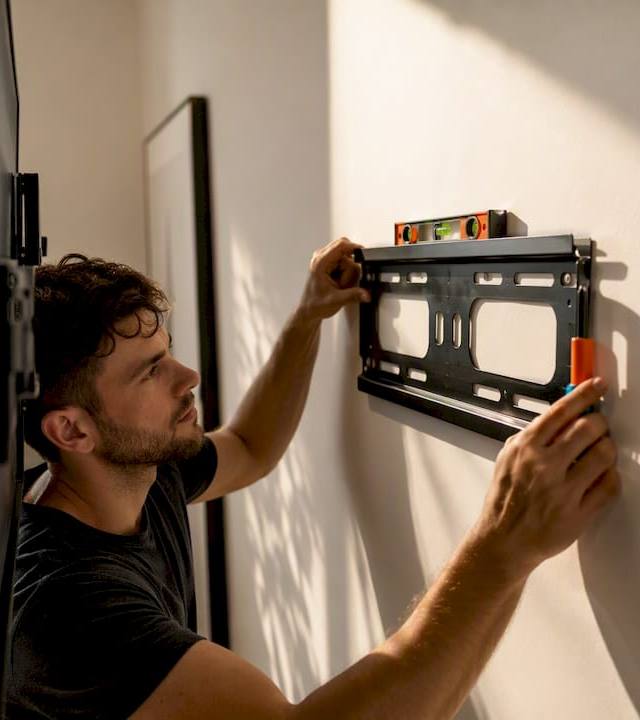
- Hold the mount plate to the wall and mark holes. Use the template that came with the mount and a level. Wrong: marking holes that land near a tile edge or a grout line that is only a thin sliver of tile.
- Protect the tile. Tape an X over each mark so the bit bites instead of skating. Lay towels below to catch dust and water. Wrong: skipping the tape, then watching the bit scratch a ring in the glaze.
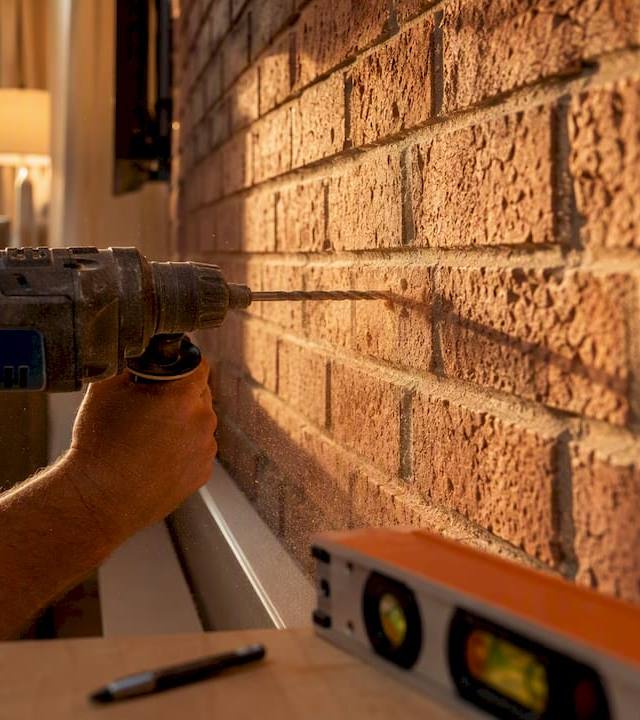
- Drill through the tile. Diamond bit, lowest speed, light pressure, a little water, no hammer setting. Wrong: pushing, running dry, or letting the bit get hot.
- Drill the substrate. Once through the tile, change to the bit the substrate calls for and drill to the depth in the manual. Wrong: stopping short, which leaves a screw that bottoms out.
- Fasten the plate. Drive lag screws into the stud or set masonry anchors by hand or with a rubber mallet rather than hammering. Check with a level before final tightening. Wrong: overtightening, which can crack the tile around the head of the screw.
- Attach the arms to the TV and lift it into place. Wirecutter recommends a second person even on a 40- or 50-inch set, because you cannot see whether the arms have fully engaged while you hold the TV. Wrong: lifting alone and dropping the screen.
- Lock it and test. Secure the safety screws, then press gently on the frame to confirm there is no play before you connect cables.
The whole job runs from the first scan to the last screw. When the wall shows a surprise, it is the scan and the pilot hole that decide the plan, which is why the early steps carry the risk.
Where tile jobs go wrong
| Problem | What causes it | How to avoid it |
|---|---|---|
| Cracked tile | Hammer drill, high speed, heat, pressure | Lowest speed, water, diamond bit, no percussion |
| Wandering bit | Smooth glaze | Tape an X, score a dimple, start at a slight angle |
| Screws pulling out | Anchored in tile or empty drywall | Hit the stud or concrete, or use a rated hollow-wall anchor |
| Crooked screen | Marks not leveled to the plate | Level the plate before drilling |
| Cracked edge tile | Holes within 1/2 inch of an edge | Shift the mount or the holes |
| Dropped TV | One person lifting | Two people, confirm the arms are engaged |
If a hole goes wrong
A misplaced hole in natural stone or tile can often be repaired. If you need to fill and patch stone tile holes, match the filler and sealer to the material so the repair does not stand out. A cracked tile that spreads past the hole is a replacement job.
Mounting a TV on tile without drilling
Adhesive strips and suction products are not built for a TV’s weight, and mount manuals state a required load rating for the wall, not for adhesives. Sanus, for example, designs its mount only for wood studs, solid concrete or concrete block, not drywall alone. If drilling the tile is the worry, there are alternatives that do not need a hole in the tile at all: a floor stand, a media console, or a mount fixed to an adjacent non-tile wall. A tile kit for ceramic, porcelain, marble and granite also exists, but you still have to match it to the structure behind the surface.
For most homeowners with a tile fireplace surround or a kitchen backsplash, the question is not whether it can be done. It is whether the wall behind it can take the weight, and that is a judgment made from the scan.
Why hiring it out is the safe call on tile
A first-time tile job asks you to do five things at once: identify a hidden wall, match the anchor to it, drill a brittle surface without cracking it, level a heavy plate and lift a screen with a partner. If any of those is wrong, the cost is a cracked tile or a screen on the floor.
This is where a local crew earns its fee. We mount TVs across Naples, Bonita Springs, Estero, Lee County and Collier County, and our approach to wall mounting is to check what the wall allows before any hardware is chosen. Our TV Mounting & Home Help starts at $99 as a one-off visit. If your job runs past a single mount, say a TV, a soundbar and a network setup in a new home, our half-day assistance starts at $299 per half-day and full-day at $599 per full-day, and you can see the options on our pricing page.

Snowbirds often book it before they arrive, so the TV is up when they walk in. Realtors and property managers use us between tenants or before a listing. You talk directly with the owner-operator for the quote and the schedule, with no dispatcher or callback chain, and same-day service is often possible. Start at fixmovehaul.com.
Our perspective
Most tile calls we hear start the same way: the homeowner has already bought the mount and wants to know if it will work. The honest answer is that it depends on the wall, not the mount.
In Southwest Florida, the wall behind your tile could be block, a stud wall or something in between. That is why we think of a TV install as a short assessment followed by the drilling, not the other way around. Getting the order right is what keeps the tile intact.
We built Fix Move Haul as a local, owner-run service so the person who quotes your job is the person who talks to you about it. Our crew is uniformed and licensed, our pricing is posted, and a TV mount is one of the most common things we are asked to do. If the same visit needs a speaker, a smart lock or a piece of furniture assembled, it all fits in the same trip.
Mark
FAQ
Can you screw directly into tile?
Not the way you screw into wood. A screw needs a pilot hole drilled with a carbide or diamond-tipped bit, plus an anchor or stud behind it. Even then, the tile is not carrying the weight. The structure behind it is.
How much weight can a tile wall support?
The tile itself supports very little, because it is a finishing layer. What matters is the wall behind it. Sony says the wall should hold four times the TV’s weight, and some mount manuals specify five times the combined TV and mount weight, so check yours.
Can I use a hammer drill on tile?
No. The percussive action of a hammer drill cracks or breaks tile. Use a diamond or carbide bit on a regular drill at low speed with water, and switch bits once you are through the tile.
What kind of mount is best on a tiled wall?
A fixed or low-profile tilting mount puts less leverage on the fasteners than a full-motion arm, which matters when the anchor point is a toggle in hollow wall. Whatever the type, the TV and mount weight must be within the mount’s rating and the wall must meet the manufacturer’s load margin.
Who can mount a TV on tile in Southwest Florida?
We do, from Naples to Bonita Springs and across Lee and Collier counties. TV Mounting & Home Help starts at $99 per visit, and we can often schedule same-day.
Sources
- TV wall mount FAQ, Sony USA
- TV wall mounting steps, LG USA Support
- Drilling Tile, Fine Homebuilding
- How to Drill Into Tile Without Cracking It, DG Floors
- Radish mount manual, Lowe’s product documents
- Sanus SLF428 installation manual
- How to Use a Stud Finder, Lowe’s
- How to mount a TV on the wall, Wirecutter
- SNAPTOGGLE specification sheet HW-24200
- Fill travertine holes, Ocean Care Store