Elevator Dimensions for Delivery: What to Measure First
Elevator Dimensions for Delivery: What to Measure First
Most elevator delivery failures come down to one number: the door opening, not the cab. A passenger elevator door is usually 3 to 3.5 feet wide and about 7 feet high, and that is the limit your sofa, mattress or dresser has to pass. Measure the door, the cab, the hallway in front of it and the building’s rules for a freight elevator before anyone schedules a truck. If you want a local crew that has handled condo and high-rise deliveries, our furniture delivery team can quote the job straight from your measurements, from $79.
TL;DR
- Measure the elevator door width and height first. The cab interior only matters once the piece clears the door.
- Standard passenger cabs run roughly 5 ft 8 in x 4 ft 3 in up to 6 ft 8 in x 5 ft 5 in, with doors of 3 ft to 3 ft 6 in. Service (freight) cabs are much deeper, with 4 ft to 4 ft 6 in doors.
- Reserve the freight or service elevator with building management ahead of time. Many Southwest Florida condos also require insurance paperwork and set delivery windows.
- Measure the hallway outside the elevator and the doorways between the elevator and your unit, and leave at least 4 inches of slack around the piece.
- Send the numbers to your delivery crew before the day. A wrong measurement found on the sidewalk costs a rebooking.
Table of Contents
- The standard sizes: passenger vs. freight elevators
- Freight elevator vs. passenger elevator: what changes for a delivery
- What to measure, in order
- A worked example: will a 90-inch sofa fit?
- Where deliveries go wrong
- Delivery in Southwest Florida: seasonal and local details
- How we handle elevator deliveries
- Our perspective
- FAQ
- Sources
The standard sizes: passenger vs. freight elevators
There is no single elevator size. Cars are built to a capacity class, and each class has its own interior and door. The best published reference is the Otis Elevator Planning and Selection Guide. It lists standard passenger car interiors from 5 ft 8 in wide by 4 ft 3 in deep (2,000 to 2,100 lb capacity, 3 ft 0 in door) up to 6 ft 8 in by 5 ft 5 in (3,500 lb, 3 ft 6 in door). Interior height is 8 ft 0 in as standard, but the clear opening of the door is only 7 ft 0 in.
That last gap is the one people miss. A cab can be 8 feet tall inside and still have an 84-inch door. Anything taller than 84 inches has to be tilted going in.
The same guide lists service elevators at 5 ft 8 in by 7 ft 11 in (4,500 lb) up to 5 ft 8 in by 9 ft 0 in (5,000 lb), with 4 ft 0 in to 4 ft 6 in doors. The cab is narrow but very deep, and the door is a foot wider than a passenger door.
| Passenger elevator | Service / freight elevator | |
|---|---|---|
| Typical interior (width x depth) | 5 ft 8 in x 4 ft 3 in to 6 ft 8 in x 5 ft 5 in | 5 ft 8 in x 7 ft 11 in to 5 ft 8 in x 9 ft 0 in |
| Door width | 3 ft 0 in to 3 ft 6 in | 4 ft 0 in to 4 ft 6 in |
| Capacity | 2,000 to 3,500 lb | 4,500 to 5,000 lb |
| Clear door height | 7 ft 0 in | Check the building |
| Who can ride | Residents and guests | Often staff, movers and delivery crews |
These are catalog sizes from a 2008 guide. Older buildings, custom cabs and residential elevators in single-family homes vary, so your own tape measure always beats the table.
Why passenger cabs are the tight spot
Passenger elevators in the U.S. also have to meet accessibility rules. Under the 2010 ADA Standards, Table 407.4.1 sets the minimum car size: a side-opening door needs a 36 in clear opening and a car of at least 68 in x 51 in. A center-opening door needs a 42 in clear opening with a car of 80 in x 51 in. Other layouts, such as 54 in x 80 in or 60 in x 60 in, are also allowed. Existing cars can fall under an exception allowing 16 sq ft of floor, 54 in of depth and a 36 in width.
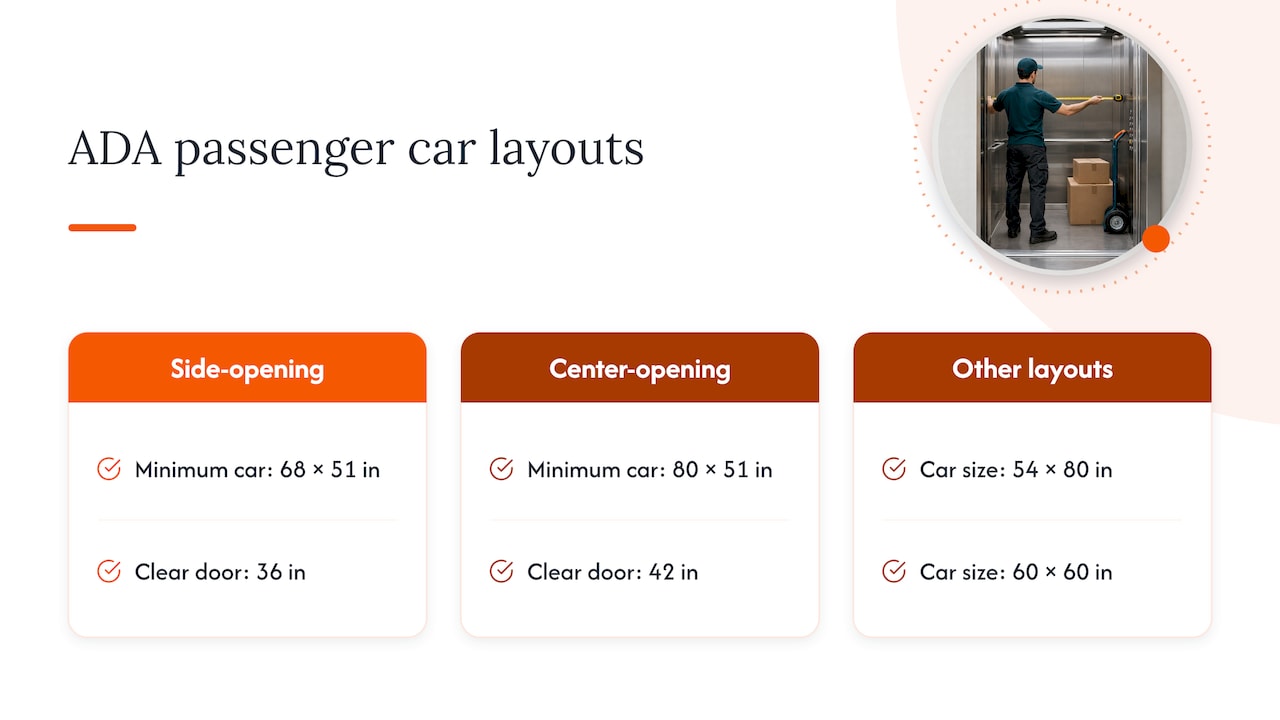
So the floor of a passenger car can be as small as 68 x 51 inches, and a door as narrow as 36 inches is legal. If your building is older or modest, plan for those numbers unless you measure something larger. For how clearances around accessible doors work in practice, this explainer on ADA door maneuvering clearance helps when you are judging the approach to a door.
Freight elevator vs. passenger elevator: what changes for a delivery
The U.S. Access Board explains that the ASME A17.1 safety code defines a freight elevator as one used primarily for carrying freight, where only the operator and loading staff may ride. Freight elevators cannot serve as the accessible route and are not required to meet the ADA Standards. The same guide notes that a “service elevator” that carries both people and freight must comply with the ADA.
For your delivery, this matters in three ways:
- Size. A service car is far deeper and has a wider door, so a sofa, sectional piece, mattress set or armoire often rides without tilting.
- Access. Because it is working equipment, buildings usually control it. Expect to book it, and sometimes to have a staff member run it.
- Rules. The building may require protective pads in the cab and hallways, a certificate of insurance from the delivery company and a set delivery window.
If a building has only passenger elevators, deliveries go in those, and the dimensions in the first table are your ceiling.
Reserving the freight elevator
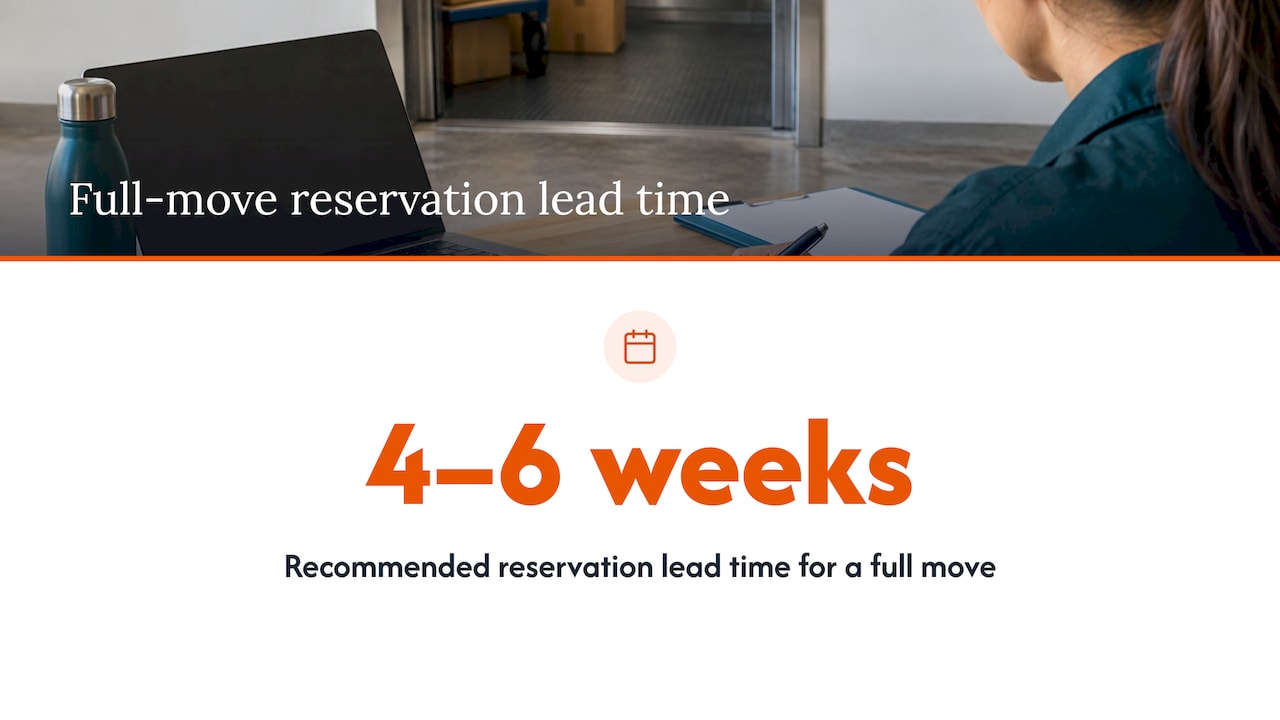
Call or email the property manager or front desk and ask four things: whether the building has a dedicated freight or service elevator, how far ahead it must be booked, what hours deliveries and moves are allowed, and whether a deposit or insurance certificate is required. High-rise buildings can have booking lead times that run to weeks; our high-rise moving checklist recommends reserving the elevator 4 to 6 weeks early for a full move. For a single delivery, shorter notice is common, but the building sets the rule, not the delivery company.
Building rules in Naples condos tend to be specific. Our guide to Naples condo delivery rules covers what to check, and the one on condo furniture delivery logistics explains how a missed window turns into a rebooking fee. If large items are in the plan, it is also worth understanding how freight costs add up, because oversize pieces shipped to you can carry surcharges before they ever reach the elevator.
What to measure, in order
Retailers that deliver furniture to apartments give nearly the same checklist. Nebraska Furniture Mart’s measurement guide tells apartment and condo buyers to measure the elevator interior height, the elevator opening, and the distance to the opposite wall, and to reserve a freight elevator in advance. It also says to measure the hallway in front of the elevator doors and the entry and interior doorways. Wayfair’s delivery measuring guide adds that you should measure the diagonal from the bottom center of the door opening to the back ceiling, and allow at least 4 inches of space between the furniture and any doorway or hallway.
Put that together into a route list, working from the street to the room:
- Building entrance and lobby doors. Measure the narrowest clear opening, not the door slab. A door open at 90 degrees steals about an inch or two from the width because of the hinge side and hardware.
- Hallway to the elevator. Measure width and look for turns. A 90-degree turn in a 4-foot hallway is where long pieces get stuck.
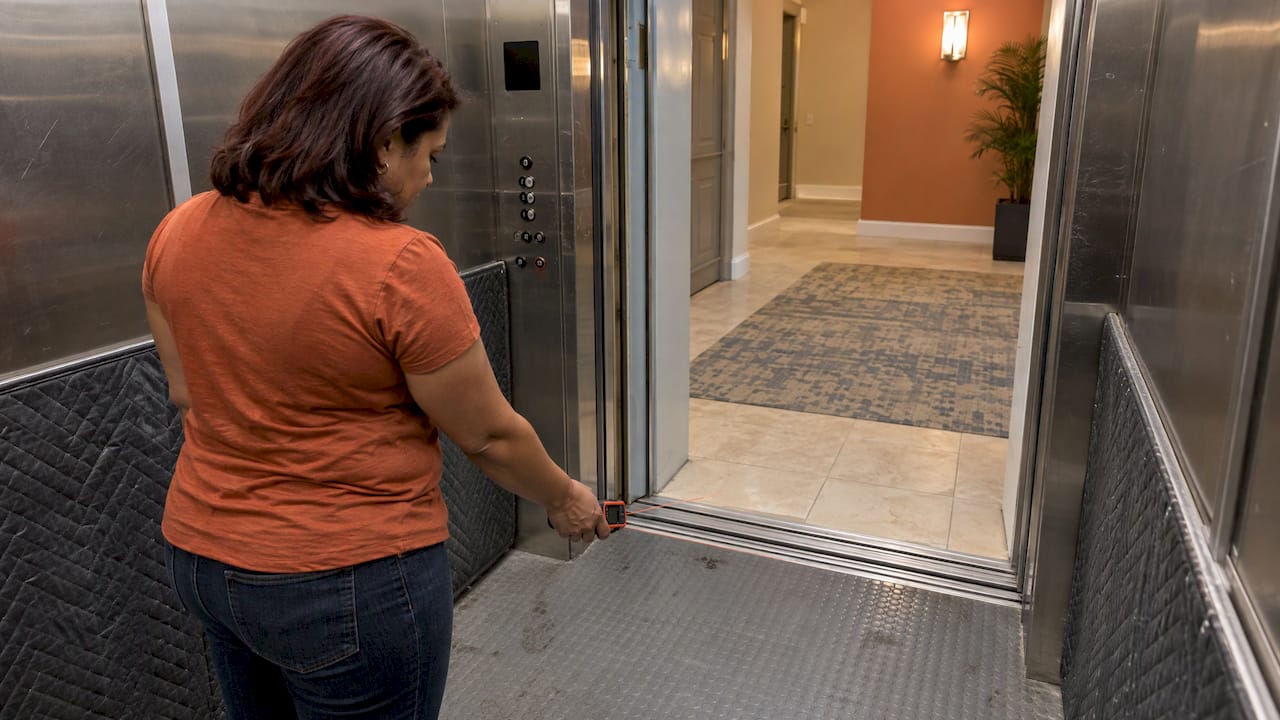
- Elevator door. Measure clear width and clear height with a tape, from the floor sill to the top of the opening.
- Cab interior. Measure width, depth and ceiling height. Note handrails, which can reduce usable width by a few inches at waist height.
- Hallway on your floor. Same as step 2, plus the distance from the elevator to your unit door.
- Your unit door and interior doors. Include any turn into a bedroom, and the distance to the opposite wall.
- The item. Measure the largest dimension, the second largest and the smallest. Also note whether legs, arms or backs come off.
Write everything on one sheet and photograph the elevator door with the tape across it. Photos make a quote faster and a no-fit call easier to catch before the day.
A worked example: will a 90-inch sofa fit?
Say the sofa is 90 in long, 38 in deep and 34 in high. The building has a passenger elevator at the ADA minimum size: a 36 in door and a 68 in x 51 in car, with a 7 ft clear door height.
- Door: the sofa’s smallest face is 38 x 34 in. The door is 36 in wide, so the sofa cannot go in on its back or its seat bottom. Standing it on its end, the footprint it presents to the door is 34 in by 38 in, and it only passes if it can be turned on its side so the 34 in face goes through the 36 in width. That is a 2-inch margin, below the 4 inches Wayfair suggests.
- Cab floor: the diagonal of a 68 x 51 floor is the square root of 68 squared plus 51 squared, which comes to 85 inches. A 90 in sofa laid flat does not fit across it.
- Cab height: on its end the sofa is 90 in tall, and an 8 ft cab is 96 in. It fits vertically with 6 inches to spare, but the door height of 84 in means it has to be tilted through the opening and then stood up inside.
That is a “maybe, with a risk of scraping and a rebooking” result. The same sofa in a service elevator with a 48 in door and a cab over 7 ft deep goes in on its back with no drama. This is why the freight booking is worth the trouble.
One more rule of thumb: a mattress is the item people assume will be fine. A queen is 60 x 80 in. In a cab with a 7 ft door, standing it on its long edge leaves just 4 inches of height clearance, and it has to flex or tilt. It usually works, but it is a good example of why measuring the door height matters as much as width.
Where deliveries go wrong
- Measuring the cab but not the door. The cab can be big while the door is the bottleneck.
- Forgetting the ceiling pop-up or a cab panel. Some cars have removable pad panels, but only the building can tell you whether they are allowed to be moved.
- Skipping the hallway. An elevator that fits the piece does not help if the corner outside it does not.
- Not reserving the elevator. Showing up with a truck and no booking often means waiting or rescheduling.
- Skipping the insurance paperwork. Many buildings will not let a crew in without a certificate.
- Forgetting stairs. If the elevator is out or the building has an upper-level walk-up section, carrying fees can apply. See our note on stair carry fees.
For a single large piece that is too awkward for anything but a careful team, our single-item furniture move page explains how we handle it.
Delivery in Southwest Florida: seasonal and local details
Condo and high-rise buildings in Naples, Bonita Springs and Estero fill up in winter as snowbirds return, and the same freight elevator may be booked for weeks. Many associations restrict moves and deliveries to weekday business hours and may ban them on certain holidays. If you own a unit but live elsewhere part of the year, sending the building’s rules and your measurements to your delivery crew before you arrive saves a trip.
Realtors and property managers prepping a unit run into the same constraints: a staged unit often needs furniture in, and a cleanout needs furniture out, both through the same elevator and the same booking window.
How we handle elevator deliveries
Our service is built around direct communication with a Southwest Florida owner-operator: you talk to the person who quotes and schedules your job, with no dispatcher and no callback chain. Our crew is uniformed and licensed, and we offer same-day options when the schedule allows. When you send us your measurements, the elevator booking window and the building’s rules, we can quote against them and plan the route. Pricing is transparent: Furniture Delivery & Pickup starts from $79, and Moving Help & Labor starts from $79 as well.
If the piece arrives flat-packed or needs setting up in the room, Furniture Assembly & Installation starts from $99.

Book through fixmovehaul.com and include your elevator door width and height, cab size and the building’s delivery hours in your message.
Our perspective
Most of the delivery problems we see in condos are not about strength. They are about information. A team can carry almost anything, but nobody can make a 38-inch piece go through a 36-inch door.
That is why we ask for the door first. We want the elevator door width and height, the hallway turns, and the building’s booking window before we promise a time. When you give us that, the day goes the way it was planned.
We run this as an owner-operator business, so the person who quotes your job is the person you reach when the building changes the rules a day before. That direct line is the real advantage: one conversation, one plan, and a crew that shows up in uniform at the window you booked.
If you are unsure about a measurement, send us the photo. We would rather look at a tape across a door than guess.
Mark
FAQ
What is the standard elevator size for furniture delivery?
There is no single standard, but common passenger cabs run from about 5 ft 8 in x 4 ft 3 in to 6 ft 8 in x 5 ft 5 in, with 3 ft to 3 ft 6 in doors, according to the Otis planning guide. Service elevators are deeper, with 4 ft to 4 ft 6 in doors. Always measure your building’s own elevator.
What is the difference between a freight and a passenger elevator?
A freight elevator is built mainly to carry goods, and per the U.S. Access Board only the operator and loading staff may ride it. It is larger, with a wider door and a higher capacity. Passenger elevators carry residents and have to meet accessibility standards, which means a minimum size but not a large one.
How far ahead should I reserve the elevator?
That depends on the building. Large moves in high-rises can need weeks, and our high-rise moving checklist suggests 4 to 6 weeks for a full move. For a single delivery, ask management for the booking lead time, the allowed hours and any insurance requirements.
What should I measure besides the elevator?
Measure the building entrance, the lobby and hallway widths and turns, your unit door, interior doors and the item itself. Retailers such as Nebraska Furniture Mart also ask for the hallway in front of the elevator and the distance to the opposite wall.
Sources
- Otis Elevator Planning and Selection Guide (2008)
- 2010 ADA Standards, Section 407.4 Elevator Car Requirements
- U.S. Access Board, Chapter 4: Elevators and Platform Lifts
- Nebraska Furniture Mart, furniture measurement guide
- Wayfair, how to measure for a furniture delivery
- ADA door maneuvering clearance
- How freight costs add up