
Stop Last Minute Denials at Loading Docks: Certificate of Insurance for Deliveries

Stop Last Minute Denials at Loading Docks: Certificate of Insurance for Deliveries
A certificate of insurance (COI) is the broker-issued proof, usually on the standard ACORD 25 form, that your mover or delivery company carries the coverage your building requires. It is not the insurance policy itself. Get your building’s COI rider today, forward it to the carrier’s operations team or broker, and expect turnaround in roughly 24 to 72 hours.
TL;DR:
- Most delivery COIs require the correct ACORD 25 form, with the building listed as Additional Insured and coverage limits meeting minimums.
- Rejections often stem from name mismatches, expired dates, missing endorsements, or inadequate coverage limits, which can typically be fixed within a day.
- Requesting a COI well in advance, at least 7 to 10 days before delivery, allows time for review and corrections if needed.
- Confirm the broker-issued COI directly by phone to verify its legitimacy and avoid relying on unofficial or incomplete documents.
- Consistent routing of building-specific requirements to the operations team speeds up processing and reduces the risk of delivery delays.
Table of Contents
- What Is a Certificate of Insurance and What Does It Cover?
- Which Buildings Require a COI for Deliveries?
- How Do You Request a COI for a Delivery, Step by Step?
- What Fields on a COI Actually Matter?
- Why Do Buildings Reject COIs, and How Do You Fix It?
- How Long Does It Take to Get a Certificate of Insurance?
- How Do You Verify a COI Is Legitimate?
- What Are the Legal Implications of a COI for Deliveries?
- Do COI Requirements Change Based on the Delivery Type?
- How Do Delivery Companies Manage and Store COIs?
- What Insurance Gaps Should You Watch for in a Delivery COI?
- A Publisher’s Take on Handling COI Logistics Smoothly
- Get COI-Ready Delivery Help in Southwest Florida
- Where to Check Official COI Guidance
- Sources
- FAQ
What Is a Certificate of Insurance and What Does It Cover?
The ACORD 25 form has become the industry standard because every insurer and broker fills it out the same way, which makes it easy for a property manager to scan for the right fields fast. The producer or broker listed in the top corner is not a throwaway detail. It is the person you call to confirm the certificate is real, and its presence is one of the clearest trust signals on the whole page.
A typical delivery COI lists several coverage lines, each protecting a different kind of risk:
- General liability — covers property damage or injury caused during the job
- Workers’ compensation — covers injuries to the delivery crew itself
- Commercial auto liability — covers the truck or van used for transport
- Cargo coverage — covers the goods while in transit
- Umbrella coverage — extends limits above the base policies
Buildings request these documents to protect shared property, other tenants, and their own insurer from picking up the bill if a delivery crew damages a lobby floor or an elevator cab.
Which Buildings Require a COI for Deliveries?
Managed properties ask for a COI far more often than standalone homes. If you live in a single-family house, you will rarely need one at all. Once a building has shared hallways, freight elevators, or a front desk logging every vendor, the paperwork requirement usually follows.
Expect a COI request from:
- Apartment high-rises and mid-rise buildings with a management office
- Condo associations and HOAs with governing documents that name insurance minimums
- Office towers and commercial buildings with loading dock rules
- Gated communities with a guardhouse or vendor check-in process
- Event venues booking outside vendors for setup or breakdown
- Corporate relocation programs moving employees into managed housing
Retailers have built entire intake systems around this. IKEA and Tempur-Pedic both tell customers to submit building details before a truck ever gets scheduled, and neither will move a delivery date without the document on file.
How Do You Request a COI for a Delivery, Step by Step?
Most denied deliveries trace back to a rider that never made it to the right person. Fix that first, and the rest of the process is mechanical.
- Get the building’s COI rider. Ask your property manager for the exact PDF or requirements sheet, including the precise certificate-holder name and any endorsement wording they demand.
- Forward it to operations, not sales. Send the rider to the delivery company’s operations team or insurance broker directly. A salesperson often has no way to push it to the person who actually issues certificates.
- Request the ACORD 25 by name. Ask the broker to issue it as an ACORD 25, name the building as Additional Insured if the rider calls for it, and have the broker email the finished certificate straight to the property manager.
- Get written acceptance before delivery day. A verbal “looks fine” from the front desk is not the same as a confirmed approval on file.
Mover-focused guidance from Ontrack Moving backs this same sequence: put the requirements in writing, route them to the carrier’s insurance contact, and confirm before the truck leaves the warehouse.
Pro Tip: Draft one short email template you reuse every time: “Attached is [Building Name]'s COI requirement. Please have your broker issue an ACORD 25 naming [exact certificate holder] as Additional Insured, with limits and dates covering [delivery date], and email it directly to [property manager email].” Reusing the same wording cuts back on typos that trigger rejections.
What Fields on a COI Actually Matter?
A COI can look complete and still get bounced at the front desk over one wrong field. Knowing which fields carry weight saves you a second round trip.
- Producer/broker contact and carrier name. This is your verification anchor, the detail you call if anything looks off.
- Policy limits and dates. General liability, auto, and cargo limits need to meet the building’s stated minimums, and the effective and expiration dates must fully cover the delivery date.
- Additional Insured wording. The building’s legal name has to match exactly, character for character, in the Additional Insured field.
- Certificate holder name and address. A misspelling here is one of the most common, and most avoidable, rejection triggers.
- Endorsement forms. Some buildings ask for a Waiver of Subrogation or a specific CG endorsement form. If the rider names one, the COI needs to show it explicitly, not just imply it.
A mover COI playbook from Muscleman Moving lists these same fields as the ones building staff check first, and confirms that 24 to 48 hours lead time is standard once a carrier has the correct requirements in hand.
Why Do Buildings Reject COIs, and How Do You Fix It?
Rejections almost always trace back to a handful of repeat offenders, and most are fixable same-day if you know the exact ask.
- Name mismatch. The certificate holder or Additional Insured field doesn’t match the building’s legal name. Fix: send the broker the exact text, copied and pasted, not retyped.
- Dates that don’t cover the delivery. The policy expired last month or hasn’t started yet. Fix: request a freshly issued certificate dated to cover the actual delivery window.
- Missing endorsement. The building wanted a Waiver of Subrogation and the COI doesn’t show one. Fix: ask the broker to add the specific endorsement or CG form by name.
- Limits below the building’s minimum. Fix: have the broker reissue at correct limits, or get a written exception from the property manager.
- Certificate looks fabricated. No broker contact, odd formatting, or a policy number that doesn’t check out. Fix: call the listed broker before accepting anything.
How Long Does It Take to Get a Certificate of Insurance?
A broker can typically issue a standard COI in 24 to 48 business hours once the rider and correct wording are in hand. That is the certificate itself. Building review adds more time on top, so plan for 7 to 10 business days total when your schedule allows it.
Same-day or 24-hour issuance is possible with an established broker relationship and a carrier that already has your policy details on file, but rushing invites more of the wording errors covered above. If a delivery date is fixed and non-negotiable, start the request the moment it’s booked, not the week before.
How Do You Verify a COI Is Legitimate?
Call the broker listed on the ACORD 25. That single step, confirmed by industry guidance on mover certificates, lets you check that the certificate and the underlying policies actually exist without the broker disclosing private client details.
For movers specifically, cross-check the carrier’s USDOT and MC numbers against the FMCSA’s SAFER database. An asset-based carrier that owns its trucks tends to issue COIs faster and shows a clean, active record. A brokered carrier reselling the job to a third party often causes delays and murkier paperwork.
Watch for a few consistent red flags: a vendor who refuses to produce a broker-issued form, offers a certificate typed on plain letterhead instead, or stalls when you ask for exact wording changes. None of those are good signs.
Pro Tip: When in doubt, ask your property manager to confirm acceptance in writing before delivery day. A text or email from the front desk saying “COI approved for [date]” is worth more than any assurance from the vendor itself.
What Are the Legal Implications of a COI for Deliveries?
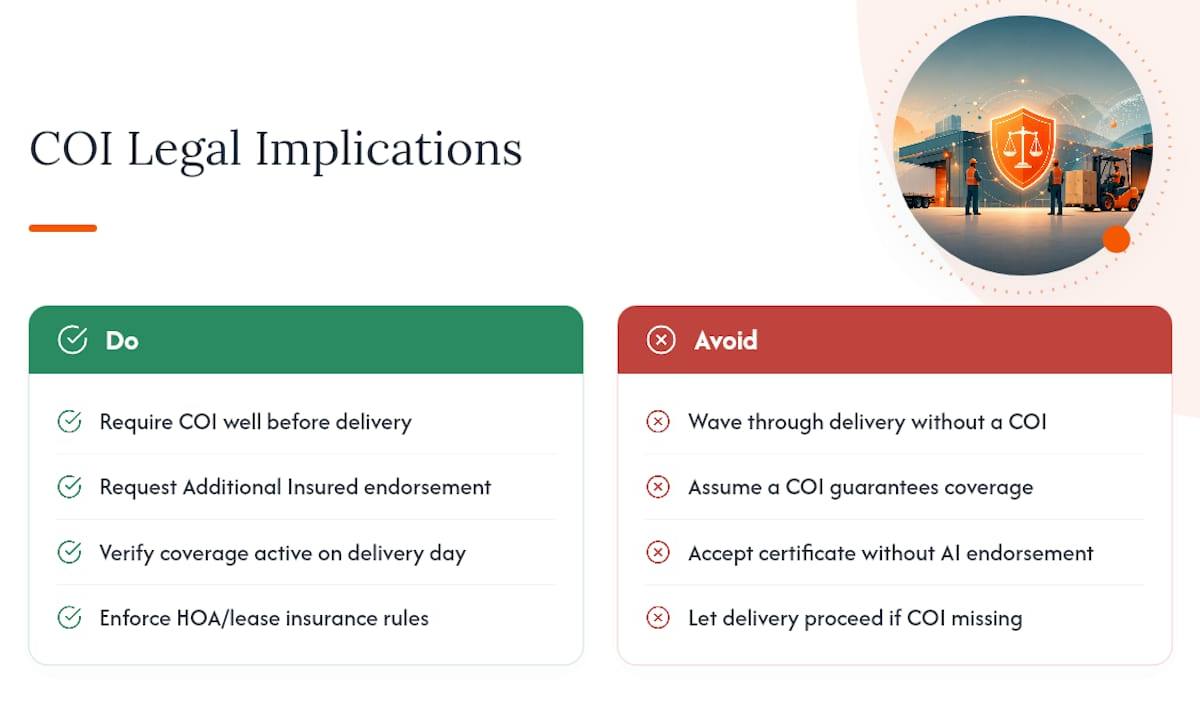
A COI shifts risk, but it doesn’t eliminate it, and understanding that distinction matters more than most people realize. The certificate is evidence that a policy exists at the moment it was issued. It is not a guarantee that coverage will still be active on delivery day, and it is not a contract between the building and the insurer.
Buildings request COIs, and often the Additional Insured endorsement specifically, because it extends a layer of protection to the property itself. If a delivery crew damages a hallway or an elevator, the building’s own policy shouldn’t be the first payer. Without that endorsement, a certificate showing general liability coverage protects the vendor, not necessarily the building.
Property managers who wave through a delivery without a valid COI take on liability exposure themselves, particularly in commercial buildings governed by HOA bylaws or lease terms that spell out insurance requirements. If those bylaws mandate a COI and management skips the check, and something goes wrong, the association can face questions about why its own rules weren’t enforced.
For individuals hiring a mover or delivery service, the practical risk is simpler: no valid COI usually means no delivery. Some retailers, including Tempur-Pedic, state outright that an order will not go out until the documentation is on file. That isn’t a formality. It’s the building enforcing a legal safeguard it’s entitled to require, and the resident’s job is to get the paperwork moving early enough that it doesn’t hold up move-in day.
Do COI Requirements Change Based on the Delivery Type?
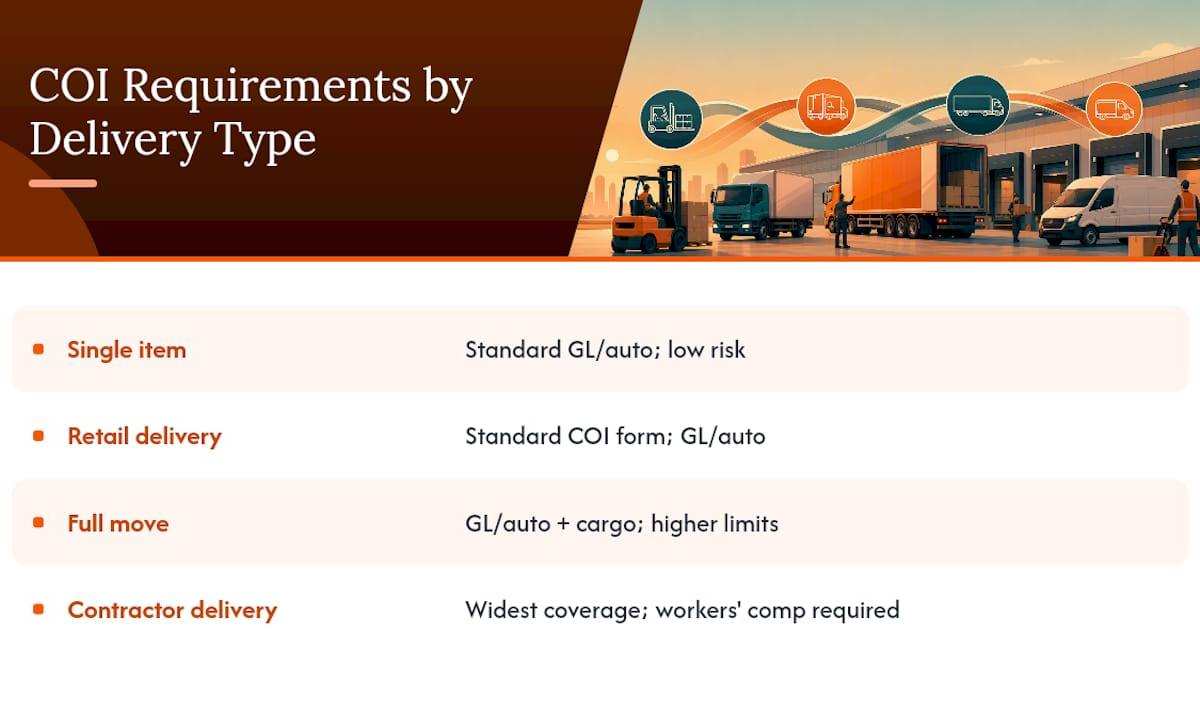
They do, and the differences track the size and risk of the job more than the dollar value of the goods. A single dresser carried up two flights by hand carries a different risk profile than a moving crew hauling a truckload of furniture through a shared freight elevator, even if the building technically applies the same insurance minimum to both.
Furniture and appliance deliveries, the kind IKEA and Room & Board process routinely, tend to follow a standard COI template because the buildings receiving them have seen the same request a thousand times. These retailers often have dedicated COI submission forms precisely because volume rewards a repeatable process.
Full household moves involve more moving parts, literally, and require proper household goods movers insurance coverage to protect the goods and parties involved. A moving company COI typically needs to show cargo coverage in addition to general liability and auto, since a mover is legally responsible for the customer’s goods in transit, not just for damage to the building. Buildings sometimes ask for higher limits on a full moving job than on a single delivered item, reasoning that more time in the building and more equipment (dollies, blanket wraps, freight elevator holds) means more exposure.
Contractor and jobsite deliveries, materials arriving for a renovation, for instance, often require the widest coverage set. Buildings may ask for workers’ compensation proof specifically, since contractor crews are on-site longer and doing work that carries higher injury risk than a two-person delivery team dropping off a couch. High-value goods, like fine art or specialty electronics, sometimes trigger a request for higher cargo limits even when the delivery itself is small.
How Do Delivery Companies Manage and Store COIs?
Established delivery and moving operations don’t generate a fresh certificate for every job from scratch. Most keep a master COI on file with their broker and a general set of standard endorsements ready, then request updated versions or building-specific endorsements as each job requires them.
Operations teams at larger companies typically keep a shared folder or vendor-management system where COIs are logged by client or building name, so a repeat request for the same property doesn’t mean starting over. This is part of why routing your building’s rider to the operations department, rather than a salesperson, gets faster results. Operations is the team that already has a relationship with the broker and a system for tracking what’s been submitted where.
Smaller, owner-operated delivery services often work directly with a single broker who can turn around a request quickly, but they may lack the same document-tracking infrastructure. That’s not necessarily a problem. It does mean the responsibility falls more heavily on you to confirm the certificate actually reached the building and was accepted, rather than assuming a system caught it.
Some retailers streamline this from their end entirely. Room & Board, for example, accepts COI submissions by email through a dedicated address, which speeds up matching a certificate to the correct order and building.
What Insurance Gaps Should You Watch for in a Delivery COI?
A COI that looks complete can still leave a real gap, and most of those gaps hide in details that look fine at a glance.
The most common gap is coverage that exists but doesn’t extend where you need it. A general liability policy with solid limits doesn’t protect the building unless the Additional Insured endorsement is actually present and worded correctly. Without it, the building’s own insurer could still end up covering a claim the vendor’s policy was supposed to handle.
Cargo coverage gaps show up often in full-service moves. A moving company’s general liability policy typically covers damage to the building itself but not damage to the customer’s belongings in transit. If cargo coverage isn’t listed separately, or the limit is too low relative to what’s being moved, the goods themselves may be underinsured even though the certificate looks reassuring overall.
Date gaps are another quiet risk. A COI issued weeks before a delivery date might expire before the truck arrives, especially if a delivery gets rescheduled and nobody checks whether the certificate still covers the new date.
Subcontracted labor is the least visible gap. A delivery company may hand off the actual job to a subcontracted crew whose insurance doesn’t match what’s on the original COI. Asking directly whether the crew showing up is the same entity named on the certificate is a fair question, and a legitimate operator should answer it without hesitation.
A Publisher’s Take on Handling COI Logistics Smoothly
The pattern that separates a smooth delivery from a stalled one is almost always the same: rider first, forwarded to the right department, broker-issued COI back, written acceptance before the truck moves. Skip a step and you’re troubleshooting at the loading dock instead of your desk. Send the building’s rider straight to operations, never just to a salesperson chasing a signed order. And if a vendor can’t produce a real broker-issued ACORD 25 when asked, take that as the clearest warning sign available.
— Mark
Get COI-Ready Delivery Help in Southwest Florida
Chasing down the right paperwork shouldn’t cost you a delivery window. A delivery company handles pickup, delivery, installation, and building logistics across Southwest Florida, and coordinates the certificate of insurance details your condo, HOA, or office building asks for before a truck shows up.

Whether you’re a snowbird waiting on a furniture delivery, a realtor prepping a listing, or a property manager who needs a vendor that already knows how managed buildings handle vendor paperwork, a delivery company works directly with residents and management offices to keep the process moving instead of stalled at the front desk. That’s a meaningfully different experience than waiting on a national retailer’s call center to process a COI request, especially when your delivery window is already tight.
If you need furniture delivered in Southwest Florida or help booking moving assistance in the region, reach out to Fixmovehaul now with your building’s requirements and get a straight answer on timing and pricing before you commit to a delivery date.
Where to Check Official COI Guidance
- ACORD 25 certificate basics
- IKEA’s COI submission guidance
- Room & Board’s COI request process
Always confirm your specific building’s requirements with property management before submitting anything, since riders vary from one building to the next.
Sources
- What is a Certificate Of Insurance? — IKEA help
- What is a Certificate of Insurance and how do I submit it? — Tempur-Pedic Help
- What Is a COI for movers? — Ontrack Moving
- COI Playbook | Muscleman Moving
FAQ
What Is a Certificate of Insurance Delivery?
It’s a broker-issued document, typically an ACORD 25 form, proving a mover or delivery vendor carries the insurance coverage a building requires before allowing a delivery on-site.
Which Vendors Need a COI?
Any vendor delivering to a managed apartment, condo, HOA, office building, or gated community typically needs one; single-family homes rarely require it.
How Do You Obtain a Certificate of Insurance?
Request the building’s exact requirements in writing, forward them to the delivery company’s operations team or broker, and have the broker issue and send the ACORD 25 directly to the property manager. Fixmovehaul coordinates this process for deliveries across Southwest Florida.
How Long Does It Take to Get a COI?
Brokers usually issue a standard COI within 24 to 48 business hours once they have complete information, though full building approval can take up to 7 to 10 business days.