
Worksheet Driven Moving Valuation Options for SW Florida Homeowners

Worksheet Driven Moving Valuation Options for SW Florida Homeowners
Most local moving and haul jobs get priced one of five ways: hourly crew rates, flat-rate job quotes, per-item pricing, load-size or volume pricing, or a hybrid that blends a base fee with add-on surcharges. Pick hourly for small, flexible jobs where timing is loose. Pick flat-rate when you want price certainty on a full household move. Per-item fits single-piece deliveries. Load-size fits junk removal and cleanouts. Labor hours and access, not distance, usually determine the final number.
TL;DR:
- Moving costs are mainly driven by labor hours and crew size, with an average of $180 per three-person crew for a four-hour job.
- Access issues like stairs and parking delays significantly increase both time and overall costs, often more than rate per mile.
- Accurate quotes require detailed, consistent information on inventory, distance, access, and timing, preferably through a standardized worksheet.
- The choice between binding, non-binding, or verbal estimates affects predictability, with binding offers best for avoiding surprises on move day.
- In Southwest Florida, quick response and itemized breakdowns matter more than just price, especially for short notice or same-day service.
Table of Contents
- Understanding Moving Valuation Options and Pricing Models
- What Actually Drives Your Moving Cost Higher or Lower
- How to Get Comparable, Accurate Moving Cost Estimates
- What Local Moves and Haul Jobs Typically Cost
- Binding, Non-Binding, and Verbal Estimates Explained
- In-Home vs. Virtual Estimates: Which One Do You Need?
- How to Prepare for a Moving Estimate Visit
- Insurance Coverage and How It Ties to Your Pricing Choice
- How Valuation Affects What You Get Paid on a Claim
- A Local Perspective on What Really Matters in Southwest Florida
- Get a Local Quote from Fix Move Haul
- Sources
- FAQ
Understanding Moving Valuation Options and Pricing Models
Every quote you get boils down to one of these five structures, and knowing which one a provider is quoting you changes how you compare offers.
Hourly crew-and-time billing charges by the hour per mover, often with a two or three hour minimum. A typical local job runs $40 to $80 per mover-hour, though tight timelines or specialty needs can push that toward $150 in some markets, according to industry cost summaries. Travel time from the crew’s shop to your door and back often counts toward the clock, so ask upfront whether “drive time” is billed.
Flat-rate job quotes come from a provider who inspects your inventory (in person or by video) and locks in one number for the whole job. These tend to be more predictable for full household moves because the risk of running long sits with the company, not you.
Per-item or per-piece pricing works best for single-item jobs: a mattress delivery, a couch removal, a refrigerator swap. Rate cards for this model are usually short and simple, which makes comparing two providers easy.
Load-size or volume pricing dominates junk removal and estate cleanouts. Providers quote by truck fraction, an eighth, a quarter, a half, or a full load, because it’s the pricing method that actually maps to labor and disposal costs.
Hybrid pricing combines a base dispatch fee with itemized surcharges: stair fees, waiting time, disposal costs. It’s common on jobs that mix moving and hauling, like a downsizing move where furniture goes to a new home and the rest goes to the dump.
- Hourly: best for small, flexible jobs with loose timing
- Flat-rate: best for full moves where you want a locked number
- Per-item: best for single-piece deliveries or removals
- Load-size: best for junk removal and cleanouts
- Hybrid: best for mixed jobs with multiple service types
What Actually Drives Your Moving Cost Higher or Lower
Labor hours and crew size drive most of the final bill. A three-person crew at $60 per mover-hour costs $180 hourly before any surcharges, so a four-hour job runs roughly $720 in labor alone, before disposal or specialty fees. That single number explains why two “local moves” of similar size can land $300 apart.
Access challenges compound fast. Stairs, long carries from the truck to the door, and tight parking don’t just add a flat fee. They create a string of small delays, a blocked driveway here, an elevator wait there, that stack up non-linearly and eat far more time than a simple per-step surcharge would suggest.
Route complexity matters more than raw mileage. A five-mile move across a barrier island during snowbird season can take longer than a fifteen-mile move on an open inland road, which is why quotes based purely on distance mislead readers.
Disposal and tipping fees are often the single biggest swing factor on haul jobs, since dump fees are set locally and vary by material type and volume.
Specialty handling (pianos, gun safes, glass tabletops) and add-on packing or unpacking services expand scope quickly. Packing alone can run $280 to $2,200 depending on home size. Seasonality adds another layer: peak season, weekends, and same-day requests all carry a premium.
- Labor and crew size: the biggest single line item
- Access (stairs, parking, long carries): adds time non-linearly
- Route and traffic: often outweighs mileage
- Disposal fees: the swing factor on haul jobs
- Specialty items and packing: can double a quote
- Peak timing: same-day and weekend requests cost more
Pro Tip: Ask every provider the same question: “What’s your minimum, and does drive time count against it?” That one question exposes more hidden cost than any other line on a quote.
How to Get Comparable, Accurate Moving Cost Estimates
Getting quotes you can actually compare means giving every provider the exact same information. A reliable worksheet forces this discipline and stops vague, apples-to-oranges numbers from creeping in.
- Locations and distance. Pickup and delivery ZIP codes, total miles, and number of stops.
- Time estimate. Expected loading and unloading minutes based on item count.
- Inventory detail. Total item count and your single largest or heaviest piece.
- Access notes. Stairs, elevators, and whether a second person is needed to carry anything.
- Proof requirements. Whether you need photo confirmation or a signed delivery receipt.
- Timing. Requested date and time window, including any same-day urgency.
Send this exact worksheet to at least two providers. A repeatable estimate framework that breaks a job into base dispatch, route, labor, handling, and admin charges makes it far easier to spot which provider padded a number and which gave you a real price. Using identical inventory, access notes, and dates with each company is standard advice for a reason: cheaper quotes often just describe less work, not better value.
Insist that every quote itemize labor, truck or travel charges, minimum hours, waiting time, disposal fees, and any specialty-item surcharge. If a provider gives you one flat number with no breakdown, ask them to split it out before you book.
A quick photo-based estimate works fine for a single sofa or a few boxes. Save the in-home or video walkthrough for full household moves or cleanouts where inventory volume is hard to judge from a phone call.
What Local Moves and Haul Jobs Typically Cost
Local full-service moves land between $876 and $2,549, with an average near $1,696, based on published industry summaries. That’s a wide range, and it should tell you something: two “local moves” can differ by more than $1,000 depending on labor hours and access alone.
For hourly work, a three-person crew at $60 per mover-hour runs $180 an hour before minimums or surcharges. A four-hour job lands around $720 in labor.
Junk removal and haul pricing follows truck fractions. Small pickups start around $100 to $200, and a full truckload commonly runs $500 to $800 in many markets. Pricing isn’t linear. The first eighth of a truck costs more per cubic yard than the last, so consolidating loads into fewer, fuller trips saves money.
Single-item furniture delivery or a TV mount typically comes as a flat fee, since the job scope is narrow and predictable.
Binding, Non-Binding, and Verbal Estimates Explained
A binding estimate locks in the price regardless of how long the job actually takes or what the crew finds on-site, as long as the scope you described stays accurate. This is the safest option if you want zero surprises on move day, but it usually requires a more detailed inventory upfront.
A non-binding estimate gives you a good-faith number based on the information you provided, but the final bill can shift if the job takes longer or the inventory changes. Most hourly-rate jobs fall into this category by default, since nobody can perfectly predict how long stairs or a tricky parking situation will add.
A verbal estimate is the loosest of the three: a phone quote with no documentation, often based on nothing more than a vague description of what needs to move. Treat a verbal number as a rough ballpark, not a commitment. If a provider won’t put a number in writing, that’s worth noting before you book.
For anything beyond a single-item delivery, ask for the estimate in writing regardless of which type it is. A written non-binding estimate still gives you a paper trail if the final bill balloons well past what you were told to expect. For jobs with real budget constraints, like a snowbird managing a seasonal home from out of state, a binding estimate removes the guesswork entirely, even if it costs a little more upfront.
In-Home vs. Virtual Estimates: Which One Do You Need?
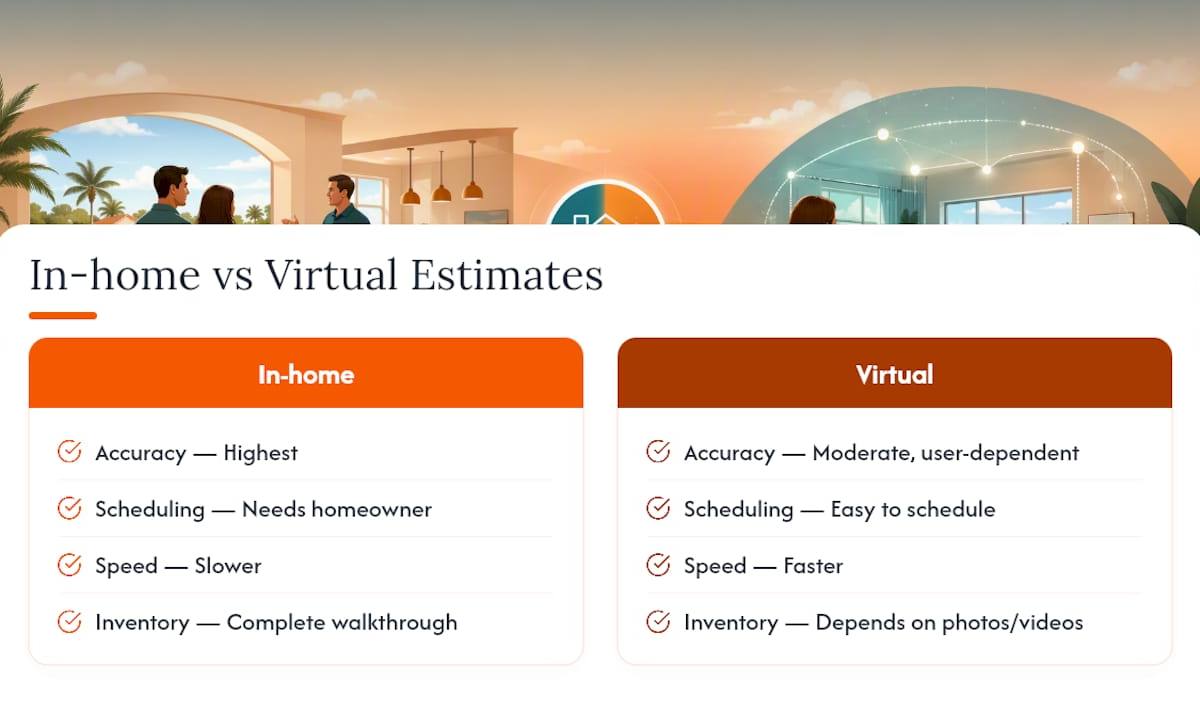
An in-home estimate means someone from the company walks through your home, counts items, checks stairs and hallway widths, and notes anything unusual, like an oversized sectional or a piano. This produces the most accurate quote because nothing gets missed. The downside is scheduling: you need to be home for a walkthrough, which can be a hassle for snowbirds coordinating a move from another state.
A virtual estimate uses a video call or submitted photos instead. You walk your phone camera through each room, or send photos of every item that needs to move. It’s faster to schedule and works well for straightforward jobs, but it depends heavily on you capturing everything accurately. Miss a closet full of boxes, and your final bill can climb once the crew arrives.
For a full household move, an in-home or detailed video walkthrough is worth the extra time. For a single-item delivery or a small junk pickup, a handful of photos usually gets you an accurate flat-rate quote without the scheduling hassle. Realtors prepping a listing for photos, or property managers handling a tenant turnover, often lean on virtual estimates simply because timelines are tight and someone doesn’t need to be physically present.
The tradeoff is straightforward: in-home estimates trade convenience for accuracy, and virtual estimates trade a small accuracy risk for speed.
How to Prepare for a Moving Estimate Visit
Walk through your home before the estimator arrives and make a mental note of anything unusual: a extra-heavy dresser, a mattress that needs a specialty bag, boxes stored in an attic or shed that aren’t obvious from the main living areas.
Clear a path to your largest items. If a couch needs to come down a narrow staircase or through a tight doorway, point that out before the estimator starts counting boxes. Access issues are the number one reason a quote changes on move day, and flagging them early lets the provider price them correctly the first time.
Have your inventory worksheet ready, including item counts, your largest piece, and any stair or elevator notes. Handing this over before the walkthrough speeds up the whole visit and reduces back-and-forth.
Ask directly about minimums, drive time, and disposal fees during the visit rather than after you’ve booked. If you’re using a virtual estimate instead, film in good lighting and open closets and cabinets that might hide extra volume. Skipping a cluttered garage or lanai storage area is the most common reason a photo-based quote comes in low.

Insurance Coverage and How It Ties to Your Pricing Choice
The pricing model you choose affects more than your bill. It can affect what happens if something breaks. Flat-rate and hybrid quotes that include specialty handling for fragile or high-value items often come bundled with a higher level of coverage responsibility on the provider’s side, since the company inspected the item and priced accordingly.
Hourly jobs, especially DIY-adjacent ones where you’re supplying some of the labor or packing yourself, typically carry a more limited coverage scope. If you packed a box yourself and it wasn’t labeled fragile, a provider has a much harder case for covering broken contents inside it.
Ask any provider directly what coverage applies to your specific job type before booking, not after something goes wrong. This matters more for snowbirds and realtors moving higher-value furniture or staged items, where a broken piece isn’t just an inconvenience, it’s a real financial hit on a tight timeline. Get the coverage terms in writing alongside your quote, the same way you’d get the price itemized.
How Valuation Affects What You Get Paid on a Claim
If an item is damaged or lost during a move, how the job was valued determines your payout, not just whether coverage exists. A provider that priced your move with a detailed inventory and itemized specialty handling for a specific piece has a documented basis for what that item was worth. A vague, undocumented job makes settling a claim slower and often smaller.
This is where the worksheet approach pays off twice. The same item count, condition notes, and largest-piece details you used to get comparable quotes also become your paper trail if something goes wrong. A provider who never saw or priced your antique dresser has no documented reason to value it highly when a leg snaps in transit.
Ask how claims get valued before you book, not after damage happens. Some providers base settlements on the declared value you provided upfront; others use a standard per-pound or per-item formula that can undervalue higher-cost furniture significantly. For realtors moving staged furniture or snowbirds relocating higher-value pieces, confirming this detail in advance avoids an unpleasant surprise months later.
A Local Perspective on What Really Matters in Southwest Florida
In a seasonal market like Southwest Florida, response time and clear itemization matter more than shaving a few dollars off an hourly rate. Snowbirds often need a quote turned around in a day, not a week, and a vague number with no breakdown just creates more back-and-forth.
Concierge or same-day service earns its premium in specific situations: a tenant cleanout before a new lease starts, a rush listing that needs staging furniture moved by Friday. The worksheet approach isn’t just a comparison tool. It’s what lets a provider like Fix Move Haul turn around an accurate quote fast, which is often the whole point when you’re working with a short window.
— Mark
Get a Local Quote from Fix Move Haul
Skip the guesswork of comparing hourly rates against flat quotes from providers you’ve never used. Fix Move Haul is an on-demand home assistance and concierge company handling pickup, delivery, installation, and junk removal with a direct line to a real person, not a call center.

To get a quote you can actually compare, send over the same worksheet details covered above: item counts, access notes, your largest piece, and your target date. Ask for itemization on labor, minimums, and disposal fees before you book, the same way you would with any provider. Whether it’s a full junk removal job in Naples, a single-piece furniture delivery, or a same-day concierge run, transparent pricing is published up front on the Fix Move Haul pricing page. Reach out with your worksheet details and get a real number back the same day.
Sources
- How much does a full-service moving company cost?
- How to Price a Junk Removal Job (2026) | FieldCamp
- Local delivery rates guide: what affects pricing for small business transport services
- How Much Does Junk Removal Cost? Real Prices | Autopilot
FAQ
What’s the Most Common Pricing Model for Local Moves?
Hourly crew billing is the most common model for small to midsize local moves, typically $40 to $80 per mover-hour with a set minimum.
Why Do Two Quotes for the Same Move Differ So Much?
Differences usually come down to labor hours, access difficulty, and whether disposal or specialty-item fees are included, not distance.
Is a Flat-Rate Quote Always Better Than Hourly?
Not always. Flat-rate gives price certainty for full moves, but hourly can cost less for small, quick jobs where the crew finishes fast.
How Do I Get an Accurate Quote for a Junk Removal Job?
Describe your load by truck fraction (an eighth, a quarter, a half, or full) and let the provider confirm with photos or an on-site look, since junk removal pricing scales with volume, not weight.
Does Fix Move Haul Offer Same-Day Quotes in Southwest Florida?
Some local providers offer on-demand quotes for moving, delivery, and junk removal across Southwest Florida, often with same-day availability.