Storage Unit vs Pod: What SWFL Homeowners Should Know
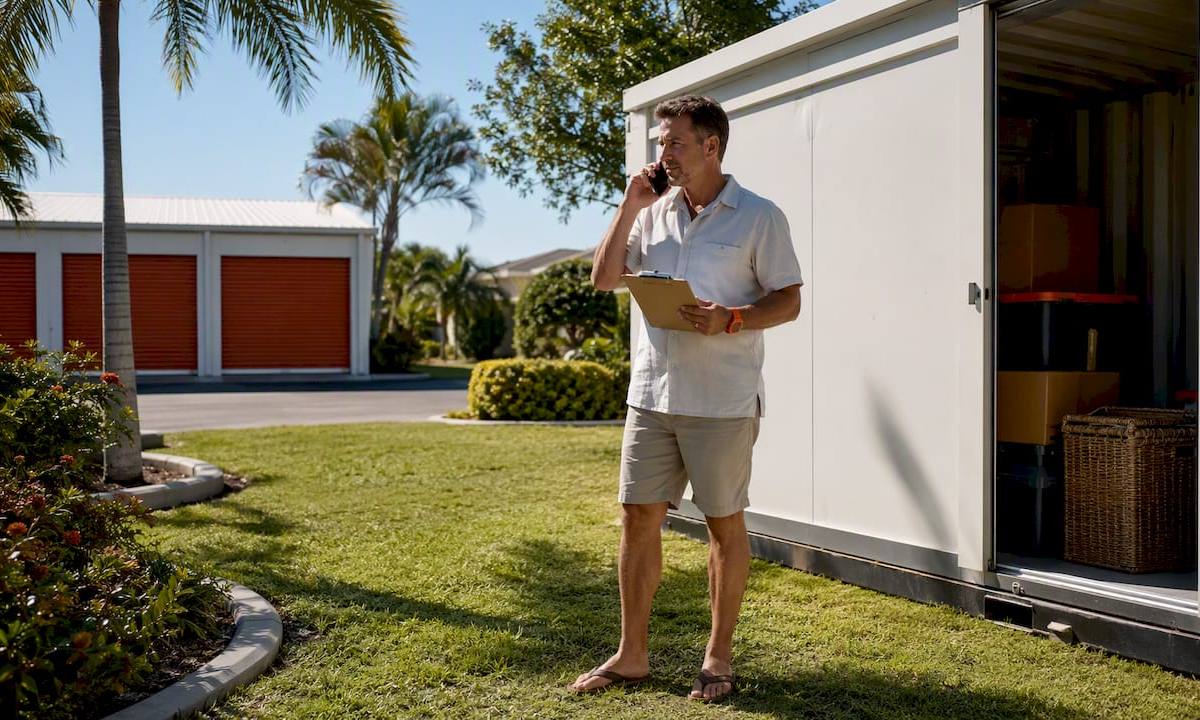
Storage Unit vs Pod: What SWFL Homeowners Should Know
Choose a portable container when your job is primarily a move. Choose a traditional self-storage unit when you need lower long-term cost, frequent access, or climate protection for Florida’s heat and humidity.
For Southwest Florida homeowners, that split matters more than it does elsewhere. Standard portable containers are not climate-controlled, and a summer in Naples or Bonita Springs can damage wood furniture, electronics, and textiles faster than most people expect. Add HOA restrictions that limit how long a container can sit on your driveway, and the decision gets more specific than the national comparison guides suggest.
Quick read on which to pick:
- Moving or bridge storage under 30 days: a portable container (PODS, U-Haul U-Box, 1-800-PACK-RAT) usually wins on convenience
- Storing beyond 60 days, frequent access, or humidity-sensitive items: a traditional unit (Public Storage, Extra Space Storage, CubeSmart) is typically cheaper and safer
- HOA or driveway restrictions: check covenants before ordering anything delivered
- Need loading help or a short-haul pickup: Fixmovehaul covers Naples, Bonita Springs, Estero, Lee County, and Collier County with same-day crews
Jump to the checklist section if you want a quick decision framework right now.
Table of Contents
- Storage unit vs pod: side-by-side comparison
- When does a portable container make more sense?
- When a traditional self-storage unit is the smarter pick
- How pricing actually works for pods vs storage units
- Local rules in Southwest Florida: what you need to check first
- How to decide: a checklist and the questions to ask providers
- Key Takeaways
- What most comparison guides miss about this decision
- Fixmovehaul handles the parts pods and units can’t
- Useful sources and next steps
Storage unit vs pod: side-by-side comparison
| Dimension | Portable Container (Pod) | Traditional Self-Storage Unit |
|---|---|---|
| Best for | One-time moves, bridge storage, on-site staging | Long-term storage, frequent access, climate-sensitive items |
| Cost model | Delivery fee + monthly rental + pickup fee | Monthly rent only (no transport costs) |
| Access | On-site (if driveway-placed) or scheduled warehouse visit | Facility gate hours, typically 6:00 AM–10:00 PM |
| Climate control | Rarely available; most containers are not climate-controlled | Available at most facilities; critical for Florida heat/humidity |
| Mobility | Moves with you to a new address | Fixed location; you drive to it |
| Labor profile | Load once; no repeated trips | Repeated trips to facility required |
| Placement/permits | Driveway or street; HOA approval often required | No placement issues; off-site facility |
| Typical rental period | Days to 60 days (cost-effective range) | Month-to-month; economical beyond 60 days |
| Sample 1-month cost | $75–$150 delivery + $75–$150 pickup | $120–$180 depending on unit size and climate control |
| Sample 3-month cost | $600 rental + transport fees | $400 total |
| Sample 6-month cost | $1200 rental + transport fees | $800 total |
| Sample 12-month cost | $2400 rental + transport fees | $1600 total |
Florida climate note: Most standard portable containers from PODS, U-Haul U-Box, and 1-800-PACK-RAT are not climate-controlled. In Southwest Florida’s summer months, interior container temperatures can spike well above outdoor air temperature. For electronics, wood furniture, and textiles, a climate-controlled unit at Public Storage, Extra Space Storage, or CubeSmart is the safer call.
Delivery and pickup fees can be substantial, making the total cost for a one-month container rental significantly higher than the monthly rate alone.
When does a portable container make more sense?
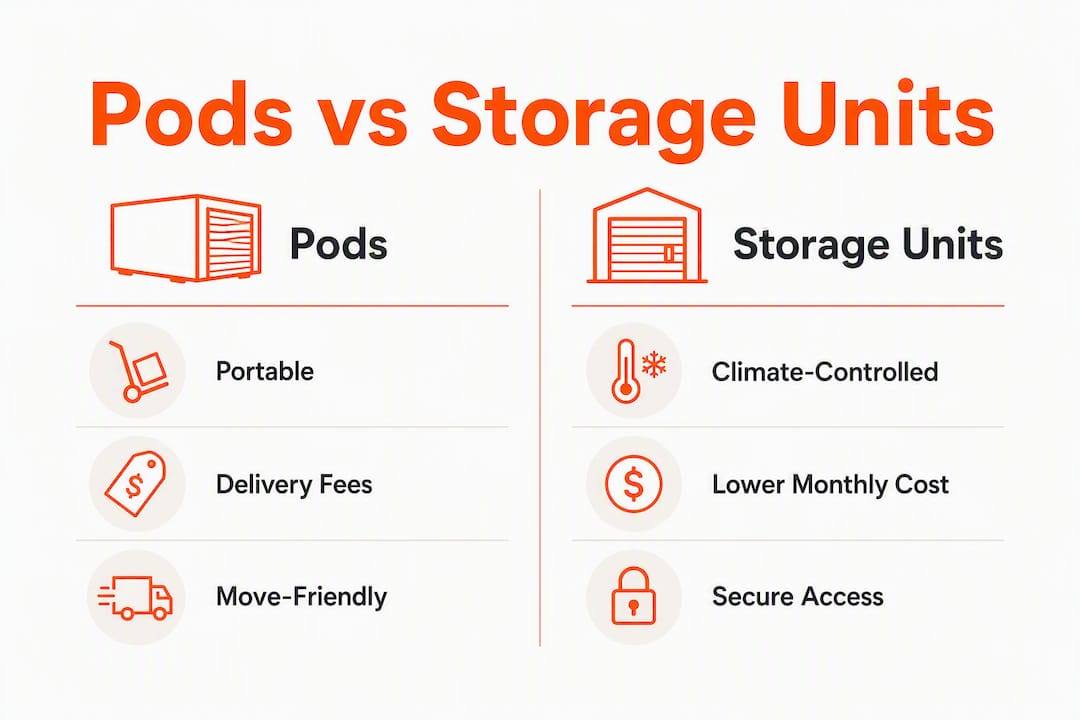
The core logic is a “move component” question: if your job is primarily moving, the container model wins. You load once, the company hauls it, and you skip the truck rental entirely.
Specific situations where a pod-style container earns its premium:
- Long-distance relocations where you need the container transported to a new state or city
- Closing-gap bridge storage when your new home isn’t ready and you need 2–4 weeks of on-site storage without repeated facility trips
- On-site renovation staging where keeping items in the driveway beats driving to a unit daily
- Mobility-limited households who physically cannot make repeated trips to an off-site facility
The labor savings are real. With a container, one crew loads everything once. No truck to return, no second loading day. When you factor in truck rental costs and the time of multiple facility trips, the delivery fee starts to look reasonable for short windows.
Pro Tip: A 16-foot container from PODS or 1-800-PACK-RAT is roughly equivalent to a 10×15 storage unit in volume. Standard sizes run 7, 12, and 16 feet. Before ordering, measure your driveway: a 16-foot container needs a long, flat run with enough clearance for the delivery truck. Sloped or obstructed driveways in SWFL neighborhoods can cause providers to refuse placement or charge extra for special handling.
When a traditional self-storage unit is the smarter pick
Self-storage beats portable containers on cost for anything beyond roughly 30–60 days, and in Southwest Florida, climate control tips the scales even further.
Situations where a unit at Public Storage, Extra Space Storage, or CubeSmart makes clear sense:
- Storage beyond two months: once delivery and pickup fees are absorbed, monthly unit rates are consistently lower
- Frequent access: facilities like Extra Space Storage and CubeSmart typically offer gate access from roughly 6:00 AM to 10:00 PM, no scheduling required
- Humidity-sensitive items: wood furniture warps, electronics corrode, and textiles mildew in uncontrolled Florida heat; a climate-controlled unit removes that risk
- Cost-constrained households: no transport fees, no re-delivery charges, just a flat monthly rate
“If your job is mostly storing with frequent access or climate needs, the facility model wins.” The industry frames this as a logistics question, not a preference question. Containers are a moving tool that happens to offer temporary storage. Self-storage units are a storage product, full stop. Conflating the two is where most people overpay.
Security at established facilities tends to be more layered than a container lock: gated access, surveillance cameras, individual unit alarms, and on-site staff. For valuables stored in SWFL long-term, that matters. Check whether your homeowner’s insurance covers off-site storage, and ask each facility about their own coverage options before signing.
How pricing actually works for pods vs storage units
The monthly rate is only part of the number. A full cost model for portable containers includes: monthly rental, delivery fee, pickup fee, potential re-delivery if the container moves between facilities, fuel surcharges, access appointment fees at the warehouse, and insurance or declared-value charges.
Here is a simple calculation template to run before committing:
- Get the monthly rental rate from the provider (PODS, U-Haul U-Box, 1-800-PACK-RAT)
- Add the delivery fee (typically $75–$150)
- Add the pickup/return fee (same range)
- Multiply monthly rate by the number of months you expect to store
- Add any re-delivery fee if the container moves to a new address
- Divide total by months to get your effective monthly rate
- Compare that number to a climate-controlled unit at Public Storage, CubeSmart, or Extra Space Storage
For a one-month rental, delivery and pickup fees can more than double the monthly rate. A comparable climate-controlled unit in SWFL typically costs less than a portable container for the same period, with no transport fees.
Distance, season, and container size all move these numbers. Summer demand in SWFL pushes container availability down and prices up. Longer distances add transport legs and fuel surcharges.
Pro Tip: When a provider advertises “first month included,” read the fine print. That offer typically applies to bundled long-distance packages. For local storage customers, delivery and pickup fees usually still apply and are not waived by the promotional month.
Local rules in Southwest Florida: what you need to check first
Local ordinances and HOA covenants commonly restrict driveway or street placement of portable containers. Many associations require prior written approval, and some prohibit containers entirely. Street placement is often capped at 24–72 hours by municipal code.
Before you order anything:
- Call your HOA management office and ask specifically about portable storage containers, not just “storage.” Get the answer in writing.
- Check your municipality’s code (Naples, Bonita Springs, Fort Myers, Marco Island, and Estero each have their own rules)
- Get any required permits before the delivery date, not after the container arrives
- Document everything: take photos of the placement area and keep the HOA approval email
If your HOA says no, or your driveway physically won’t accommodate a 16-foot container, a self-storage unit is the default answer. Fixmovehaul can handle local pickup and delivery to bridge that gap, moving items from your home to a facility without you needing a truck or a container on-site.
Pro Tip: When submitting HOA approval requests, include the container dimensions, the exact placement location on your property, and the planned duration. Specific requests get faster responses than vague ones.
How to decide: a checklist and the questions to ask providers
Work through these before calling any provider:
- How long do you actually need storage? (Under 30 days: lean container. Over 60 days: lean unit.)
- Are you moving to a new address, or just storing locally?
- How often will you need to access your items? (Daily or weekly: facility wins.)
- Do you have electronics, wood furniture, or textiles that need climate control?
- Does your HOA or municipality allow a container on your property?
- Does your driveway accommodate a 16-foot container and a delivery truck?
- What is your total budget cap, including transport fees?
- Do you have help for loading, or do you need to hire a crew?
Questions to ask every provider before booking:
- What is the delivery fee, and is it separate from the pickup fee?
- If I need to access the container at your warehouse, what is the process and cost?
- Is the container climate-controlled?
- What insurance or declared-value coverage do you offer?
- What happens if my HOA rejects placement after delivery?
- What is the re-delivery fee if I move to a new address mid-rental?
Red flags that should push you toward a storage unit or local on-demand help: your HOA has banned containers, the provider cannot confirm climate control, warehouse access requires 48-hour advance scheduling, or the effective monthly cost after fees exceeds local unit rates by more than 30%.
Key Takeaways
For most Southwest Florida homeowners, the storage unit vs pod decision comes down to one question: are you primarily moving, or primarily storing?
| Point | Details |
|---|---|
| Pods win for moves | Portable containers are cost-effective for one-time moves and bridge storage under 30 days. |
| Units win for long-term storage | Self-storage is typically cheaper and safer beyond 60 days, especially with climate control. |
| Florida climate is a real factor | Standard containers are not climate-controlled; heat and humidity damage electronics, wood, and textiles. |
| SWFL permits matter | Check HOA covenants and municipal codes before ordering any container delivery. |
| Fixmovehaul fills the gaps | Fixmovehaul provides same-day loading crews, local pickup/delivery, and moving help across Naples, Bonita Springs, Estero, Lee County, and Collier County. |
What most comparison guides miss about this decision
The national guides frame the storage unit vs pod question as a cost comparison. That framing is incomplete for Southwest Florida homeowners, and it leads people to the wrong answer.
The real variable is not price per month. It is what happens to your items inside an uncontrolled container during a Florida summer. Wood furniture can warp. Electronics corrode from humidity. Textiles absorb moisture and develop mildew. None of the national cost calculators account for the replacement cost of a damaged sectional or a ruined TV.
The second thing guides underweight is the HOA reality. A significant portion of SWFL homeowners live in communities with covenants that restrict or ban container placement entirely. Ordering a pod without checking first is not just an inconvenience. It can result in HOA fines and a container the provider has to remove at your expense.
The honest answer for most SWFL homeowners is this: use a container for the move leg, then transition to a climate-controlled unit for anything that needs to sit more than a month. That two-step approach costs more upfront but protects your items and keeps you compliant. Hiring local loading help for each transition makes the handoff clean without the repeated-trip burden.
Fixmovehaul handles the parts pods and units can’t
Portable containers and self-storage units solve the storage problem. They do not solve the loading, transport, or placement problem. That is where Fixmovehaul comes in.

Fixmovehaul serves Naples, Bonita Springs, Estero, Lee County, and Collier County with on-demand moving help, furniture pickup and delivery, and short-haul transport. If your HOA won’t allow a container on-site, Fixmovehaul can move items directly from your home to a storage facility without you renting a truck. If you need a crew to load a PODS container before pickup, that is a straightforward booking. Realtor prep, renovation staging, and seasonal home opening and closing are all on the menu.
For same-day or scheduled help, book your moving help in Fort Myers or across SWFL directly through Fixmovehaul. Transparent pricing, no hidden fees, and crews who know the local neighborhoods.
Useful sources and next steps
Before committing to any provider, get at least two quotes and confirm HOA and municipal rules in writing. These sources informed the cost, access, and climate guidance in this article:
- RecNation Storage: cost comparison between pods and storage units — delivery fee ranges, break-even timing, sizing equivalencies, and climate control guidance
- Modern Storage: self-storage vs portable containers — move component framing, hidden fee mechanics, and warehouse access logistics
- Freightamigo: storage options and local restrictions — permit and HOA caution, container placement and site requirements
Practical next steps:
- Get quotes from at least two providers (PODS, U-Haul U-Box, or 1-800-PACK-RAT for containers; Public Storage, Extra Space Storage, or CubeSmart for units)
- Confirm HOA covenants and your municipality’s placement rules before any delivery
- If you need loading crews or local short-haul transport, contact Fixmovehaul for same-day availability across Southwest Florida
- Consider junk removal before you pack to reduce the volume you are paying to store