How to Move a Piano Upstairs Safely in Southwest Florida
How to Move a Piano Upstairs Safely in Southwest Florida
If stairs are involved, hire professionals. That’s the short answer. Pianos weigh a significant amount — spinets and console uprights typically 300–400 lbs, studio/full uprights 400–500 lbs, baby grands 500–650 lbs, grands 650–900 lbs, concert grands 900–1,200+ lbs — and a staircase converts what is already a demanding job into the highest-risk scenario in residential moving. The physics alone are punishing: gravity shifts most of the load onto whoever is below the instrument, and a single misstep can send hundreds of pounds accelerating downward with no safe way to stop it.
For homeowners and property managers in Southwest Florida, Fixmovehaul provides on-demand moving help for exactly this kind of job, including staircase piano carries in Naples, Bonita Springs, Estero, and across Lee and Collier Counties. If you want the job done today without the risk, book moving help in SWFL and skip the rest. If you want to understand what the job actually involves before you decide, read on.
Table of Contents
- Should you move a piano upstairs yourself or call pros?
- What equipment and crew does a staircase piano move actually require?
- Step-by-step: how to move a piano up stairs safely
- What are the real risks, and does insurance cover them?
- How much does a staircase piano move cost, and how long does it take?
- How to prepare your home before movers arrive
- Fixmovehaul handles staircase piano moves across Southwest Florida
- Key Takeaways
- The part most guides skip
Should you move a piano upstairs yourself or call pros?
DIY is reasonable only for short, flat moves with the right equipment and enough helpers. The moment stairs enter the picture, the job crosses into professional territory for almost every homeowner.
DIY may be acceptable when ALL of these are true:
- No stairs anywhere on the route
- Piano weighs under 400 lbs (spinet or small console)
- At least four physically capable helpers available
- You have a stair-rated piano dolly, moving blankets, and heavy-duty straps
- Every doorway and hallway clears the piano’s dimensions with room to spare
Call professionals when ANY of these apply:
- The route includes stairs, even a single short flight
- There are turns on the staircase or a narrow landing
- The piano is a studio upright (400–500 lbs), baby grand (500–650 lbs), or larger
- You have fewer than four helpers
- The instrument is an antique or high-value piece
- You are a property manager coordinating a move without being on-site
Pro Tip: Photograph every doorway, measure every stair width and landing depth, then shoot a 30-second video walking the route. Send it to your mover before booking. Crews who see the route in advance can give you a binding flat-rate quote instead of an estimate that grows on moving day.
What equipment and crew does a staircase piano move actually require?
Professional crews bring gear that most homeowners simply do not own, and the crew positioning on stairs is not intuitive.
Piano weight and crew size by type
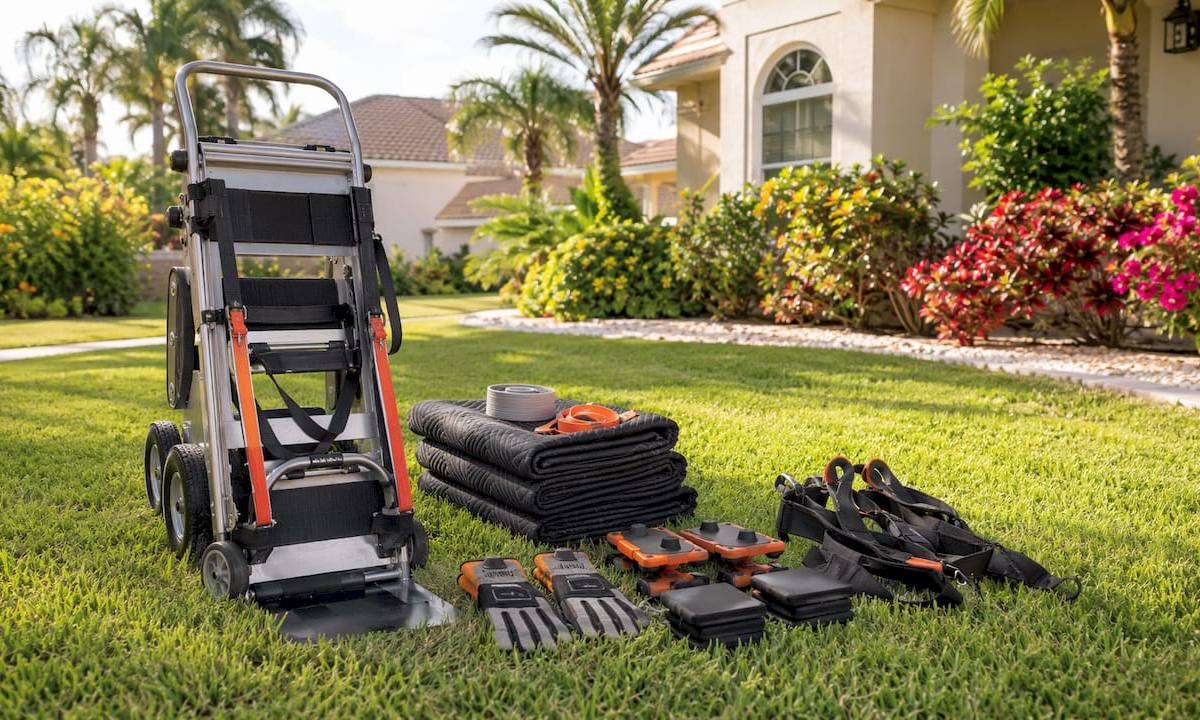
Professional piano moves require specialized equipment including a stair-rated piano dolly, padded boards for grands, harnesses, heavy-duty straps, moving blankets, protective materials for floors and handrails, and leg removal tools for grand pianos. Crew size and equipment needs vary depending on piano type and weight, and more helpers are generally required for larger pianos.
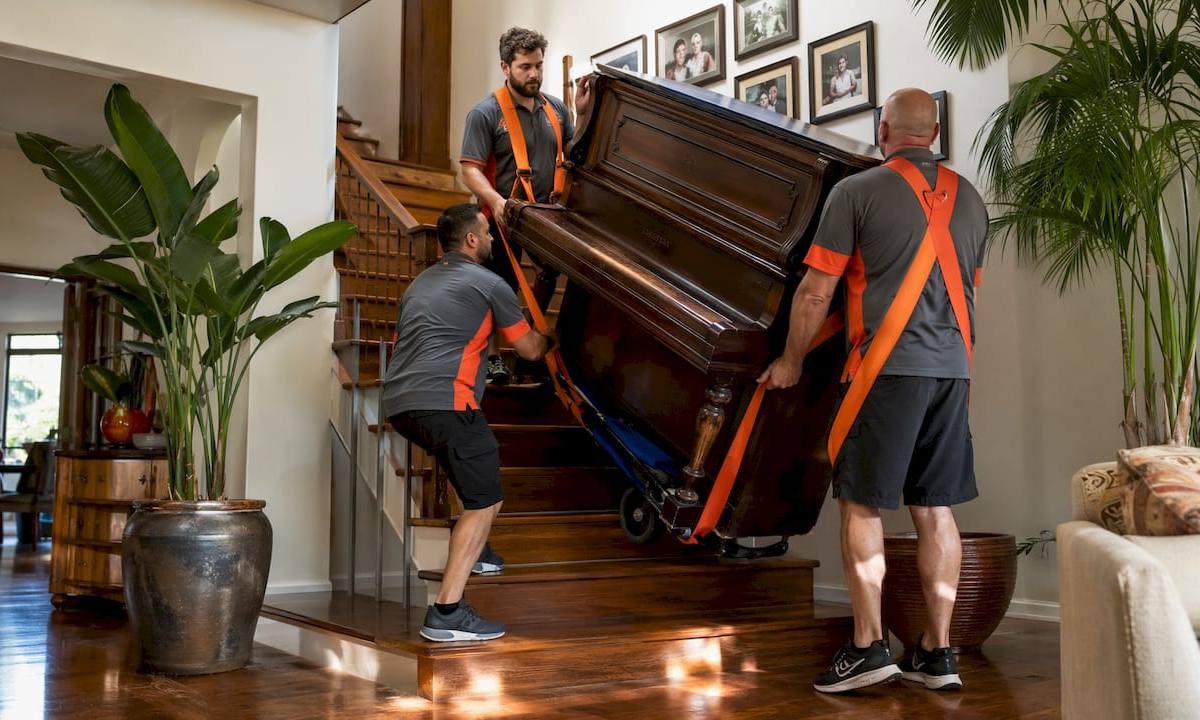
The two movers below the piano on stairs carry the majority of the load. Shoulder and forearm harnesses transfer that weight to the legs and core rather than the wrists and lower back — which is exactly why specialist harnesses matter and why untrained helpers get hurt.
Crew roles matter as much as crew size. The load-side lead works from below and calls the cadence. Two upper stabilizers guide and control tilt. A crew leader watches the whole picture and calls each step. Nobody moves until the leader says so.
Step-by-step: how to move a piano up stairs safely
This sequence is what trained crews follow. It is here so you understand the job, not as a substitute for professional help on a staircase.
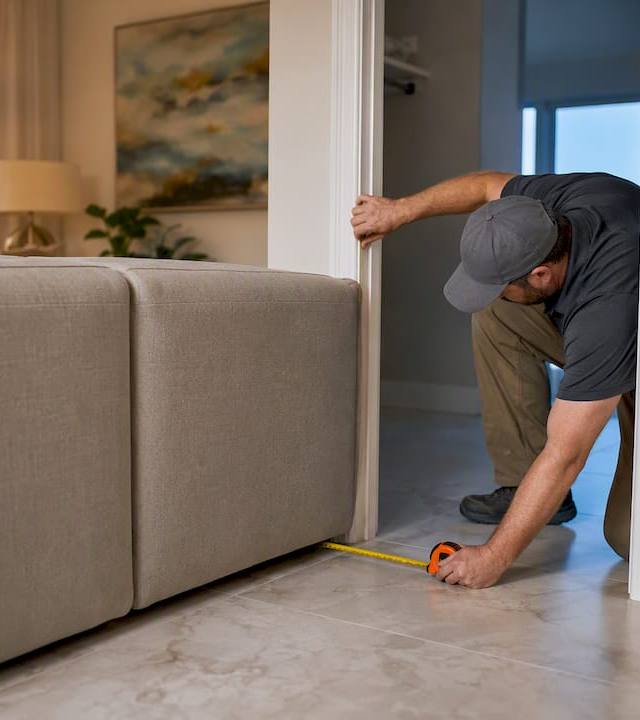
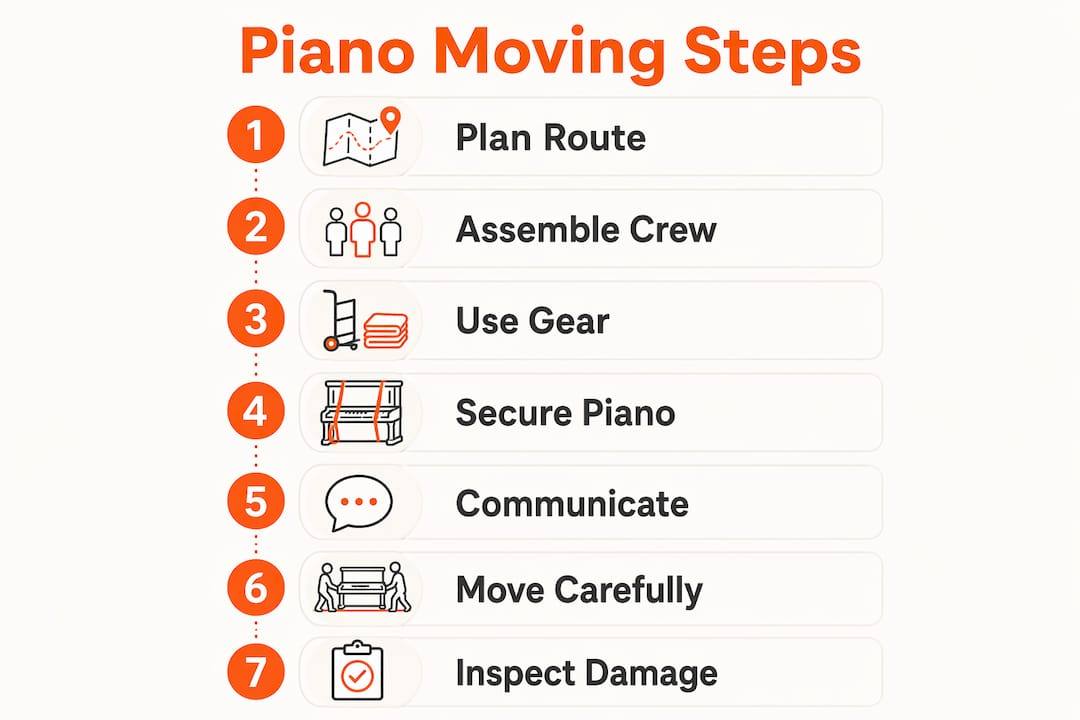
- Measure everything first. Piano height, width, and depth against every doorway, hallway width, stair width, and landing depth. If anything is tight, removing interior doors from their hinges is faster and safer than forcing the instrument through.
- Clear and protect the route. Remove furniture, rugs, and any fragile trim. Lay plywood over hardwood floors and pad handrails and door frames with moving blankets.
- Prep the piano. Lock the keyboard lid. Remove the music stand and fallboard. For grand pianos, remove the legs and pedal lyre, wrap each piece individually, and place the body on a padded piano board. Never lay an upright flat for a stair carry.
- Wrap and strap. Cover every surface with moving blankets, pay extra attention to corners, and secure with stretch wrap. Run ratchet straps through the dolly frame. The piano should not shift at all when tested.
- Position the crew. Two movers below, two above, crew leader at the side with a clear sightline. Everyone confirms grip and strap tension before the first step.
- Move one step at a time. The crew leader calls each step. No one moves independently. Straps stay taut throughout. On a short, straight flight, a 2-inch plywood ramp over three to six steps can convert the climb into a controlled roll — but turns or long flights rule that out.
- Rest and reset on landings. Set the piano down, check strap tension, confirm everyone’s footing, then continue.
- Set down and reassemble. Lower the piano onto its dolly at the top, wheel it to its final position, reassemble legs and pedals, and remove all blankets.
Never trust piano casters for stair work. Built-in casters are designed for minor adjustments on flat surfaces only. On stairs, they can buckle under load and damage both the instrument and the floor.
Pro Tip: Plan your route for the fewest stairs and turns possible, not the shortest distance. A longer flat path is almost always safer than a shorter one with a landing turn.
What are the real risks, and does insurance cover them?
The injury list for DIY staircase piano moves is predictable: back and shoulder tears, crushed fingers, falls from loss of footing, and dropped instruments. Property damage runs from wall gouges and broken handrails to cracked soundboards and snapped piano legs.
A single slack strap or one step taken out of cadence during a carry can convert a 500-lb piano into an accelerating hazard. Professional crews use a cadence caller and never allow straps to go slack, especially on descent.
Before any hired crew arrives, ask for a Certificate of Insurance (COI). Confirm their liability coverage includes the instrument value and any property damage. Standard homeowner policies often exclude damage caused during a move, and mover valuation limits (typically released value at $0.60 per pound) rarely cover what a piano is actually worth. Request a written service agreement that specifically notes stairs and any unusual access. A crew that hesitates to provide a COI is a red flag worth acting on.
For similar heavy-item risk context, Fixmovehaul’s approach to pool table removal in Florida follows the same insurance-first logic.
How much does a staircase piano move cost, and how long does it take?
| Move Type | Typical Price Range | Estimated On-Site Time |
|---|---|---|
| Upright, single flight, straight | — | 1–2 hours |
| Upright, turns or narrow landing | — | 2–3 hours |
| Grand, single flight | — | 2–4 hours |
| Grand, complex access | — | 3–5 hours |
Base local piano moves typically start around $250–$600, but staircases push prices higher. The main cost drivers are crew size, stair count, turns and landing depth, instrument type, whether disassembly and reassembly are required, and whether the mover must provide a COI for a building or HOA.
Same-day local jobs in Southwest Florida are often possible for straightforward staircase carries. Specialty grand piano moves with complex access usually require scheduled booking a day or two out.
How to prepare your home before movers arrive
A little prep on your end cuts the job time and reduces the chance of damage.
- Measure the piano: height, width, and depth
- Measure every doorway on the route (width and height)
- Measure stair width, landing depth, and note any turns
- Clear all furniture and rugs from the path
- Remove interior doors from hinges where clearance is tight (even a straightforward door removal adds meaningful clearance)
- Cover hardwood floors with cardboard or plywood along the route
- Pad door frames and handrails with moving blankets or towels
- Secure pets and keep children out of the work area
Simple measurement template to send your mover:
Piano: W___ × H___ × D___ Narrowest doorway: ___ wide × ___ tall Stair width: ___ | Number of stairs: ___ | Landing depth: ___ Turns on stairs: yes / no | Description: __________
Shoot a 30-second video walking the route from the piano’s current location to its destination and send it with your booking request. Fixmovehaul uses video walk-throughs to provide accurate quotes before crew dispatch.
Fixmovehaul handles staircase piano moves across Southwest Florida
Skip the risk and the guesswork. Fixmovehaul brings trained crews, stair-rated equipment, and full liability coverage to piano moves in Naples, Bonita Springs, Estero, and across Lee and Collier Counties. Same-day bookings are available for most staircase carries. Send a video of your route and get a flat-rate quote before anyone shows up.

After the move, it is recommended to plan for professional piano tuning within a few weeks, as humidity changes affect tuning and the piano’s sound immediately post-move
Book your moving help or browse Fixmovehaul’s full range of on-demand home services to see what else the team can handle in a single visit.
Key Takeaways
Any staircase makes a piano move a professional job: the right crew, the right gear, and a COI are non-negotiable for a safe outcome.
| Point | Details |
|---|---|
| Stairs = hire professionals | Any staircase, turn, or narrow landing pushes the job beyond safe DIY territory. |
| Crew and equipment minimums | Upright moves need 3–4 movers; grands need 4 or more, plus a stair-rated dolly and shoulder harnesses. |
| Never trust casters on stairs | Built-in piano casters are for flat-surface adjustments only and can buckle under stair load. |
| Confirm insurance before booking | Request a COI and a written agreement noting stairs; mover valuation limits rarely cover instrument value. |
| Fixmovehaul covers Southwest Florida | Same-day staircase piano moves in Naples, Bonita Springs, Estero, Lee County, and Collier County. |
The part most guides skip
Most piano-moving articles spend their energy on equipment lists and step counts. What they underplay is the asymmetry problem on stairs, and it is the real reason DIY fails.
When two people carry a piano up a flight of stairs, the two movers on the lower side are not sharing half the weight. They are absorbing the majority of it, because gravity is pulling the instrument back toward them the entire time. That load multiplies with every step. Shoulder harnesses exist specifically to move that force from the arms and wrists, which fail first, to the legs and core. Without them, even strong, experienced people hit their limit faster than they expect.
The other thing guides skip: the descent is more dangerous than the climb. Going up, the crew is fighting gravity. Going down, gravity is helping, and a slack strap or a half-step out of cadence is all it takes for the instrument to accelerate. Professional crews use a cadence caller for exactly this reason. There is no improvising your way through it safely.
If you are a property manager coordinating a move without being on-site, that risk doubles. You cannot call cadence over the phone. For any staircase carry in Southwest Florida, the practical answer is the same one this article opened with: call Fixmovehaul, send the video, and let a trained crew handle it.