
Homeowners: 5 Charges That Determine Your Junk Removal Cost

Homeowners: 5 Charges That Determine Your Junk Removal Cost
Most junk removal jobs cost between $100 and $800, with a typical single-load job landing in the $150 to $375 range. The single biggest rule to understand: nearly every company prices by truck volume, not by the hour, and almost all of them enforce a minimum charge even for one item. Disposal fees, labor, and how hard the job is to access decide where you land in that range.
TL;DR:
- Most jobs are priced by truck volume, with costs ranging from $85 for a small item to around $625 for a full truck load, depending on location and job complexity.
- Disposal fees vary significantly based on local landfill rates, often between $65 and $171 per ton, affecting the final quote especially for dense materials.
- High-refrigerant items like refrigerators and freezers cost more to remove due to regulatory recovery costs, sometimes reaching up to $200 per appliance.
- Quotes include disposal fees, labor, drive time, overhead, and profit margins, with transparent estimates requiring detailed photos and access information upfront.
- Dumpster rentals are cheaper for multi-day projects if you can manage loading, but full-service removal is better for same-day needs and heavy or hard-to-lift items.
Table of Contents
- Junk Removal Pricing Explained by Load Size
- What Do Specific Items Cost to Remove?
- How Companies Calculate Your Quote
- Dumpster Rental or Full-Service Haul-Away?
- Getting a Quote You Can Trust
- Fix Move Haul’s Take on Fair Pricing
- Get a Straight Answer on Your Junk Removal Cost
- Where to Verify Local Rates
- Sources
- FAQ
Junk Removal Pricing Explained by Load Size
The fastest way to estimate your own job is to think in truck fractions, not dollars. Junk haulers measure everything against the volume of a standard 15 to 20 cubic yard trailer, then quote a fraction of that space.
Here’s the ladder most residential crews work from, using operator rate-sheet data as a mid-market baseline:
- Minimum or single item: roughly $85 to $150. This covers one couch, one mattress, or one appliance and includes the drive out regardless of size.
- 1/8 load: around $125 to $175. Think a couple of bags, a small table, a few boxes.
- 1/4 load: about $185. This clears a bedroom’s worth of furniture or a stack of old patio chairs.
- 1/2 load: roughly $345. A one-car garage cleanout or a small basement purge usually lands here.
- 3/4 load: typically $450 to $550. Multiple rooms of furniture, a larger garage, or a light renovation debris pile.
- Full truck (15 cubic yards): around $625. A full house cleanout, a hoarding situation, or a two-car garage packed floor to ceiling.
Those numbers assume a national mid-market baseline. In higher cost-of-living metros, expect quotes to run 15% to 25% above that ladder, a gap that tracks closely with the regional price differences the Bureau of Economic Analysis tracks between states and metro areas. A quarter load in a high-cost coastal city can cost what a half load runs somewhere cheaper.
What Do Specific Items Cost to Remove?
Per-item pricing exists because not every “one item” job takes the same effort or carries the same disposal cost. A folding chair and a piano both count as “one item,” but they don’t cost the same to haul.
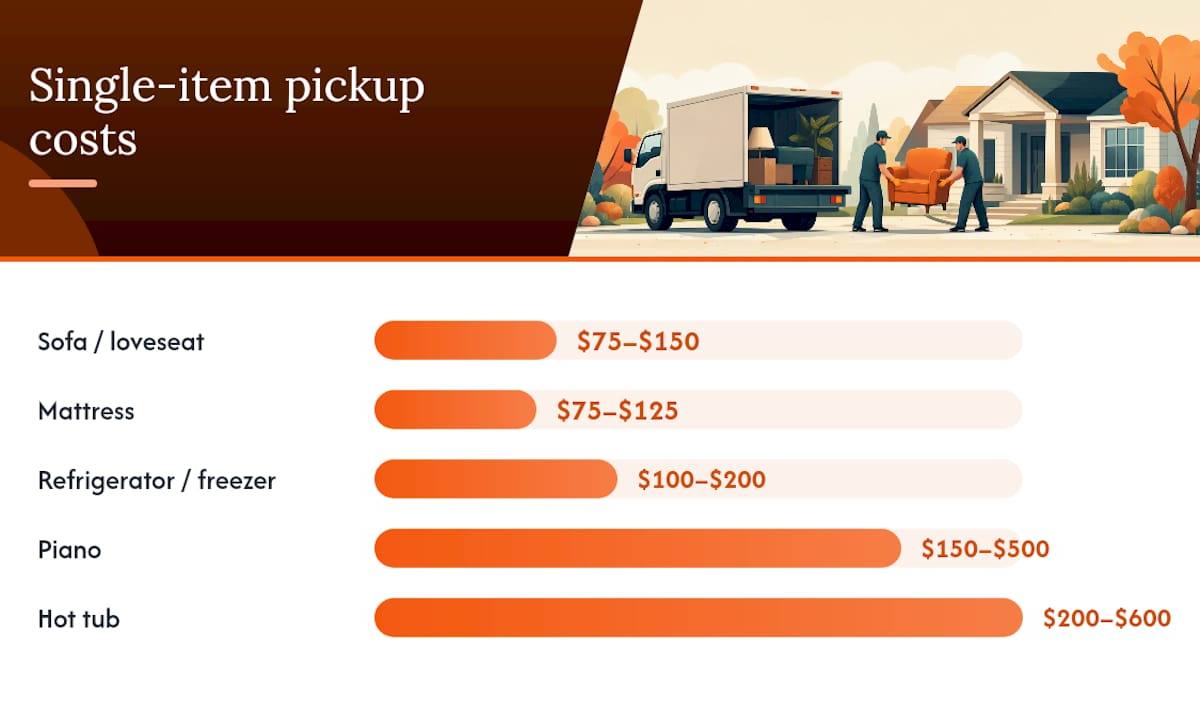
Here’s roughly what to expect for common single-item pickups:
- Sofa or loveseat: $75 to $150, more for sectional pieces or sleeper sofas with metal frames.
- Mattress: $75 to $125. Many landfills charge a separate mattress disposal fee because they can’t be compacted, and that fee usually gets passed straight to you.
- Refrigerator or freezer: $100 to $200. This one runs higher because of refrigerant.
- Piano: $150 to $500, depending on whether it’s an upright or a grand, and whether stairs are involved.
- Hot tub: $200 to $600, since these often require partial disassembly and two or three crew members instead of two.
Refrigerant matters more than most people expect. Federal rules require certified recovery of refrigerant from any appliance that uses it before that unit can be scrapped, which is why fridges and window AC units carry a built-in surcharge that a sofa never will. Electronics face a similar story: TVs and monitors often get treated as e-waste, which means a separate recycling fee instead of a simple landfill drop.
The minimum charge floor exists for a practical reason. A crew still burns 45 minutes to an hour driving to your house, loading one item, and disposing of it, whether that item is a lamp or a loveseat. That fixed cost is why “just one small thing” rarely comes in under $85.
How Companies Calculate Your Quote
A junk removal quote isn’t a random number. It’s five line items stacked together: disposal fees, labor, drive time, overhead, and margin.
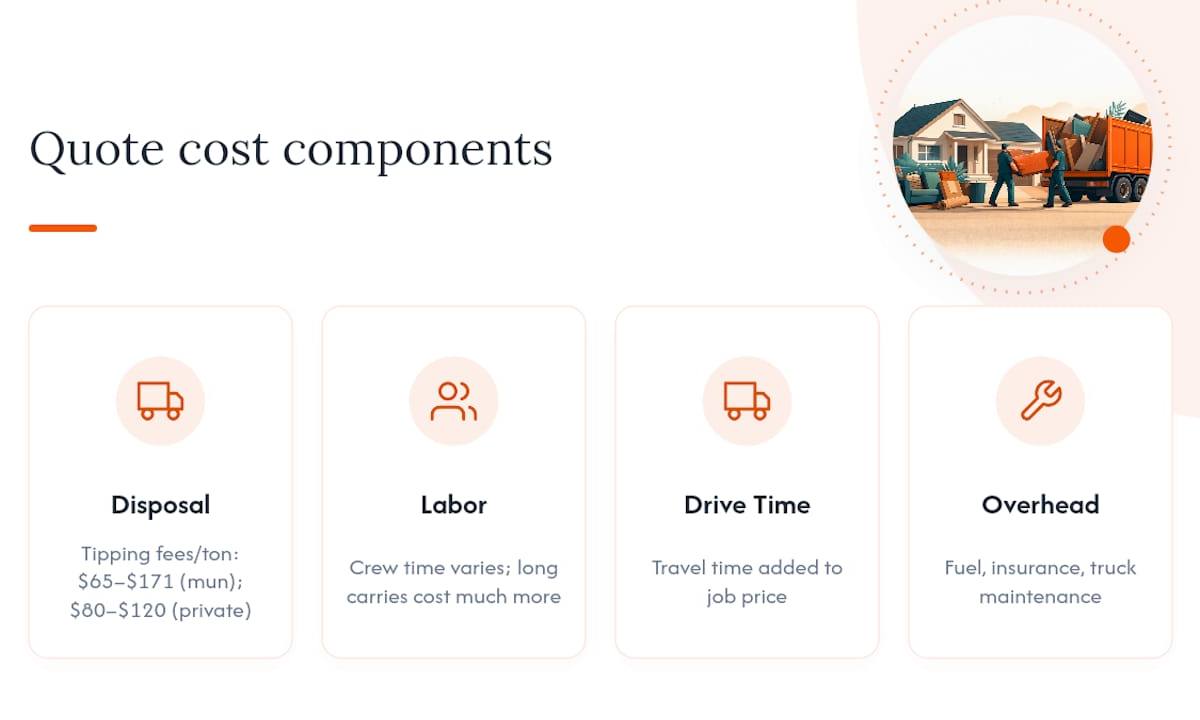
Disposal fees are the least visible cost and the most variable. Landfills and transfer stations charge haulers a tipping fee per ton to dump, and that rate swings hard by county. A 2024 analysis of municipal landfill tipping fees found rates ranging from roughly $65 to $171 per ton nationally, with private metro transfer stations often charging $80 to $120 per ton.
Labor is the second lever, and it moves more than people expect. Two crew members loading a truck for an hour costs a fraction of what a job with a long carry down three flights of stairs costs, even though the item pile is identical. Bureau of Labor Statistics data on hand laborers and material movers gives a useful baseline for what that crew time is actually worth on the open labor market.
Drive time, fuel, insurance, and truck maintenance make up overhead, and companies build in a margin on top of all of it, typically somewhere between 15% and 30% depending on local competition.
Here’s a simplified worked example for a half-load garage cleanout:
Weight matters most when you’re removing dense material like concrete, tile, or wet carpet, since disposal fees are charged per ton. Volume matters most for bulky, lightweight loads like furniture and boxes, since the truck fills up long before the weight limit does.
Pro Tip: Ask whether your quote is weight-capped or volume-capped. A job full of old carpet or tile can blow past a volume-based estimate fast, and you want to know that before the truck shows up, not after.
Dumpster Rental or Full-Service Haul-Away?
The two pricing models solve different problems, and picking the wrong one is the most common way people overpay.
A dumpster rental typically runs $300 to $600 for a week, based on container size, plus a weight allowance with overage fees if you go past it. Full-service junk removal charges by load and includes labor, so no lifting happens on your end.
- Choose a dumpster for multi-day projects like a slow room-by-room cleanout, or when you and family members can do the loading yourselves.
- Choose full-service when you need same-day results, when items are too heavy to lift (a sofa bed, a piano, an old washer), or when there’s no legal place to park a dumpster on your property.
- Watch for permit costs. Many municipalities require a street-placement permit for a dumpster, which can add $50 to $150 depending on the county, on top of the weekly rate.
If your driveway can’t fit a dumpster or your HOA restricts them, that decision gets made for you regardless of price.
Getting a Quote You Can Trust
A reliable estimate starts with what you send the company before they show up.
- Send clear photos of every pile, room, or item, taken from a few angles so scale is obvious.
- List access details upfront: stairs, elevators, long carries, or narrow gates that add labor time.
- Ask what’s included in the number: labor, disposal, and drive time, or is drive time billed separately?
- Ask about surcharges for mattresses, e-waste, refrigerant units, or anything requiring special handling.
- Ask about cancellation or no-show fees before you book a time slot.
A photo-based estimate is usually accurate enough for a standard household load. Multi-room cleanouts, construction debris, or anything involving hazardous materials deserve an on-site walk-through instead, since photos rarely capture true weight or hidden access problems.
Pro Tip: If a quote comes in dramatically lower than everyone else’s for the same job, ask what’s excluded. Cheap quotes usually mean disposal fees or a return trip get added later, not that you found a better deal.
Fix Move Haul’s Take on Fair Pricing
Transparent pricing means the quote you get from a photo matches what you pay at pickup, no surprise line items added once the truck is loaded. A professional crew should walk you through what’s included before they lift anything, and same-day scheduling shouldn’t come with a rush surcharge nobody mentioned upfront.
On tipping, it’s appreciated but never required. A crew that explains inclusions clearly earns trust faster than one that just shows up and starts hauling.
— Mark
Get a Straight Answer on Your Junk Removal Cost
Some local junk removal services quote by load rather than by the hour, and often provide direct communication with the crew performing the work, which can help ensure that the initial quote is reliable.

Junk removal and hauling starts from $99, and that quote comes with a same-day option when your schedule allows it. For bigger jobs, a full property cleanout covers estate situations, garage purges, and multi-room jobs where a single load estimate won’t cut it. Send a few photos of the pile, mention any stairs or tight gates, and expect a straight number back with disposal and labor already baked in, not tacked on later. Check current service rates or request a photo estimate today to get a same-day slot on the schedule.
Where to Verify Local Rates
Disposal fees swing by county, so check your local landfill’s published tipping fee schedule before assuming a national average applies to you. Labor cost context comes from BLS wage data for material movers.
Sources
- How Much Does Junk Removal Cost in 2026? (Load Sizes, Item Pricing, and the Math Behind the Quote) - Service Anchor
- Move
- 2024 analysis of municipal solid waste (MSW) landfill tipping fees - EREF
- U.S. Bureau of Labor Statistics: Hand Laborers and Material Movers
FAQ
How Do You Price Out Junk Removal?
Most companies price by truck volume, quoting fractions of a full load such as 1/4, 1/2, or 3/4, then add disposal fees, labor, and drive time on top. A quarter load runs about $185 while a full 15 cubic yard truck runs closer to $625 at mid-market rates.
What’s Included in a $99 Junk Removal Service?
A starting rate around $99, like Fix Move Haul’s junk removal service, typically covers a small single-item pickup or minimum-load job, including labor and standard disposal. Extra charges can apply for items with refrigerant, mattress disposal fees, or difficult access like multiple flights of stairs.
What Is the Average Price for Junk Removal?
The national average for full-service junk removal falls between $100 and $800 per load, with most single jobs landing between $150 and $375. Your actual price depends heavily on local disposal fees, which can vary by more than $100 per ton between counties.
Is a Junk Removal Service Worth It?
For heavy, bulky, or awkward items, hiring a crew is usually worth it once you factor in truck rental, dump fees, and the physical risk of lifting furniture or appliances yourself. It’s the better choice over a dumpster when you need same-day results or can’t do the loading yourself, since full-service pricing bundles labor into a single number.
Why Do Junk Removal Quotes Vary So Much Between Companies?
Quotes vary mainly because of local disposal fees, which can differ by $65 to $171 per ton depending on the county, plus differences in labor rates and how each company defines its minimum charge. Always ask what’s included in the number before comparing two quotes side by side.