Tenant Left Junk in Florida: Legal Steps and Fast Cleanout

Tenant Left Junk in Florida: Legal Steps and Fast Cleanout
If a tenant left junk behind in your Florida rental, your first move depends on how the tenancy ended. If the sheriff hasn’t yet executed a writ of possession as part of an eviction, do not touch a single item until that happens; Florida Statutes Section 83.62(2) only shields you from liability once the writ is served. If the tenant simply moved out and left the lease behind them, you’re working under Chapter 715, and specifically the notice rules in Section 715.104.
Either way, grab your phone before you grab a trash bag.
- Photograph and video every room, every item, before you move anything.
- Confirm your legal path: writ of possession or Chapter 715 notice.
- If Chapter 715 applies, draft and send the statutory notice today.
- If a professional cleanout will save you a week of vacancy, call one now.
Key Takeaways
A defensible tenant-junk cleanout in Florida depends on documenting everything before you move it and matching your disposal method to the correct statute, not a guess.
| Point | Details |
|---|---|
| Confirm your legal path first | Wait for the writ of possession in an eviction; use Chapter 715 notice if the tenant simply vacated. |
| Document before you touch anything | Photograph and video the unit and create a written inventory with condition notes. |
| Know the $500 threshold | Items under $500 in resale value can be kept or disposed of; above that triggers a public sale under 715.109. |
| Keep proof of every step | Retain notices, delivery receipts, and disposal records for at least a year. |
| Call a local pro for fast turnaround | Fixmovehaul handles same-day junk removal and property cleanouts across Southwest Florida when speed matters most. |
This article is general information, not a substitute for advice from a qualified lawyer. Consult a qualified legal professional about your own circumstances before acting on anything here.
Table of Contents
- What Florida Law Requires: Notice, Timelines, and the $500 Rule
- A Step-by-Step Cleanout Checklist for Landlords
- What Records to Keep, and How Long
- When to Hire a Professional Cleanout Service
- Why the Public Sale Rule Rarely Gets Used
- Get the Unit Cleared Fast Without Cutting Corners
- Sources
What Florida Law Requires: Notice, Timelines, and the $500 Rule
Florida law gives landlords a defined, if narrow, path for clearing out a unit after a tenant leaves belongings behind. Skip a step and you risk a claim for the value of whatever you tossed.
715.104 requires written notice describing the abandoned property, stating where the tenant can claim it, and warning that storage costs may apply. You have to give the former tenant at least 10 days to respond if the notice is hand-delivered, or 15 days if you mail it. The notice has to be specific enough that the tenant can identify their own belongings, not a vague reference to “personal items.”
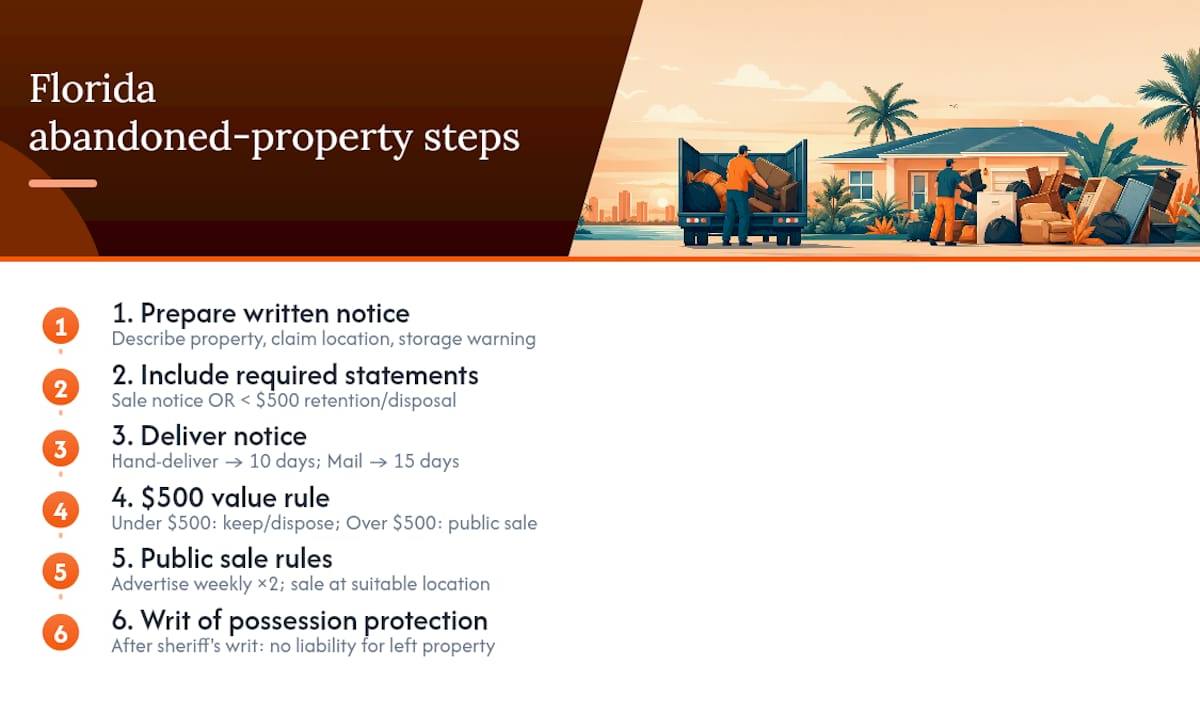
715.105 provides sample notice language that satisfies the statute. A compliant notice needs the property description, the claim location, the deadline, and one of two required statements: that the property will be sold at public sale, or that it’s worth less than $500 and will be kept or thrown out if unclaimed.
715.109 is where the real decision point lives.
If a landlord reasonably believes the total resale value of the abandoned items is under $500, the property can be retained or disposed of without a sale. Above that line, the law requires a public sale, and the rules around it are specific: advertisement once a week for two consecutive weeks in a paper of general circulation, sale at the nearest suitable location, and any leftover proceeds after costs go to the county treasury if nobody claims them.
83.62(2) is the statute landlords actually want to lean on. Once a sheriff executes a writ of possession, you’re not liable for loss, destruction, or damage to whatever property is left behind as long as you followed the eviction process correctly. Legal commentary consistently flags this as the strongest protection available to landlords, but it only works if you wait for the writ. Clear out a unit early and you forfeit the shield entirely.
A Step-by-Step Cleanout Checklist for Landlords
Once you know which legal track applies, the actual work is mechanical. Here’s the order that keeps you defensible at every stage.
- Document the unit. Photograph and video every room before anything moves. For anything that looks like it might be worth real money, jewelry, electronics, tools, take individual close-up shots and note the apparent condition. Low-value junk like trash bags or broken furniture just needs a wide shot for the record.
- Confirm your legal path. If this was a formal eviction, check whether the writ has been executed. If it was a lease that simply ended, Chapter 715 governs and you need to send notice.
- Draft the notice. Include the property address, a description of the items, the location where the tenant can claim them, a deadline of at least 10 days (personal delivery) or 15 days (mail), and the required disposal statement from 715.105.
- Deliver and prove delivery. Hand-deliver with a signed receipt, or mail it and keep the certificate. Photograph a posted copy if you leave one at the unit too.
- Sort the unit into three piles. Obvious trash, donateable goods, and anything with possible resale value. Store the valuable pile separately and note exactly where.
- Act once the deadline passes. If items are under $500 in resale value, dispose of or retain them and write down your reasoning. If they’re over $500, you’re required to run a public sale under 715.109.
Pro Tip: Give yourself a short, fixed holding window, 24 to 72 hours after the deadline, before you dispose of anything you’re on the fence about. It costs you almost nothing and it’s the single easiest way to avoid a dispute over an item you guessed wrong on.
Once the unit is clear, note every cost, storage, disposal, cleanout labor, so you have a clean record if the deposit or damages ever get disputed.

What Records to Keep, and How Long
Keep a folder for every cleanout, and treat it like evidence, because that’s exactly what it is if a former tenant comes back with a claim.
- Photos and video from before you touched anything.
- A written inventory with condition notes for each significant item.
- A copy of the notice you sent, plus proof of delivery, a signed receipt, mail certificate, or a photo of the posted notice.
- Receipts for storage, disposal, and any cleanout labor.
- Public sale documentation, if the $500 threshold pushed you into a sale.
- Sheriff’s writ paperwork, if the unit was cleared through eviction.
Hold sale and disposal records for at least a year in case a former tenant surfaces with a claim on proceeds. Deposit-dispute documentation is worth keeping as long as your normal record retention practice allows, most landlords default to several years given how deposit disputes can resurface. Digital files with date-stamped names are the easiest to search later; keep a printed backup for anything tied to a public sale, since those often need to be produced if a county or a court asks.
When to Hire a Professional Cleanout Service
Some units are a quick sweep with a trash bag, but for more complex situations, hiring professional cleanout services in Florida can save you time and ensure compliance with turnover workflows. Others involve a mattress, a broken recliner, three months of accumulated clutter, and a lease that starts for the next tenant in five days. That’s when calling a professional stops being a convenience and starts being the financially smart move.
Bring in a cleanout crew when:
- You need same-day turnaround to avoid extra vacancy days.
- The items are heavy, bulky, or require more than one person to move.
- There’s a hazard involved, mold, sharp debris, or anything that needs careful handling.
- You’d rather pay for documented, timely disposal than burn staff hours on it yourself.
Before you book anyone, ask for an itemized estimate, a clear plan for where items are going (donation, recycling, or landfill), and proof of disposal once the job’s done. Confirm they carry insurance, since you’re liable for whatever happens in your own unit if the crew doesn’t.
Practitioner guidance consistently notes that running a public sale is often more expensive in time and advertising costs than whatever the items are actually worth, which is a big part of why most landlords lean on professional cleanout services instead of hosting a sale themselves.
Why the Public Sale Rule Rarely Gets Used
Most landlords never run a public sale, even when the letter of the law seems to point that way. Once you factor in two weeks of newspaper advertising, coordinating a sale location, and the actual labor of running it, the $500 threshold usually isn’t worth crossing on paper for a mattress and some kitchenware. The smarter play is almost always documentation plus disposal, rather than preparing for a public sale that few landlords actually conduct.
Where I’d push back on the conventional advice: too many landlords treat the writ-of-possession shield as automatic. It isn’t. The statute only protects you if you followed the eviction process correctly and didn’t jump the gun. I’ve seen the instinct to “just clear it out already” cost landlords their strongest legal protection, right when they needed it most.
If you take one thing from this, take the holding window. A 48 hour pause between “deadline passed” and “dumpster arrives” costs you almost nothing and closes off the single most common way these situations turn into a dispute.
— Mark
Get the Unit Cleared Fast Without Cutting Corners
Once your notice period has run or the writ has been executed, the fastest path to a re-rentable unit is a same-day local crew, not a week of DIY hauling between tenants. Fixmovehaul serves landlords and property managers across Naples, Bonita Springs, Estero, and the rest of Southwest Florida with junk removal and full property cleanouts built for exactly this situation: fast turnaround, transparent pricing, and no long-term contract to sign.

Before you book, have your photo inventory ready, confirm keys or access with your team, and flag anything hazardous so the crew comes prepared. If you’re prepping the unit for a listing on top of the cleanout, Fixmovehaul’s realtor and listing prep services can handle both in one visit. For Southwest Florida units on a tight vacancy clock, book a junk removal appointment and get the space ready for your next tenant this week, not next month.