
Moving Help for Seniors: Real Options and Where to Start

Moving Help for Seniors: Real Options and Where to Start
If you’re helping an older parent move, the realistic options are family and friends, a nonprofit referral, a NASMM-certified senior move manager, or a straight hire of movers and local labor. The right choice depends on budget, timeline, and how much decision-making the senior can handle alone. Your first move: call 211 for a local referral, search the National Association of Senior and Specialty Move Managers directory for a certified move manager near you, or ask any company you’re considering for a written Order of Service before you sign anything.
- Call 211 first if cost is the main obstacle.
- Check the NASMM directory if the move involves floor planning, sorting, or a health-related deadline.
- Get a written scope of work from any paid provider before agreeing to a price.
- Know that nonprofit programs often cap assistance and require proof of income or age, so ask about eligibility before you count on free help.
Key Takeaways
Moving help for seniors works best when families match the service to the actual need: nonprofit referrals for tight budgets, a NASMM-certified move manager for complex sorting and planning, and local on-demand labor for the physical tasks that still need doing.
| Point | Details |
|---|---|
| Start with 211 | Call for a same-day local referral list before researching paid options on your own. |
| Verify credentials in writing | Check the NASMM directory and insist on a written Order of Service before hiring. |
| Sequence donations before junk removal | Book donation pickups first since they often need one to two weeks of lead time. |
| Budget by volume, not distance | A full home cleanout costs more than a short-distance move because of what’s inside it. |
| Use Fixmovehaul for the physical work | Fixmovehaul handles furniture pickup, junk removal, and installation in Southwest Florida once sorting and planning are done. |
Table of Contents
- Types of Senior Moving Help: Which One Fits Your Situation
- Where Can You Find Low-Cost or Nonprofit Moving Help?
- How Do You Choose the Right Mover or Move Manager?
- What Does a Senior Downsizing Checklist Look Like?
- What Do Senior Moves Actually Cost, and How Long Do They Take?
- How Do You Apply for Government or Charity Moving Assistance?
- How Fixmovehaul Fits Into a Senior Move
- How Do You Handle the Emotional Side of a Senior Move?
- What Should Families Know About Mobility and Health Limitations?
- What Legal and Financial Steps Should Happen Before the Move?
- Why the “Just Hire a Mover” Advice Misses the Point
- Get Local Help for the Parts of the Move That Still Need Doing
- Frequently Asked Questions
- Sources
Types of Senior Moving Help: Which One Fits Your Situation
A senior move manager is not the same thing as a moving company. Move managers coordinate the whole project: sorting belongings, planning furniture layout in the new space, scheduling donation pickups, and hiring the actual movers. Many provide a written Order of Service that spells out exactly what’s included, which prevents the surprise add-on fees that plague unplanned moves.
Standard movers, by contrast, handle labor and transport only. That split matters when you’re budgeting.
- Labor-only movers: hourly crews who load, carry, and unload, but do zero planning or sorting.
- Full-service downsizing companies: handle sorting, packing, selling unwanted items, and coordinating the move, often bundled with an estate-sale partner.
- Junk removal and donation pickup: separate services for what’s left behind, usually scheduled after the keep pile is set.
- Move managers: project coordinators who oversee some or all of the above and answer to you, not to a moving crew’s schedule.
Pro Tip: Before hiring anyone, ask if they’re a member of NASMM or can show proof of insurance. A legitimate senior move manager will hand you a written scope without hesitation.
Where Can You Find Low-Cost or Nonprofit Moving Help?
Start with a single phone call, then work outward from there.
- Call 211. This is a national referral line that connects callers to local social services, including charity-run moving programs, furniture banks, and donation pickup services. Have the senior’s ZIP code, income range, and moving date ready when you call.
- Ask about Salvation Army, Catholic Charities, and YWCA programs. These organizations frequently run or fund local moving assistance, furniture donation, and sometimes direct labor help, though availability varies heavily by chapter and city.
- Contact your local Area Agency on Aging. These agencies sit inside the national aging network and often know which municipal or charity programs are currently taking applications, which saves you from cold-calling five different offices.
- Look for a municipal or county senior services program. Some counties fund modest moving grants or connect residents with underwritten programs. One example, the H.O.M.E. moving assistance program, underwrites moves on a sliding scale, up to $900 in some cases, with the client covering a small service fee.
When you call any of these, ask three things: eligibility rules, whether it’s sliding-scale or fully free, and how much lead time they need. Two to four weeks is typical.
How Do You Choose the Right Mover or Move Manager?
Get everything in writing before a single box gets packed. That means scope of work, estimated timeline, insurance or valuation coverage, and cancellation policy, all on paper, not promised over the phone.
For interstate moves, verify the company’s USDOT number through the Federal Motor Carrier Safety Administration’s database. For move managers, check the NASMM directory directly. A real senior move manager will show credentials without being asked twice.
- Ask for a written Order of Service listing every task included.
- Confirm the cancellation policy before you put down a deposit.
- Check reviews specifically mentioning senior or downsizing moves, not just general moving reviews.
- Walk away from anyone who wants full payment upfront in cash.
Pro Tip: If a quote seems unusually low, ask what’s excluded. Junk removal, stair fees, and long-carry charges are the most common items left off a bare-bones estimate.
Red flags include no physical business address, no insurance documentation, and pressure to sign same-day. If the situation involves a health deadline, mobility limits, or a home that needs full sorting, that’s the point to bring in a move manager rather than trying to coordinate labor-only movers yourself.
What Does a Senior Downsizing Checklist Look Like?
Work room by room, not category by category. Trying to sort “all the books in the house” at once is overwhelming; clearing one room completely builds momentum and gives a visible sense of progress. Start with low-emotion spaces, garages, guest rooms, home offices, before tackling anything sentimental like a primary bedroom.
- Sort each room into four piles: keep, donate, sell, dispose. Don’t create a fifth “decide later” pile; it always grows.
- Pack an “open first” box. Fill it with medications, chargers, a few days of clothing, important documents, and any small items of real sentimental value. This box travels with the senior, not on the moving truck.
- Skip sorting photos and paperwork during active packing. Caregiving guidance consistently recommends boxing sentimental items as-is and sorting them later once the move is done and stress has dropped. Trying to make emotional decisions under a moving deadline usually backfires.
- Schedule donation pickups first. Groups like Habitat ReStore, Salvation Army, and Goodwill often need one to two weeks of lead time, so book those before anything else.
- Book an estate sale if there’s enough volume to justify it. This step happens after donations are scheduled but before junk removal.
- Schedule junk removal last, once the keep, donate, and sell piles are confirmed and cleared out.
Nearly every downsizing guide agrees on one point: sequence matters more than speed. Rushing junk removal before donations are picked up means usable furniture ends up in a landfill instead of a Habitat ReStore truck. Getting the order right saves money and reduces waste.
What Do Senior Moves Actually Cost, and How Long Do They Take?
Costs swing widely depending on scope. Junk removal alone can start around $79 per item for a single piece of furniture. A senior move manager project, covering sorting, planning, and coordination, typically costs a moderate to high amount depending on the scope. Full-service downsizing that bundles packing, moving, and disposal often costs several thousand dollars, varying with home size and distance.
Timelines follow a similar pattern: a small local move typically takes four to eight weeks from decision to move day, a mid-size home runs three to six months, and a full estate cleanout can stretch six to twelve months when there’s decades of belongings to sort.
- Combine a few hours of paid move-manager sorting with cheaper curbside junk removal instead of paying for full-service downsizing.
- Schedule during off-peak months (fall and winter) when movers often have more availability and better rates.
- Ask about bundled pricing if you need junk removal, donation pickup, and moving labor all from one provider.
The single biggest driver of cost isn’t distance, it’s volume. A four-bedroom home with 30 years of accumulated belongings costs far more to clear than a studio apartment, regardless of how far the move itself is.
How Do You Apply for Government or Charity Moving Assistance?
Work through a logical order rather than calling programs at random.
- Start with 211 for a same-day list of local options based on your ZIP code and situation.
- Call your local Area Agency on Aging next. These offices sit inside the national aging network and frequently know which nonprofit programs currently have open funding.
- For veterans, check VA housing assistance pages or call the homeless veterans call center directly; this is a dedicated line separate from general VA benefits.
- For anyone using a housing-choice voucher, contact your local public housing authority through HUD’s PHA directory early, since voucher paperwork and inspection timing can affect your move date.
Expect to provide proof of income, age or veteran status, and sometimes a doctor’s note if the move is health-related. Most nonprofits need two to four weeks of lead time, so apply as soon as a move date is even tentatively set.
How Fixmovehaul Fits Into a Senior Move
Nonprofits and move managers handle the planning and the paperwork. Somebody still has to physically move the couch, haul the junk to the curb, and mount the TV in the new place. That’s where Fixmovehaul comes in for families across Naples, Bonita Springs, Estero, and the rest of Southwest Florida.
- Furniture pickup and delivery for pieces that are staying, selling, or heading to a new address.
- Junk removal for everything left behind once the keep and donate piles are cleared.
- TV mounting, furniture assembly, and installation at the new home.
- Return and exchange runs for anything that doesn’t fit the new space.
- Same-day response for last-minute needs that pop up mid-move.
Pro Tip: If a NASMM move manager is handling the sorting and planning, Fixmovehaul can be the muscle that executes the physical part, same-day, without adding another layer of coordination.
Choose a certified move manager when the project needs full planning and floor design. Choose Fixmovehaul when you know what needs to move and just need it done.
How Do You Handle the Emotional Side of a Senior Move?
Downsizing a home isn’t just a logistics problem. It’s often tied to losing a spouse, giving up independence, or accepting that a house full of forty years of memories has to shrink into a much smaller space. Families frequently underestimate how much grief shows up during packing, even when the move itself is a positive step toward safety or lower cost of living.
Watch for signs of decision fatigue: a parent who suddenly can’t decide whether to keep a coffee mug, or who gets uncharacteristically short-tempered halfway through a closet. That’s not stubbornness. It’s exhaustion from making hundreds of small emotional decisions in a short window.
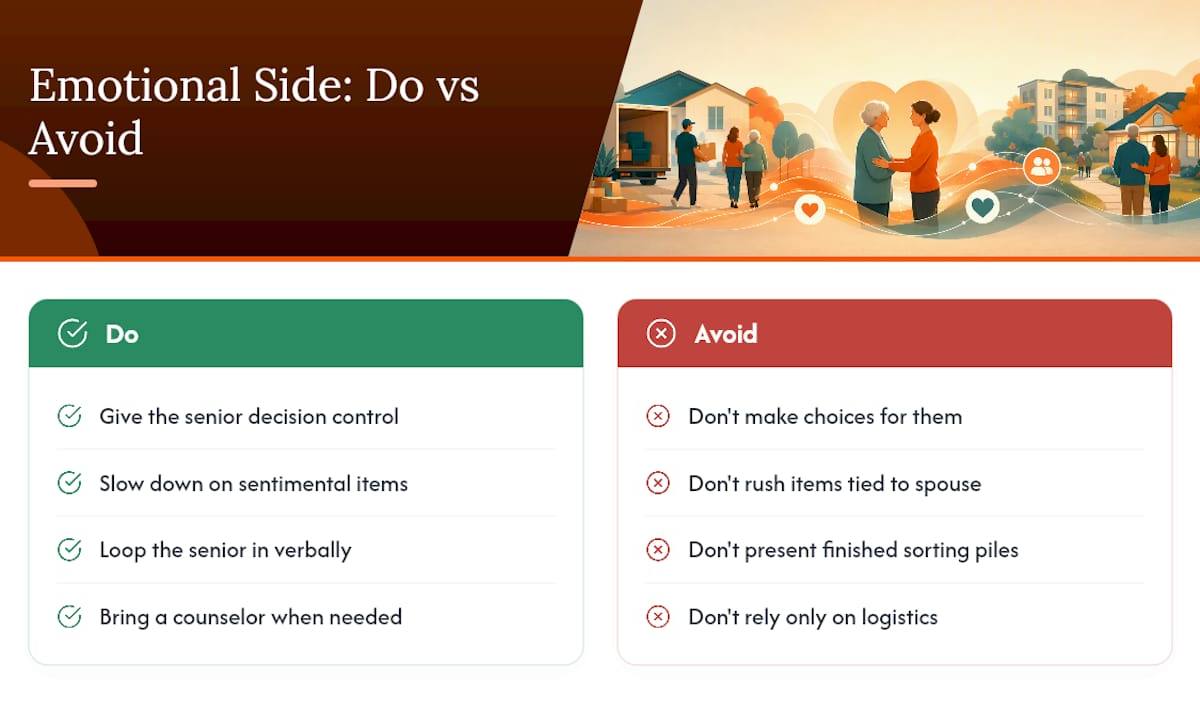
A few things help. Give the senior actual control over decisions, even small ones like which box gets packed first, instead of quietly making choices for them. Slow down around anything tied to a deceased spouse or an old family home; these items deserve extra time, not a five-minute call. If a sibling or adult child is doing most of the physical sorting, loop the senior in verbally rather than presenting finished piles for approval.
Some families bring in a counselor or grief specialist alongside the move manager, particularly when the move follows a loss or a health crisis. That’s not overkill. Recognize that pushing through purely on logistics, without acknowledging what’s actually being given up, tends to backfire later, sometimes as resentment, sometimes as depression that surfaces weeks after the boxes are unpacked.
What Should Families Know About Mobility and Health Limitations?
Physical limitations change almost every part of a move plan. A senior who uses a walker or wheelchair needs a new home assessed for doorway widths, step-free entry, and bathroom accessibility before the lease or purchase is even signed, not after moving day.
Packing itself needs adjustment too. Heavy lifting, bending into low cabinets, and climbing into attics are off-limits for most seniors with joint issues or cardiac conditions, which means family members or hired labor need to handle that work entirely. Trying to “help a little” with heavy boxes is one of the more common ways a move ends in an emergency room visit instead of a new address.

Medication management deserves its own plan. Pack a clearly labeled bag with several days of medication, a printed list of prescriptions and dosages, and any medical devices, and keep that bag with the senior at all times during the move, never in the truck.
For anyone with cognitive decline, moving day itself can be disorienting. Familiar furniture arranged in a similar layout at the new home, even loosely, helps orient someone with dementia faster than a completely reimagined floor plan. If the senior has a home health aide or regular caregiver, keep that person’s schedule as consistent as possible through the transition instead of pausing care during the “busy” week.
What Legal and Financial Steps Should Happen Before the Move?
Handle the paperwork before the truck shows up, not after. If a senior’s mental capacity is declining, a power of attorney needs to be signed while they can still legally consent, giving a trusted family member authority to manage finances, sign contracts, or handle the home sale if the senior becomes unable to.
Selling the family home often runs on a separate, slower timeline than the physical move itself. If the house needs to sell to fund the new living arrangement, work with a real estate agent early enough that the closing date doesn’t force a rushed, poorly planned move; guidance on selling a house while relocating covers timing this correctly.
Update the senior’s address with Social Security, Medicare, banks, and insurance providers as soon as the new address is confirmed, not after the move. Delayed updates on Medicare or Social Security records can disrupt benefit payments for weeks.
If the senior is moving into assisted living or a care facility, review the admission contract with a family member or elder law attorney before signing. These contracts often include financial obligations that aren’t obvious on a first read, refund policies, care-level upgrade fees, and deposit terms that matter far more than the glossy brochure suggests.
Why the “Just Hire a Mover” Advice Misses the Point
Most articles on this topic treat moving help for seniors like a single decision: nonprofit or paid, cheap or expensive. That framing misses how these paths actually work together. A family might use 211 to find a nonprofit that covers half the labor cost, hire a move manager for just the sorting and floor planning, and still need someone local to haul the recliner nobody wants.
The conventional advice oversells the all-in-one option, whether that’s a full-service downsizing company or a single moving crew, when the smarter approach is usually modular. Sort with a move manager if the emotional and logistical load is heavy. Lean on nonprofits if money is tight and there’s lead time to apply. And for the physical tasks that remain regardless of which path a family takes, junk removal, furniture delivery, mounting a TV in the new place, a local on-demand service fills the gap without requiring a second full moving contract.
Prioritize getting the paperwork and credentials in writing first. Every other decision gets easier once that’s settled.
Get Local Help for the Parts of the Move That Still Need Doing
Nonprofits and move managers handle the planning. Fixmovehaul handles the physical work that comes after, without asking families in Naples, Bonita Springs, Lee County, Collier County, or Estero to sign another moving contract to get it done.

Once the keep pile is sorted and the donation trucks have come and gone, someone still has to move the heavy furniture, haul the leftover junk, and get the new place set up. Fixmovehaul offers same-day junk removal and moving help across Southwest Florida, with pricing published up front so families know the cost before a truck shows up. That’s the real difference from waiting on a nonprofit’s schedule or negotiating a full-service downsizing package for a task that only needs a few hours of labor.
Fixmovehaul also handles TV mounting, furniture assembly, and returns or exchanges for anything that doesn’t fit the new home. If your family needs local, same-day help finishing the physical side of a senior move, check availability at Fixmovehaul’s Naples service page or request a quote today.
Frequently Asked Questions
What is the cheapest way to get moving help for seniors? Calling 211 for a nonprofit referral is typically the lowest-cost path, since programs like Salvation Army or municipal senior services sometimes underwrite part or all of the labor cost based on income eligibility.
How do I know if a senior move manager is legitimate? Check the NASMM directory and ask for a written Order of Service before signing anything. A legitimate move manager will provide both without hesitation.
Do nonprofit moving programs cover the entire cost? Rarely. Most work on a sliding scale with caps, like the H.O.M.E. program’s underwriting up to $900 with a small client service fee, so ask about eligibility and coverage limits before counting on full coverage.
How far in advance should a senior start downsizing? A small local move needs four to eight weeks of lead time, a mid-size home needs three to six months, and a full estate cleanout can take six to twelve months depending on volume.
Should I sort photos and important papers while packing? No. Caregiving guidance recommends packing sentimental items and paperwork as-is and sorting them later, once the stress of the move itself has passed.
Sources
- Downsizing a Home: A Checklist for Caregivers
- NASMM
- VA housing assistance
- HUD — PHA contacts
- Area Agencies on Aging — Eldercare/ACL
- H.O.M.E. moving assistance program