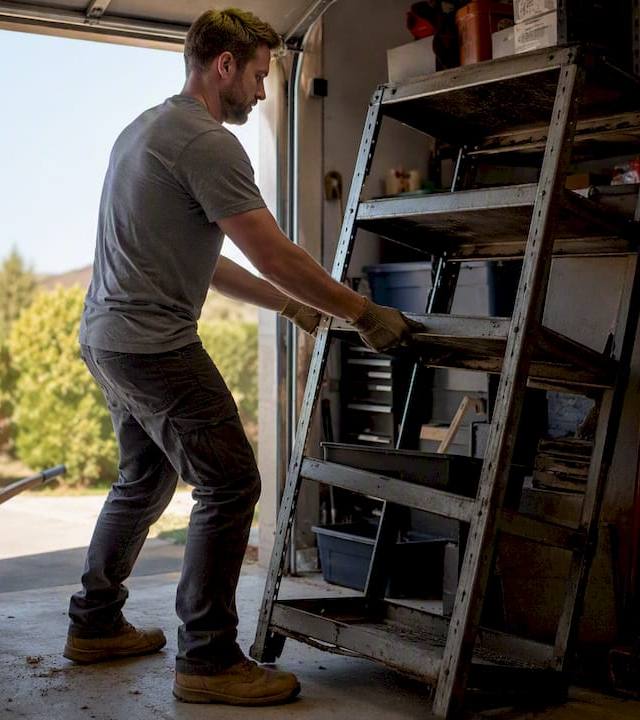
In-Home Heavy Lifting: Safe DIY Steps and When to Hire
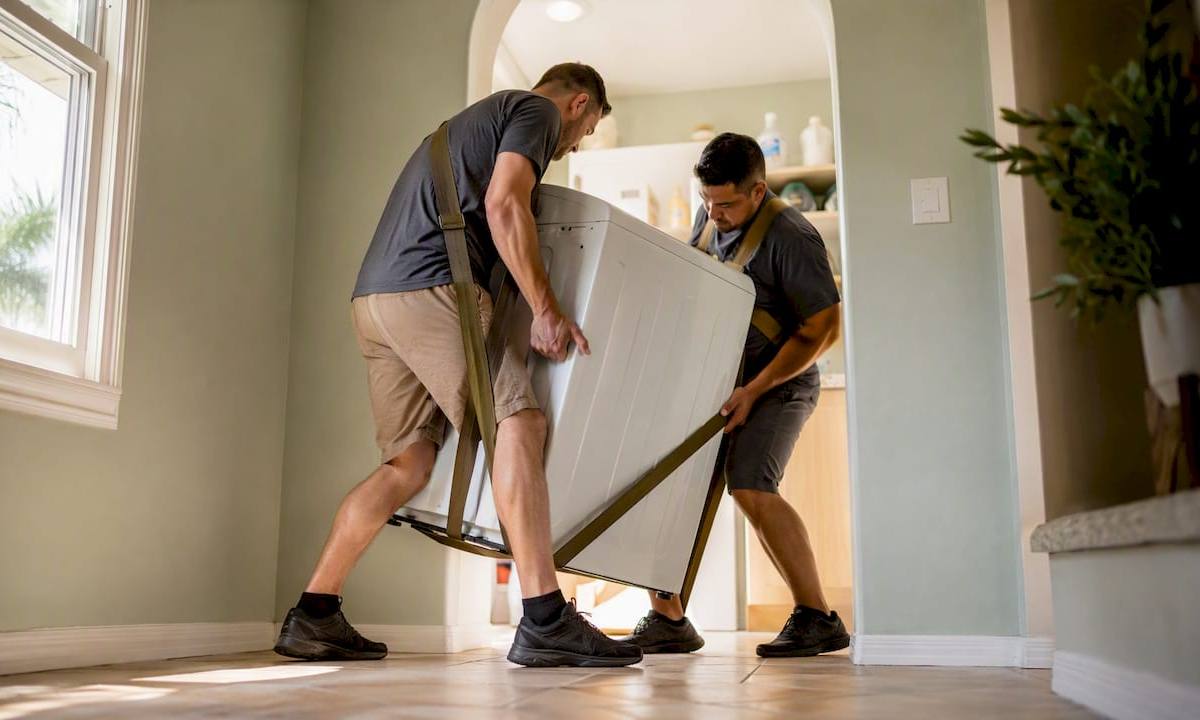
In-Home Heavy Lifting: Safe DIY Steps and When to Hire
The safest way to handle in-home heavy lifting is to check three things before you touch the item: your path is clear, you have a second person, and the item is light enough for the number of persons lifting it. If any of those conditions fail, stop and call a pro. Right now, you can do this in 90 seconds: measure the narrowest doorway on your route, slide a furniture pad under one corner to test friction, and do a two-person test lift just a few inches off the floor. If the item shifts unexpectedly, feels unbalanced, or you feel strain immediately, set it down.
Red flags that mean call a professional now:
- The item must travel up or down stairs
- It is very heavy and you have fewer than two helpers
- The doorway or hallway is narrower than the item’s widest point
Pro Tip: Before any lift, tape a strip of painter’s tape at the item’s height on every doorframe along the route. You’ll spot clearance problems in seconds without measuring twice.
If you’re in Southwest Florida and need a local, insured team today, Fixmovehaul’s moving help covers Naples, Bonita Springs, Estero, and the surrounding area with same-day availability.
Key Takeaways
Safe in-home heavy lifting comes down to one rule: check the path, check the weight, and hire a pro the moment either condition exceeds what your team can safely handle.
| Point | Details |
|---|---|
| Use legs, not your back | Squat close, brace your core, and lift on a shared count with your team. |
| Three tools worth buying | Lifting straps, a furniture dolly, and floor sliders cover most in-home heavy moves. |
| Hire a pro for stairs or 100+ lbs | Staircases, narrow doors, and items that cause strain even with two people require professional equipment. |
| Measure before anyone lifts | Compare item dimensions to every doorway and hallway on the route before the move starts. |
| Fixmovehaul for SWFL heavy lifts | Insured, background-checked crews with same-day availability across Naples, Bonita Springs, and Southwest Florida. |
Table of Contents
- What does safe in-home heavy lifting actually look like?
- Which tools make heavy furniture moving safer at home?
- When should you hire professional in-home heavy lifters?
- How much does in-home heavy lifting typically cost?
- How to prepare your home before a heavy lift
- Common mistakes that cause injuries and damage
- What to expect when you book Fixmovehaul for a heavy lift
- A local perspective on heavy lifting in Southwest Florida
- Fixmovehaul handles the heavy work so you don’t have to
- Sources
What does safe in-home heavy lifting actually look like?
The correct technique starts with your legs doing the work, not your lower back, and a clear verbal plan between everyone on the team before anyone bends down.
For a two- or three-person lift:
- Assign one person as the caller. Every movement starts on their count: “Ready, lift on three.”
- Everyone squats close to the item, feet shoulder-width apart, back straight, core braced.
- Grip low and firm. Lift together on the count, pushing through your heels.
- Move in small steps. No one pivots at the waist while holding weight.
- The caller announces every direction change: “Turning left, step together.”
- To set down, reverse the squat, keeping the back straight until the item is fully on the ground.
Single-person stability test: Before a solo attempt, push the item firmly from the top. If it rocks or shifts, it’s too unstable to move alone. For weight estimation, try the two-person test lift: both people lift just two inches off the floor. If either person feels immediate strain, the item needs more help or better equipment.
Avoid twisting at the waist while carrying weight. That single motion causes more lifting injuries than any other. Never step over a threshold while holding a heavy item without a dolly underneath it — the step-up breaks your stance and shifts the load unpredictably.
Pro Tip: In a narrow hallway, angle the item diagonally and shuffle sideways rather than trying to carry it straight. For a treadmill or other long exercise equipment, the Atlas Kings treadmill guide walks through a specific folding and tilting sequence that works inside tight spaces.
Which tools make heavy furniture moving safer at home?
Three categories of gear give you the biggest return on safety: lifting straps, wheeled dollies, and floor sliders. Family Handyman’s moving guide consistently points to these as the highest-impact purchases for reducing back strain on home moves.
Lifting straps and hump straps
- Forearm Forklift straps loop under the item and over your forearms, shifting the load to your forearms and legs rather than your lower back. They work well for appliances and mattresses and are available on Amazon.
- Hump straps are a two-person version designed for furniture. They transfer weight to stronger muscle groups and make staircase carries significantly safer. Buy them if you move items more than a few times a year; rent or borrow otherwise.
Dollies and hand trucks
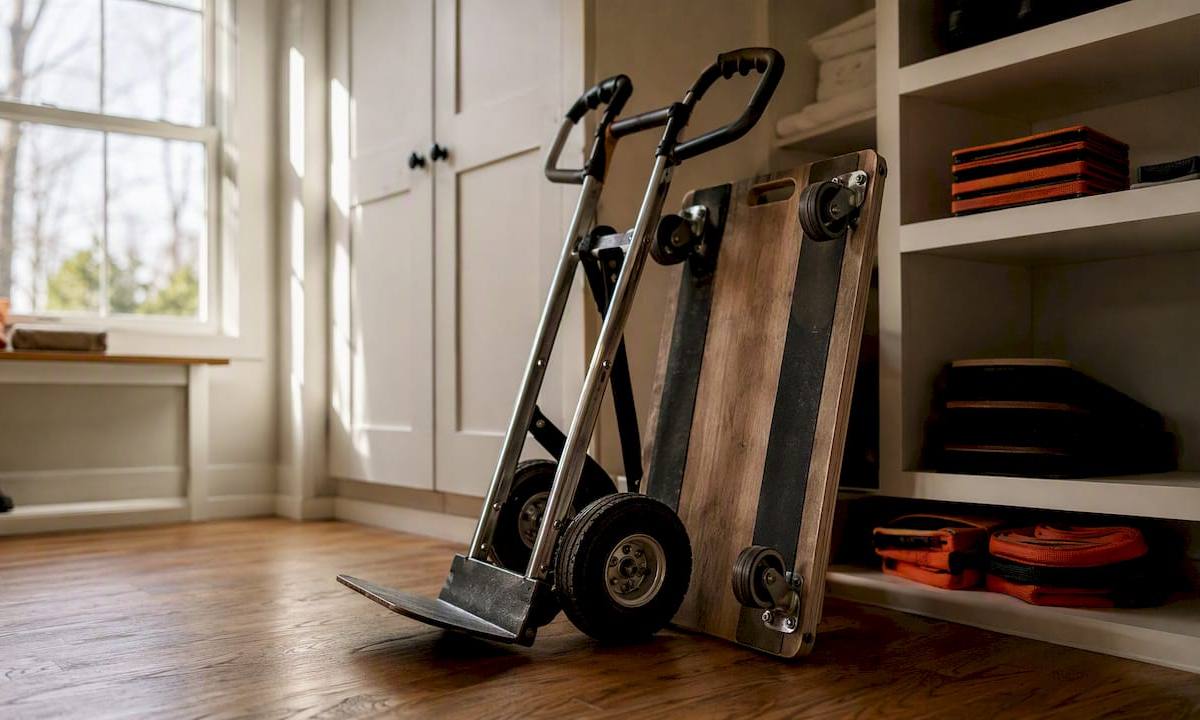
A good appliance hand truck with a rated weight capacity handles refrigerators, washers, and heavy boxes. A flat furniture dolly works better for sofas and dressers. For a one-time move, most tool rental shops and big-box stores rent both by the day. Sam’s Club and similar retailers also carry moving tool sets if you prefer to buy.
Floor sliders
Furniture sliders are inexpensive discs that sit under each leg or corner of a piece. They cut friction dramatically on both carpet and hard floors, letting one or two people push a heavy sofa across a room without lifting it at all. They also protect hardwood and tile from scratches. Buy a set and keep them. At a few dollars each, they pay for themselves the first time you use them.
Quick buy-vs.-rent rule: If you’ll use a tool more than twice, buy it. For a single move, rent the dolly and buy the sliders.
When should you hire professional in-home heavy lifters?
Hire a pro when any one of these five situations applies:
- Stairs are involved. Staircase moves multiply injury risk and require specific technique, equipment, and at least two experienced people.
- The item is too heavy to lift comfortably. A good rule: if two adults cannot lift the item two inches off the floor without strain, it needs professional equipment or more hands.
- Doorways or hallways are too narrow. Items that require disassembly to fit through a doorway are almost always faster and safer with a pro who carries the right tools.
- The item is fragile, antique, or high-value. A piano, gun safe, or heirloom armoire carries financial and sentimental risk that no amount of DIY prep fully covers. See Fixmovehaul’s guides on moving a piano upstairs and moving a gun safe for how specialized those jobs get.
- You’re short on time or helpers. A two-hour professional job that costs $150–$200 is almost always cheaper than a pulled back, a damaged floor, or a broken appliance.
What to look for when vetting a provider:
- Proof of insurance and bonding (ask directly; a legitimate company answers immediately)
- Background-checked crew members
- A written or clearly itemized estimate before work starts
- Recent customer reviews on Google or a similar platform
- Same-day or next-day availability for urgent jobs
The cost of skipping these checks shows up fast. An uninsured crew that damages your hardwood floor leaves you with no recourse.
How much does in-home heavy lifting typically cost?
Most in-home heavy lifting jobs are priced one of two ways: hourly labor (typically $75–$150 per hour for a two-person crew) or a flat rate per job. Flat rates are more predictable and work well for single-item moves with a defined scope.
What changes the price:
- Stairs. Almost every provider charges a stair fee, either per flight or as a percentage add-on.
- Disassembly and reassembly. Expect an additional charge if the item must come apart to fit through a door. Professional disassembly services add time and skill.
- Item weight and size. A 300-pound gun safe costs more to move than a 150-pound dresser.
- Distance moved inside the home. Ground-floor, short-distance moves are the simplest and cheapest.
- Urgency. Same-day bookings sometimes carry a premium.
Typical time ranges: A single-item ground-floor move usually takes 30–60 minutes. An appliance move with a staircase adds 30–45 minutes. A full staircase job with disassembly can run 2–3 hours.
Quotation checklist — give your provider these details:
- Item dimensions (height, width, depth) and estimated weight
- Photos of the item and the route (doorways, hallways, stairs)
- Whether disassembly is needed
- Floor type along the route (carpet, tile, hardwood)
- Any tight turns or low ceilings
Pro Tip: Pre-disassemble what you can before the crew arrives. Removing legs from a sofa or a headboard from a bed frame can cut 20–30 minutes off a job and lower your bill.
How to prepare your home before a heavy lift
Measuring and clearing the path before anyone touches the item is the single step that prevents the most problems. A crew that arrives to a clear, measured route works faster and charges less.
Prep checklist:
- Measure every doorway, hallway, and turn on the route (width and height)
- Compare those measurements to the item’s dimensions before the move date
- Remove rugs, cords, and furniture from the path
- Protect hardwood and tile floors with moving blankets or furniture sliders along the route
- Pad doorframes and wall corners with moving blankets or foam tape
- Remove doors from hinges if the item is within an inch of the doorway width
Measurement template — fill this in before your move or quote:
| Measurement | Your Item | Your Space |
|---|---|---|
| Width | Item width (inches) | Narrowest doorway (inches) |
| Height | Item height (inches) | Lowest ceiling or beam (inches) |
| Depth | Item depth (inches) | Hallway width (inches) |
| Diagonal (if tilting) | Diagonal measurement | Stairwell width (inches) |
Photos to send a provider for an accurate quote: the item itself, the starting room, every doorway on the route, any stairs, and the destination room. Four to six photos get you a precise estimate without a site visit.
Common mistakes that cause injuries and damage
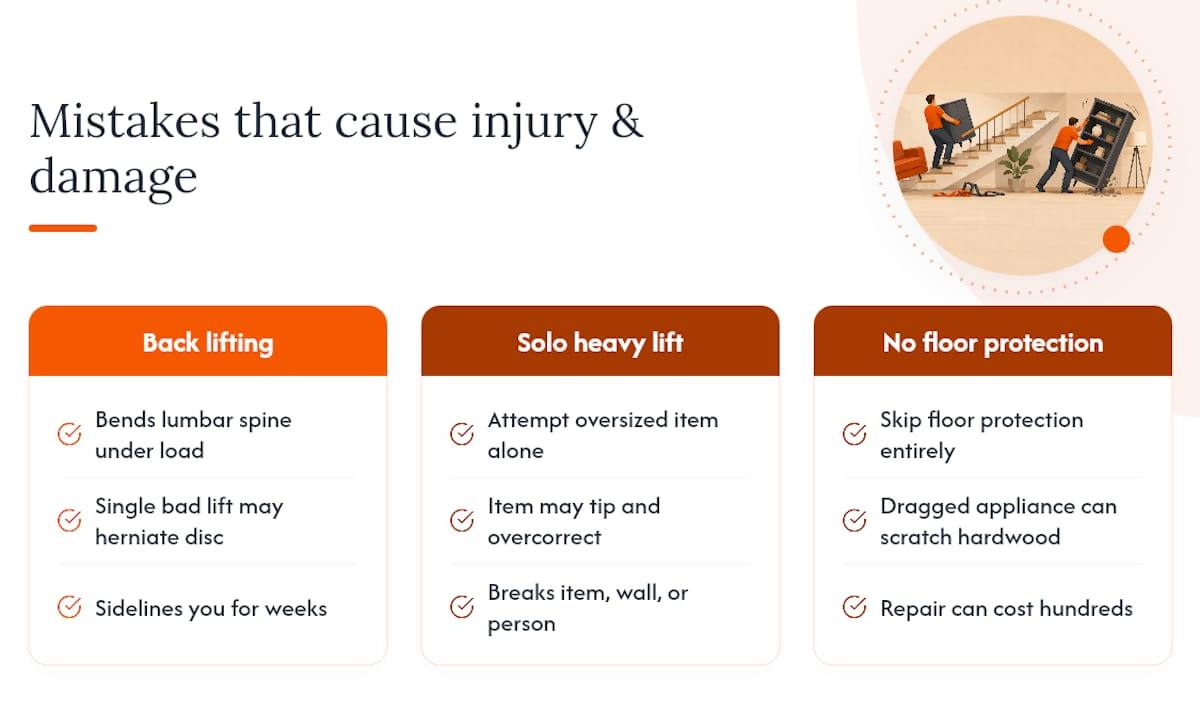
The three most common DIY mistakes are lifting with the back instead of the legs, attempting an oversized item solo, and skipping floor protection entirely. Each one is avoidable.
Lifting with the back is the most dangerous. The lumbar spine is not built to bear heavy loads in a bent position. Even a single bad lift can cause a herniated disc that sidelines you for weeks. The second mistake, solo attempts on very heavy items, is where most home damage happens too: the item tips, the person overcorrects, and something breaks — the item, the wall, or the person. The third mistake, skipping floor protection, is the most expensive. A single scratch across a hardwood floor from a dragged appliance can cost hundreds of dollars to repair.
Stop and call a professional if any of these happen during a move: the item shifts unexpectedly on a staircase, you hear a creak or crack from the stairs or floor, the item gets stuck at a landing and cannot be safely set down, or anyone on the team feels sharp pain. These are not “push through it” moments. Set the item down immediately if you can, and do not attempt to continue.
One more thing worth saying plainly: an uninsured crew that damages your home or injures themselves on your property can become your liability. Insured and bonded crews carry their own coverage. That single fact is worth the difference in price between a legitimate provider and someone who answers a classified ad.
What to expect when you book Fixmovehaul for a heavy lift
Fixmovehaul handles in-home heavy lifting across Naples, Bonita Springs, Estero, Lee County, and Collier County. The typical job flow is straightforward: you describe the item and the route (photos help), get a transparent estimate, and the crew arrives with the right equipment for the job.
What the crew brings and does:
- Moving blankets, straps, and dollies appropriate for the item
- Floor and wall protection placed before anything moves
- Disassembly and reassembly when needed, using proper tools
- Careful handling of fragile or high-value items, including antiques and electronics
- Cleanup of the work area after placement
Trust signals Fixmovehaul carries:
- Insured and bonded crews
- Background-checked staff
- Flat or clearly itemized pricing with no surprise charges
- Same-day availability across Southwest Florida
- Verified customer reviews
For specialty items, Fixmovehaul also handles furniture assembly and installation when a piece needs to come apart to move and go back together in the new room.
To get the fastest accurate quote: send photos of the item, the starting room, every doorway on the route, and the destination. Include the item’s approximate dimensions and whether any disassembly is needed. That information lets the team give you a firm number without a site visit.
A local perspective on heavy lifting in Southwest Florida
We handle a lot of the jobs that homeowners in Naples and Bonita Springs attempt once, decide they never want to do again, and then call us for gun safes down narrow hallways. Refrigerators up a half-flight of stairs in a condo. Sectional sofas through a lanai door that’s two inches too narrow. The common thread is that the job looked manageable until it wasn’t, and by then someone was already straining or the wall was already scratched.
Southwest Florida homes have their own quirks: tile floors everywhere, tight condo corridors, and seasonal timing that means half the calls come in when snowbirds are opening up for the season. If you’re staring at something heavy and wondering whether to try it yourself, the honest answer is usually: measure first, and if anything on that route gives you pause, call us. Fixmovehaul’s moving help page has the details on what we cover and how to book.
Fixmovehaul handles the heavy work so you don’t have to
When you’ve read the checklist, measured the doorway, and realized the job is bigger than a two-person DIY attempt, Fixmovehaul is the direct alternative to renting equipment and figuring it out yourself. The crew arrives with moving blankets, straps, and dollies. The estimate is flat and clear before anyone lifts a finger. Same-day availability across Southwest Florida means you’re not waiting a week for a slot.

Fixmovehaul serves homeowners, snowbirds, seniors, and realtors across Naples, Bonita Springs, Estero, Lee County, and Collier County. Whether it’s a single appliance, a sectional sofa, or a specialty item like a piano or gun safe, the team handles the lift, the floor protection, and the placement. Need a new appliance picked up from Home Depot and installed the same day? That’s covered too through Fixmovehaul’s Home Depot and Lowe’s pickup service. To book or get a quote, visit Fixmovehaul and send photos of the item and route.
Sources
The links below cover the tools mentioned in this article and a few practical how-to references for specific item types.
- 11 Handy Tips and Helpful Products for Moving Heavy …
- Forearmforklift
- Amazon
- Amazon
- Amazon
- Amazon
- Moving a Treadmill: Safe Step-by-Step Home Guide