
E-Waste Pickup Options for SWFL Homeowners and Realtors
E-Waste Pickup Options for SWFL Homeowners and Realtors
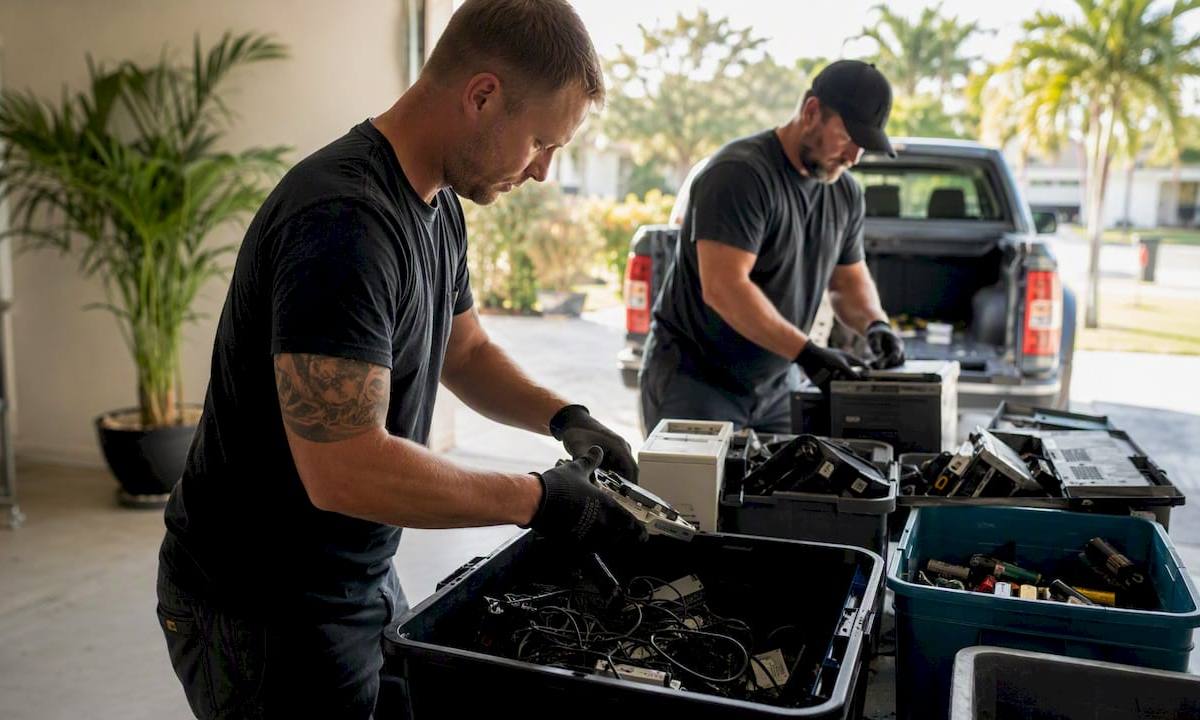
Hire an on-demand e-waste pickup crew when you have 10 or more electronics, bulky or heavy equipment, or any devices that stored sensitive data. For Southwest Florida homeowners, snowbirds, realtors, and property managers, Fixmovehaul is the local, concierge-style crew that handles the whole job from your driveway to certified disposal.
Why a pickup crew beats hauling it yourself:
- No transport required. The crew loads everything from wherever it sits — garage, lanai, spare bedroom.
- Heavy-lift capability. CRT TVs, server racks, and copiers go out without you touching them.
- Documented disposal. You get a paper trail showing where the electronics went.
- Single-contact scheduling. One call or message covers the estimate, pickup, and post-job receipt.
According to Rica Recycling, pickup is the right call for loads of 10 or more items, with standard residential pickups typically running $50–$200.
Key Takeaways
On-demand e-waste pickup is the right call when volume, weight, or data risk makes self-transport impractical — and Fixmovehaul is the local SWFL crew built for exactly that job.
| Point | Details |
|---|---|
| Hire threshold | Choose a pickup crew for 10+ items, heavy equipment, or any data-bearing devices. |
| Ask these questions | Confirm downstream recycler certification, insurance, Certificate of Destruction, and surcharges before booking. |
| Stage before the crew arrives | Pull items into one area, flag data devices, and separate battery-containing equipment. |
| Documentation matters | Require chain-of-custody records and a Certificate of Destruction for any device that stored sensitive data. |
| Fixmovehaul for SWFL | Local on-demand crew serving Naples, Bonita Springs, Estero, Lee County, and Collier County with same-day availability and documented disposal on request. |
Table of Contents
- What are the e-waste pickup options for a professional crew?
- When should you hire an on-demand pickup crew?
- What to prepare before the crew arrives
- How much does on-demand e-waste pickup cost?
- What do pickup crews accept, and what gets flagged?
- What data security and documentation should you expect?
- How Fixmovehaul handles e-waste pickup in Southwest Florida
- How to book a pickup and what happens on the day
- Fixmovehaul picks up your e-waste in SWFL — here is how to get started
- Sources
What are the e-waste pickup options for a professional crew?
A professional electronic waste pickup follows four phases: schedule, on-site inspection, loading, and certified downstream disposal. Here is what each one looks like from your side of the driveway.
- Schedule the appointment. You call, text, or submit an online form. Give the crew a rough item count, your address, and any access notes (gated entry, elevator, parking restrictions). This is also when you flag any data-bearing devices.
- On-site inspection and estimate. The crew arrives, walks the space, and confirms the load. Pricing is finalized here based on volume, item type, and access. No surprises after the fact.
- Professional loading. The crew handles all the heavy lifting. Electronics are separated from general junk and staged for compliant routing — not tossed into a mixed-load trailer.
- Certified downstream disposal. Items go to a certified recycling partner. If you requested a Certificate of Destruction or Recycling, it arrives after the job closes.
Pro Tip: Flag data-bearing devices — laptops, desktops, phones, hard drives — at the time of booking, not on pickup day. Some crews need to bring specific paperwork or arrange certified wiping in advance. Mentioning it early prevents a second trip.
Compliant e-waste disposition requires separating electronics from mixed loads and routing them into certified recycling channels. A crew that treats old laptops the same as broken furniture is not providing compliant disposal — it is just hauling. Confirm the downstream recycler before you book. (Fulton Junk Removal)
When should you hire an on-demand pickup crew?
The practical threshold is 10 or more items, any single piece of heavy or bulky equipment, or any device that held confidential data. Below that, a drop-off program may be faster and cheaper. Above it, a pickup crew saves time, labor, and liability.
Scenarios that clearly favor a crew:
- Estate or whole-house cleanout. Dozens of devices across multiple rooms, often with no one available to transport them.
- Realtor or property turnover. Tenants leave electronics behind. The listing clock is ticking.
- Contractor or jobsite cleanout. Surplus IT equipment, monitors, and printers from a renovation or office build-out.
- Snowbird seasonal clearout. You are leaving Florida and need the property cleared before you go north.
- Server or IT refresh. Old racks, UPS systems, and desktop towers that require documented data destruction.
Retail drop-off programs are built for household convenience, not bulk or business disposition. They typically cap daily drop quantities and provide no certified data-destruction proof.
| Factor | On-demand pickup | Drop-off program |
|---|---|---|
| Best volume | 10+ items | Fewer than 10 items |
| Transport required | No | Yes |
| Cost signal | $50–$200+ depending on load | Often free |
| Data-security documentation | Available on request | Not provided |
Some nonprofit collection fleets offer route-based free pickups, but scheduling follows existing truck routes rather than your timeline. For property managers and realtors working against a deadline, that flexibility gap matters.
What to prepare before the crew arrives
Start with a quick walkthrough of the property the day before. Pull everything into one accessible area if you can — a garage bay, a hallway, or a staging spot near the front door. The less the crew has to hunt, the faster the job goes.
Prep checklist:
- Gather all devices in one location or clearly mark each room that has items.
- Remove loose media: DVDs, USB drives, external hard drives, memory cards.
- Flag devices needing certified destruction with a sticky note or tape.
- Collect power cords and accessories with the device they belong to.
- Identify any battery-containing items (laptops, UPS systems, power tools with lithium packs) and set them aside separately.
Questions to ask during the estimate:
- Is the crew insured, and does that coverage extend to property damage during loading?
- Who is your downstream recycler, and are they R2 or e-Stewards certified?
- Do you provide a Certificate of Destruction or Recycling, and is there an extra fee?
- Are there surcharges for CRT monitors, large UPS systems, or items above a certain weight?
- What items do you not accept, and what happens if something is excluded on pickup day?
- What are your parking and access expectations — do you need a loading dock or elevator reservation?
Pro Tip: Photograph large or hard-to-move items before the crew arrives and send the photos when you book. A visual headcount prevents trip-charge disputes and helps the crew bring the right equipment.
How much does on-demand e-waste pickup cost?
Price depends on load size, item type, access difficulty, and whether you need certified data destruction. Standard residential pickups typically run $50–$200, according to industry reporting. Large or complex jobs — server rooms, multi-unit property clearouts, heavy specialty equipment — can push well above that range.
| Job type | Typical price range | Notes |
|---|---|---|
| Small residential pickup | $50–$200 | Standard electronics, easy access |
| Mid-size residential pickup | $50–$200 | May include CRTs or mixed devices |
| Large or commercial pickup | Over $200 | Server racks, bulk IT, multi-floor access |
| Qualifying commercial loads | Potentially free | Volume and routing dependent (iGotEwaste) |
Cost drivers to confirm before you commit:
- Per-unit surcharges on CRT monitors and older televisions
- Heavy-item fees for anything over a set weight threshold
- Tight-access fees for upper floors, narrow hallways, or no elevator
- Battery disposal fees for lithium or lead-acid packs
- Whether certified data destruction is included or billed separately
What do pickup crews accept, and what gets flagged?
Most on-demand crews accept the full range of consumer and light commercial electronics: flat-screen TVs, desktop computers, monitors, laptops, printers, routers, game consoles, small kitchen appliances with circuit boards, and cables and peripherals. For a detailed look at what a professional crew typically takes, this accepted-items breakdown from a partner provider gives a useful reference.
Items that frequently carry restrictions or extra fees:
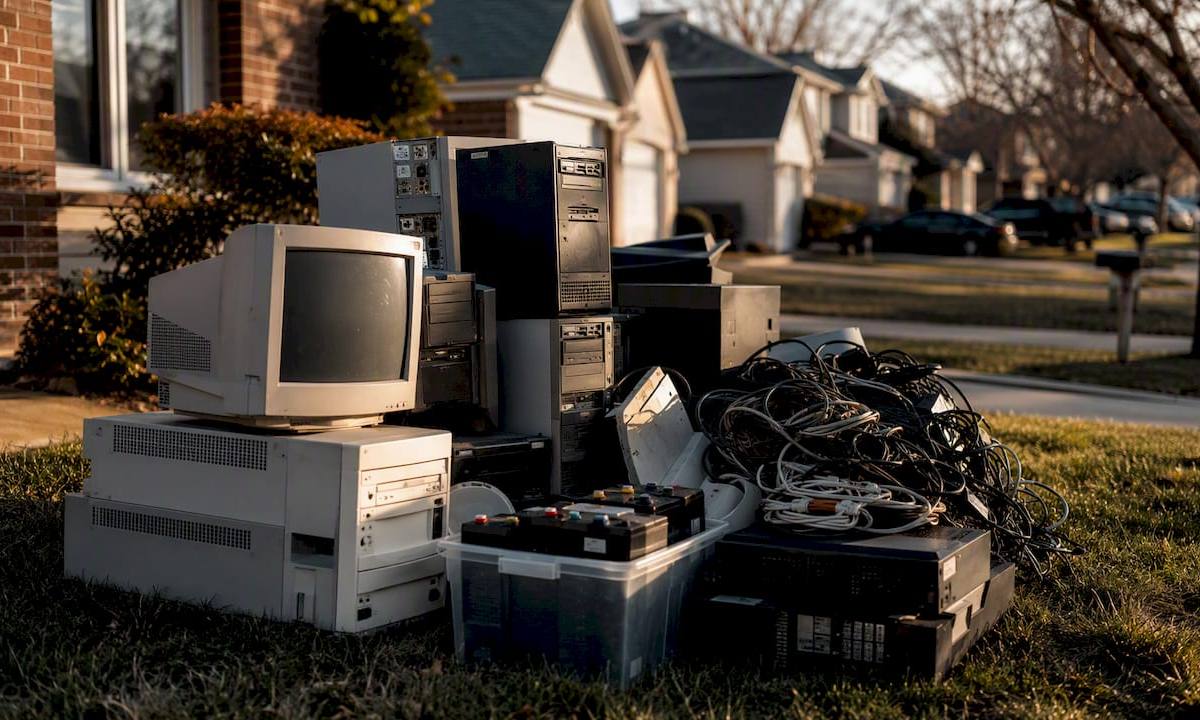
- CRT monitors and tube TVs. Lead content requires specialized processing. Expect a surcharge.
- Large appliances. Refrigerators, washers, and HVAC units usually fall outside standard e-waste pickup scope.
- Certain batteries. Lithium-ion packs and sealed lead-acid batteries need separate handling.
- Fluorescent bulbs and mercury-containing devices. Hazardous material rules apply.
- Large UPS systems. Heavy, battery-laden, and often require advance notice.
Disclose CRTs, large UPS systems, and sealed lead-acid batteries during the estimate stage, not on pickup day. Crews that encounter undisclosed hazardous items may decline them on-site or add a fee that was not in the original quote. A two-minute conversation at booking prevents that friction entirely.
What data security and documentation should you expect?
For any device that stored personal, financial, or business data, require documented chain-of-custody and a Certificate of Destruction or Recycling that states the method and date. That document is your proof that the device was handled correctly — and it transfers liability away from you.
What to verify before the crew loads a single device:
- Downstream recycler certification. Ask whether they use an R2 or e-Stewards certified facility. Pickup services that provide chain-of-custody documentation and Certificates of Destruction are the standard for secure disposition.
- On-site wiping or physical destruction options. Some crews offer hard-drive shredding at the pickup location.
- Serialized asset records. For high-value IT equipment, ask whether each device gets logged by serial number.
- Insured crew. Confirm the provider carries liability insurance that covers both property damage and data incidents.
For property managers and businesses, audit-grade documentation is the primary reason to hire a professional pickup crew rather than a general hauler. A Certificate of Destruction is not a formality — it is the record that protects you if a device’s data surfaces later.
Clients frequently assume data sanitization is included in any haul-away service. It is not. Flag data-bearing devices explicitly at booking and confirm in writing what the crew will do with them.
How Fixmovehaul handles e-waste pickup in Southwest Florida
Fixmovehaul runs on-demand pickup as a concierge service, not a scheduled route. That means you get a crew when you need one — not when a truck happens to be in your neighborhood.
Service scope includes:
- Single-device pickups and whole-house electronic clearouts
- Realtor and property turnover cleanouts with flexible scheduling around listing timelines
- Heavy-item handling for CRT TVs, server equipment, and oversized electronics
- Documented disposal on request, including chain-of-custody paperwork
- Seasonal scheduling for snowbirds who need the property cleared before heading north, including seasonal opening and closing support
Fixmovehaul serves Naples, Bonita Springs, Estero, Lee County, Collier County, and the broader Southwest Florida area. Response times are fast because the crew is local — not dispatched from a regional hub two hours away. For a look at how on-demand junk removal services compare in this market, this breakdown of SWFL providers is worth a read before you book.
How to book a pickup and what happens on the day
Booking is a quick call or online form. You give the crew your location, a rough item list, access notes, and whether any devices need secure destruction. That is enough to get an estimate on the calendar.
Typical timeline:
- Submit your request with item count and address.
- Crew confirms the appointment window — often same-day or next-day for Southwest Florida bookings.
- On-site inspection confirms the final price before any loading begins.
- Crew loads and removes all items; electronics are separated and staged for certified routing.
- Post-job documentation (disposal receipt, Certificate of Destruction if requested) is delivered after completion.
Have ready on pickup day:
- A clear staging area or marked rooms for the crew to work through
- Parking access for the truck (note any HOA restrictions in advance)
- Flagged data devices separated from the general pile
- An on-site contact or keyholder if you will not be present
For same-day pickup scheduling, the booking process works the same way — item list, access, and any special handling notes up front.
The honest take on choosing the right method
Match the method to the pile. A pickup crew makes sense for volume, weight, or data risk. If you have two old monitors and a working car, a drop-off program is faster and free. But the moment you are looking at a garage full of electronics, a property turnover with unknown devices, or anything that touched a business network, a crew is the lower-risk, lower-effort call.
Property managers and realtors especially should not be hauling electronics themselves. Tenant turnover timelines are tight, and a missed disposal step — a laptop left behind, a hard drive not wiped — creates liability that far outweighs the cost of a pickup. Use a local concierge crew to protect the timeline and the paper trail.
One thing worth repeating: always confirm documentation when data-bearing devices are involved. Ask for it at booking, not after the truck leaves.
Fixmovehaul picks up your e-waste in SWFL — here is how to get started
Fixmovehaul offers on-demand e-waste and junk removal across Southwest Florida with insured crews and documented downstream recycling available on request.

A standard visit includes on-site inspection, professional loading, and electronics separated for certified disposal. Need a Certificate of Destruction or Recycling? Request it at booking and it is included in the job. Snowbirds and property managers get flexible appointment windows — including Naples-area pickups and seasonal service scheduling.
To get started, request a free estimate through the Fixmovehaul website. Give the crew your item count, address, and any access notes, and they will confirm a window — often same-day or next-day for Southwest Florida properties.
Sources
The following sources informed the guidance in this article on e-waste pickup thresholds, pricing, documentation, and compliant disposal practices.
- E-Waste Pickup vs Drop-Off: Which Option Works Best? — Rica Recycling
- Pickup Service vs Dropoff for Business E-Waste — iGotEwaste
- Era
- Can Junk Removal Handle IT Disposal in Atlanta? — Fulton Junk Removal