How Much Does Art Hanging Cost? A Homeowner's Guide
How Much Does Art Hanging Cost? A Homeowner’s Guide
Hiring a professional to hang art typically runs within a general range for a standard residential job, with many homeowners paying an amount around the average for a single-piece install, according to Thumbtack’s marketplace data. A gallery wall or multi-room install can push that total to $400–$1,000 or more depending on wall type, piece count, and crew requirements. Before you request a quote, gather the following: photos of each piece, approximate weights, wall material (drywall, plaster, brick), and ceiling heights. That information alone will cut your back-and-forth with installers in half.
Quick reference:
- National typical range: a typical range per project for single piece or small job
- Common service-call/trip fee: a typical range, charged even on small jobs
- Local Southwest Florida option: Fixmovehaul offers insured, on-demand installation in Naples, Bonita Springs, Estero, and across Lee and Collier counties
Key Takeaways
Professional art hanging in the U.S. typically costs $98–$213 per project, with wall type, piece weight, and trip fees being the three variables that most reliably push a quote above or below that range.
| Point | Details |
|---|---|
| National typical range | Most residential jobs fall between $98–$213; many homeowners pay around $143 for a single piece. |
| Trip fee is fixed | A $75–$100 service-call fee applies to nearly every job; bundling pieces into one visit lowers per-piece cost. |
| Wall type drives cost | Stone or masonry installs run $100–$200 per piece vs. $40–$120 on drywall; disclose wall material upfront. |
| Get everything in writing | A proper quote includes scope, hardware, crew size, insurance, damage policy, and a cancellation clause. |
| Fixmovehaul for SWFL | Insured, on-demand installation in Naples, Bonita Springs, Estero, Lee and Collier counties with transparent pricing. |
Table of Contents
- How art hanging cost breaks down by pricing model
- What actually changes the price on your job
- How installers bill and which model protects your budget
- Worked estimation examples you can replicate
- Practical ways to reduce art hanging cost without risking damage
- When to hire a pro and when DIY is a reasonable option
- What to ask installers and what a proper written quote should include
- A local installer’s perspective on what homeowners actually get wrong
- Fixmovehaul handles art hanging and installation across Southwest Florida
- Sources
How art hanging cost breaks down by pricing model
Professional installers use four billing formats, and knowing which one applies to your job changes how you read a quote.
Per-piece pricing
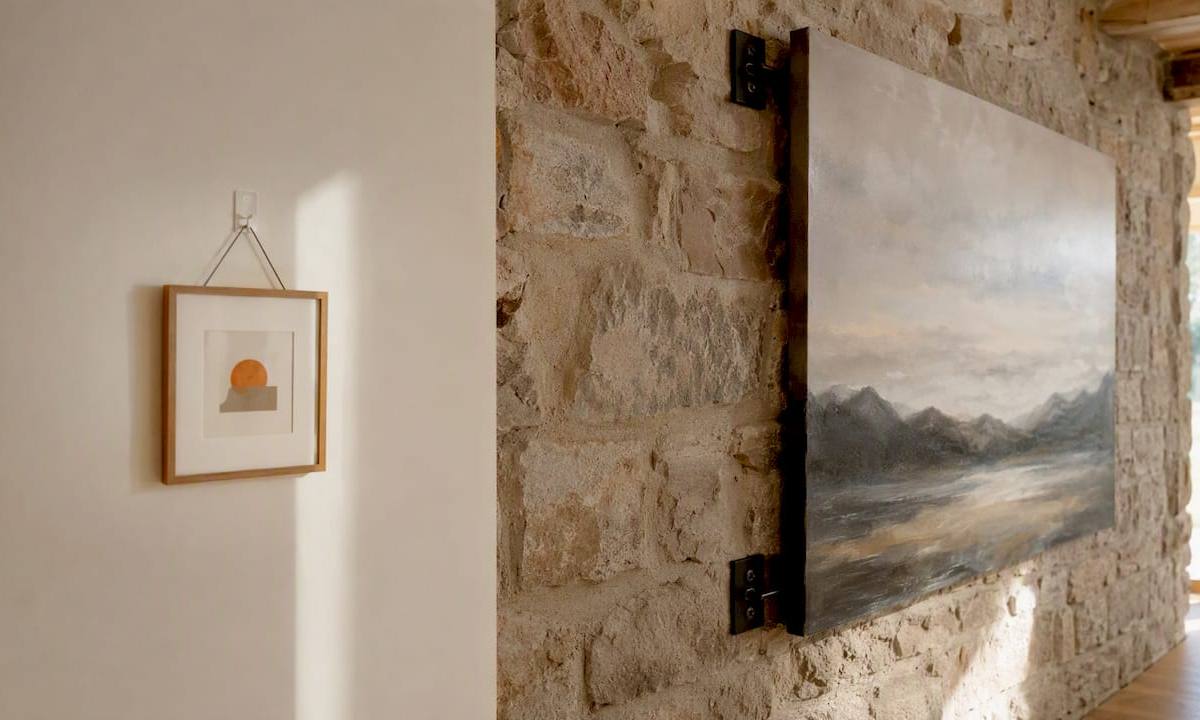
The most common format for residential work. Artwork Archive puts the nationwide single-piece average near $60, but surface type shifts that number significantly: drywall installs typically run $40–$120 per piece, while stone or masonry can reach $100–$200 per piece. A small framed print on standard drywall sits at the low end. A large canvas over a fireplace on a stone surround sits at the high end.
Hourly rates
Hourly billing applies when scope is hard to predict upfront, such as gallery walls with custom layouts or jobs requiring stud-finding, patching, or level adjustments across many pieces. Colorado Art Services and Artwork Archive cite a common hourly band in a typical range per installer. In high-cost cities, that floor rises: NYC-based installers often quote $95–$150 per hour per installer, with two- to three-hour minimums standard even for small jobs.
Flat/project pricing
For whole-home installs or gallery walls where the homeowner wants cost certainty, many installers offer a flat project rate. A small job of one to three pieces in New York commonly runs $200–$450 flat. A gallery wall of five to eight pieces in Los Angeles typically falls within a common price range, according to LA-based pricing data, depending on whether the homeowner supplies the layout plan.
Service-call / trip fee
Almost every installer charges a trip fee, typically within a common fee range, to cover travel, ladders, and basic hardware. On a single small-print job, that fee can represent half the total bill. On a ten-piece install, it’s a minor line item. This is the single strongest argument for bundling multiple pieces into one visit.
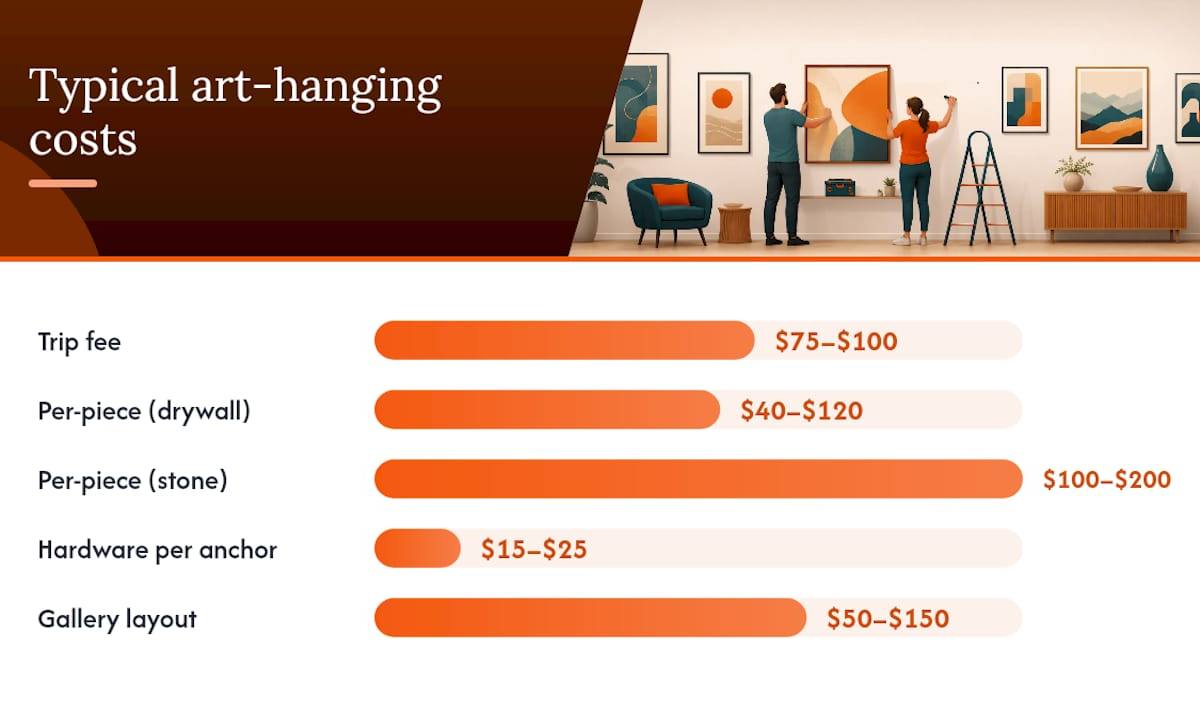
Sample quote line items for a typical residential job:
| Line item | Typical range |
|---|---|
| Trip/service-call fee | $75–$100 |
| Per-piece hang (drywall) | $40–$120 each |
| Per-piece hang (stone/masonry) | $100–$200 each |
| Hardware (anchors, cleats) | $15–$25 per anchor |
| Gallery wall layout time | $50–$150 flat |
| Second installer (heavy/large) | $40–$85/hr additional |
What actually changes the price on your job
Five factors drive most of the variation in art installation cost: the artwork itself, the wall, the site, the equipment needed, and how the piece is handled.
Piece-related factors:
- Size and weight: pieces over 30–50 lb typically require two installers and specialty anchors
- Frame condition: loose joints or fragile gilding slow handling and add time
- Crating or special packaging that must be removed and disposed of on-site
Site-related factors:
- Wall material is disproportionately important. A single masonry hang or a 12-foot-high placement can add more to labor and hardware cost than adding several small pieces to the same visit
- Stairwells, vaulted ceilings, or elevator-only buildings add crew time and sometimes require scaffold rental
- Parking and building access fees in urban buildings often pass directly to the homeowner
Service-related factors:
- Gallery layout and design time: if the installer is arranging the composition, not just executing a plan you provide, expect an additional $50–$150
- Lighting adjustments, picture lights, or seismic/security anchors each add hardware and labor
- Conservation-grade handling (white gloves, acid-free materials) for valuable or fragile pieces
Operational factors:
- Number of pieces per trip: more pieces per visit dilutes the fixed trip fee across the job
- Required crew size: a two-person crew for a 60 lb mirror costs roughly double the labor of a solo hang
- Insurance and building certificate of insurance (COI) requirements, common in condos and managed properties
Pro Tip: A single nonstandard variable, such as a stone wall, a piece over 50 lb, or a job requiring scaffold, often adds more to the total than three or four small add-ons combined. Identify those variables before you request quotes, not after.
How installers bill and which model protects your budget
Each billing model has a logic behind it, and the right choice depends on how well-defined your job is.
Per-piece billing works best when the scope is clear: a fixed number of pieces, known wall types, and no layout decisions left to the installer. You know the ceiling on cost before the crew arrives. The downside is that per-piece rates can feel high on a single-piece job once the trip fee is added.
Hourly billing suits complex or open-ended jobs: gallery walls where you want the installer’s eye for spacing, or multi-room installs where wall conditions vary. The risk is that an underestimate of hours turns a reasonable quote into a surprise invoice. Always ask for a minimum and maximum hour estimate in writing.
Flat/project billing gives the most budget certainty for large jobs. Installers price in a buffer for unknowns, so you may pay slightly more than hourly on a smooth job. On a complicated one, you come out ahead.
When each model saves you money:
- Single piece, known wall type: per-piece pricing is cleanest; ask if the trip fee is included or separate
- Gallery wall with your layout already planned: flat project rate, since the installer’s time is predictable
- Gallery wall where you want design input: hourly, but cap it with a written maximum
- Multi-room, multi-day install: flat project rate; hourly risk compounds across days
- Heavy or specialty piece (mirror, sculpture, large canvas): hourly with a written crew-size and minimum, so you see exactly what two-person time costs
Worked estimation examples you can replicate
These three scenarios use the pricing bands cited throughout this guide. Copy the math into your own quote requests.
Scenario A: Single framed print on drywall
- Piece: 18" x 24" framed print, approximately 8 lb
- Wall: standard drywall, single-story home
- Per-piece rate: $50 (mid-range drywall)
- Hardware: one anchor at $15
- Trip fee: $85
- Estimated total: $150
This is close to the national typical figure of $143 cited by Thumbtack. If you have two or three similar prints ready to hang in the same visit, the trip fee spreads across them and per-piece cost drops to roughly $65–$80 each.
Scenario B: Gallery wall of 8 mixed frames
- Pieces: 8 frames ranging from 8" x 10" to 24" x 30", all under 20 lb each
- Wall: drywall, single room
- Layout: homeowner supplies a paper template (saves $75–$100 in layout time)
- Per-piece rate: $45 average x 8 = $360
- Hardware: 8 anchors at $15 each = $120
- Trip fee: $85
- Estimated total: $565
If the installer provides the layout instead, add $75–$150. If you request hourly billing at $65/hr and the job takes 3 hours, the total is $195 plus hardware and trip fee, or roughly $400. Flat vs. hourly here is close; get both quotes and compare.
Scenario C: Heavy mirror or large canvas on stone or over a fireplace
- Piece: 40" x 60" mirror, 55 lb, mounted over a stone fireplace surround
- Wall: natural stone, requires masonry anchors
- Crew: two installers required
- Per-piece rate (stone): $150
- Hardware: 4 masonry anchors at $25 each = $100
- Two-installer labor (2 hrs at $65/hr each): $260
- Trip fee: $85
- Estimated total: $595
This is where low bids become a liability. NYC installer data shows gallery walls and oversized pieces regularly reach $1,000 or more in high-cost markets. For heavy or valuable pieces, the required crew size and anchoring method mean price functions as a safety investment, not a discretionary line item.
Sample quote request template (copy into an email):
Pro Tip: To convert an hourly quote into a reliable project estimate, ask the installer for their minimum and expected maximum hours. That number is your real budget ceiling.
Practical ways to reduce art hanging cost without risking damage
Cutting picture hanging service cost doesn’t require finding the cheapest installer. It requires reducing the variables that drive labor time.
- Bundle pieces into a single visit. The trip fee is fixed whether you hang one piece or ten. Spreading it across more pieces is the fastest way to lower per-piece cost.
- Supply your own layout plan. A paper template or floor mockup showing exact placement eliminates the installer’s design time, which typically runs $50–$150 extra.
- Prepare pieces before the crew arrives. Remove fragile packaging, have pieces leaning against the correct wall, and note any existing hardware on the back of each frame. Every minute of prep you do is a minute of billable labor you don’t pay for.
- Disclose wall material upfront. Surprises on-site (hidden brick behind drywall, plaster over lath) can trigger mid-job rate changes. Accurate wall information in the quote request prevents that.
- Use standard anchors where the piece allows. Specialty anchors for seismic zones, security mounts, or conservation-grade hardware add $15–$50 per piece. If the piece doesn’t require them, say so explicitly.
- Know when savings are false economy. A piece over 40 lb, a masonry wall, or a ceiling height above 10 feet is not the place to find the lowest bidder. The cost of a dropped mirror or a failed anchor far exceeds the difference between a $95 and a $65 hourly rate.
When to hire a pro and when DIY is a reasonable option
Not every nail in a wall needs a professional. The decision comes down to weight, wall type, and what happens if something goes wrong.
DIY is generally reasonable when:
- The piece weighs under 20 lb and uses standard wire or D-ring hardware
- The wall is drywall and you can locate a stud or use a rated hollow-wall anchor
- The piece has no significant monetary or sentimental value
- Ceiling height is standard (8–9 ft) and no ladder above a step stool is needed
Hire a professional when:
- The piece weighs over 40–50 lb, particularly mirrors, large canvases, or sculptural works
- The wall is plaster, brick, stone, or tile
- The installation is above 10 feet or requires scaffold
- The piece has high monetary or sentimental value and damage would be irreplaceable
- Your building requires a COI from any contractor working on-site
A handyman pricing guide puts the typical residential per-visit range at $65–$150 for standard picture hanging. For many homeowners, that’s a reasonable price to avoid the risk of a misplaced hole, a cracked plaster wall, or a frame that shifts over time.
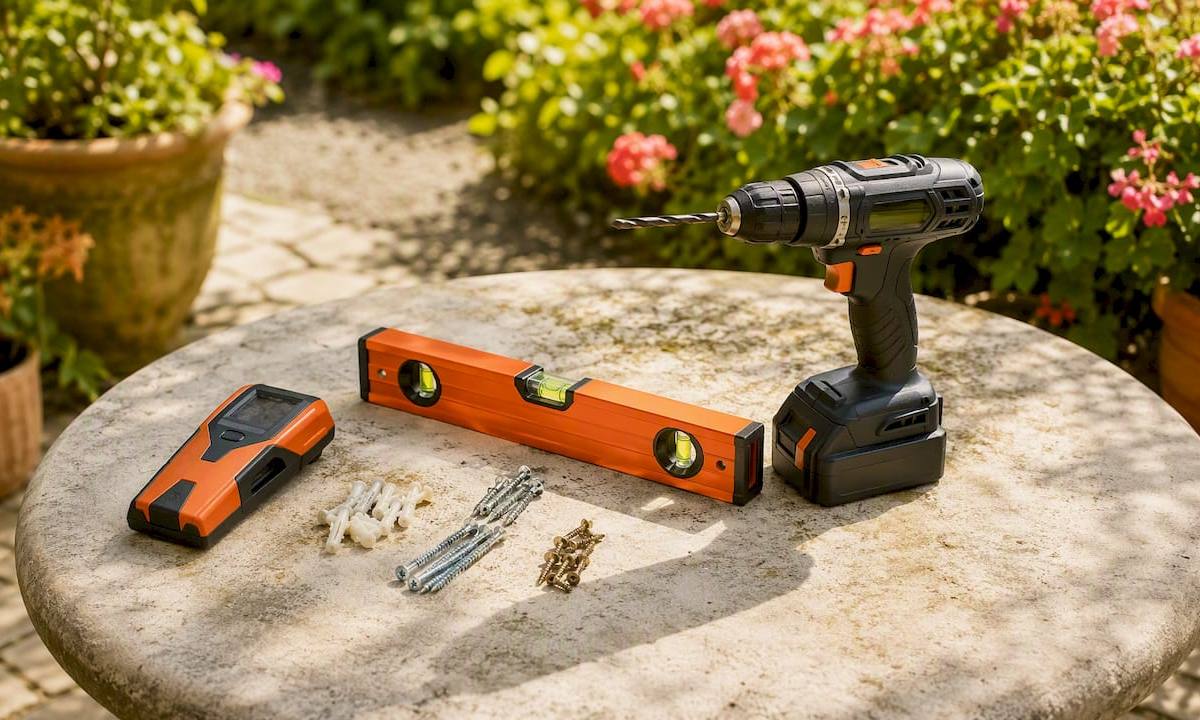
Minimal tools for safe DIY hanging: a stud finder, a torpedo level, a drill with appropriate bit for your wall type, and rated anchors matched to the piece weight.
What to ask installers and what a proper written quote should include
A verbal quote is not a quote. Before any installer starts work, get the following in writing.
Written quote checklist:
- Scope of work: exact number of pieces, locations, and wall types covered
- Hardware: whether anchors, cleats, and hanging hardware are included or billed separately
- Trip fee: stated as a flat amount, not buried in the hourly rate
- Hourly rate and estimated hours: minimum and maximum, not just a single number
- Crew size: one or two installers, and whether the second is billed separately
- Insurance and COI: confirmation the installer carries liability insurance; COI available for managed buildings
- Damage policy: what happens if a wall is damaged or a piece is dropped during installation
- Timeline and cancellation policy: scheduled date, arrival window, and any cancellation fee
Timeline expectations: a single-piece residential job typically takes 30–60 minutes including setup. A gallery wall of 8–10 pieces runs 2–4 hours. A multi-room install may require a half or full day.
Warning signs in a quote:
- No written confirmation of scope or price
- No mention of insurance or COI availability
- A flat rate with no itemization (you can’t verify what’s included)
- A price significantly below the market floor ($40–$65 per visit) with no explanation
- Pressure to book same-day without a site assessment for complex jobs
A local installer’s perspective on what homeowners actually get wrong
The most common mistake homeowners make when budgeting for professional art hanging isn’t underestimating the per-piece rate. It’s forgetting the trip fee entirely, then feeling blindsided when a $50 print costs $135 to hang.
The second mistake is treating all installers as interchangeable. A handyman who hangs pictures as a side service and a dedicated art installer who carries liability insurance, knows how to read a plaster wall, and can source conservation-grade anchors are not the same product at different price points. For a $200 print, the distinction barely matters. For a $4,000 original canvas or a 60 lb antique mirror, it matters considerably.
In Southwest Florida specifically, a few local conditions shape pricing in ways the national averages don’t capture. Coastal homes often have concrete block or stucco-over-block construction rather than standard drywall, which pushes masonry anchor costs into nearly every job. Snowbird-season demand (roughly November through April) compresses scheduling windows, and last-minute installs during peak season sometimes carry a premium. Parking and elevator logistics in high-rise condos along the Naples and Bonita Springs coastline add crew time that flat-rate quotes may not account for.
The homeowners who get the best results are the ones who show up to the quote conversation with a clear plan: photos of each piece, a rough floor plan showing placement, and honest information about wall construction. That preparation doesn’t just save money. It signals to the installer that the job is well-organized, which tends to attract better bids.
Fixmovehaul handles art hanging and installation across Southwest Florida
Skip the guesswork of vetting an unknown installer. Fixmovehaul’s on-demand assembly and installation service covers Naples, Bonita Springs, Estero, and across Lee and Collier counties, with insured crews, transparent flat-rate and hourly pricing, and same-day availability when your schedule demands it.

Whether you’re hanging a single statement piece or setting up a full gallery wall in a seasonal home, Fixmovehaul brings the hardware, handles the wall type, and gives you a written quote before work starts. No surprise fees, no verbal-only agreements. Coastal concrete block walls, high-rise condo COI requirements, and heavy mirrors are all part of the regular workload. Request a quote or book a visit to get a same-day or scheduled installation on your calendar.
Sources
- 2026 Average Art Installation Cost | Get Estimates
- Cost of Your Art Collection: Installation and Conservation | Artwork Archive
- Your 2026 Guide to Art Installation Cost
- How Much Does a Handyman Charge to Hang Pictures and Mirrors? 2026