5 Step COI Check: Hauling Liability and Insurance for SWFL Homes

5 Step COI Check: Hauling Liability and Insurance for SWFL Homes
Any hauling company working in your home should carry general liability (typically $1M per occurrence), commercial auto, cargo coverage, and workers’ compensation if they employ a crew. Before booking, ask for a Certificate of Insurance (COI) showing these policies, their limits, and your name as Additional Insured. Some local providers can supply this on request, and you should never let a truck onto your property without it.
TL;DR:
- Most hauling companies should carry at least $1 million in general liability, commercial auto, cargo insurance, and workers’ compensation, verified by a valid Certificate of Insurance.
- Confirm the COI includes the correct Additional Insured endorsement and ensure it is provided at least 24 to 48 hours before the job to meet property manager requirements.
- For irreplaceable items or high-value jobs, purchase full value protection instead of default released value, and obtain a signed inventory and photos before the move.
- Immediately document any damage with photos, record crew details, and contact the provider promptly to facilitate faster claim processing.
- Independent contractors may lack comprehensive coverage, especially for helpers not classified as employees, increasing your liability risk compared to established firms with full insurance stacks.
Table of Contents
- The Insurance Stack Explained: What Each Policy Actually Protects
- How Do You Verify a Hauler’s Insurance Before Booking?
- Should You Choose Released Value or Full Value Protection?
- What to Do Immediately After Damage or Loss
- Independent Contractors vs. Hauling Companies: Who’s Actually Liable?
- What Should Snowbirds Watch for With Seasonal Hauling?
- What Do Hauling Insurance Policies Typically Exclude?
- A Local Publisher’s Note on Insurance Friction
- Need an Insured Hauler in Southwest Florida? Here’s Where to Start
- Sources
- FAQ
The Insurance Stack Explained: What Each Policy Actually Protects
A one-line “we’re insured” claim tells you nothing. Real protection comes from a stack of separate policies, each covering a different failure point, and knowing what each one does lets you spot gaps before they become your problem.
General liability covers property damage and third-party injuries that happen during the job. If a crew member scrapes your hardwood floor dragging a sectional sofa, or a neighbor trips over a ramp left in the driveway, this is the policy that pays. Industry guidance treats $1M per occurrence and $2M aggregate as the common baseline, and anything lower should raise questions.
Commercial auto is a separate animal from a personal car policy. Personal auto insurance almost universally excludes business use, so a hauler running paid jobs on a personal policy risks a denied claim if their truck causes an accident with your furniture inside it. Commercial auto covers liability, collision, and comprehensive damage specific to business driving.
Cargo, or motor truck cargo insurance, protects the items being transported, separate from valuation selection, which determines how much you can recover if something breaks. Local residential jobs typically carry cargo limits in the range recommended by moving insurance guidance, though the number should scale with the value of what’s being moved.

Workers’ compensation matters more than most homeowners realize. If a hauler misclassifies employees as contractors to skip this coverage, an injured worker on your property could sue you directly. Ask whether the crew are W-2 employees covered under a workers’ comp policy.
Two more pieces round out a solid stack:
- Inland marine coverage protects tools and equipment (dollies, straps, power tools) against theft or damage, which matters when a provider stores gear between jobs.
- Umbrella coverage extends liability limits beyond the base policy. HOAs and luxury property managers in Southwest Florida sometimes require $2M to $5M in umbrella protection before granting building access.
Cost is a useful sanity check. Solo one-truck hauling operators typically pay $1,200 to $3,600 annually for a baseline package, with multi-truck operations paying considerably more. A company quoting rock-bottom prices while claiming full coverage across all five policy types is worth a second look.
How Do You Verify a Hauler’s Insurance Before Booking?
Verification takes ten minutes and saves you from a denied claim later. Here’s the sequence that works:
- Request the Certificate of Insurance (COI) in writing. Do not accept a verbal “yes, we’re insured.” The COI should list the insurer’s name, policy numbers, policy types, coverage limits, and effective dates.
- Confirm the Additional Insured endorsement language, not just your name on the certificate. A COI can be issued casually, but the Additional Insured endorsement is the binding document insurers actually rely on when a claim comes in.
- Check the timing window. Most buildings and condo associations want the COI 24 to 48 hours before move day; some HOAs push that to 72 hours. Property managers commonly enforce this and will turn a truck away without it.
- Call the insurer or broker directly using the contact information on the COI, not a number the hauler gives you separately. Ask them to confirm the policy is active and matches the limits shown.
- Write down the broker’s name and callback number. If a dispute happens later, this saves you from starting the verification process over.
Watch for red flags that should stop a booking cold: an expired policy date, coverage limits that don’t match what was promised verbally, a provider who won’t share their insurer’s contact information, or no mention of workers’ compensation for a multi-person crew.
Pro Tip: If your building requires Additional Insured naming, ask specifically for the endorsement PDF by name. Some haulers will send a generic COI template and hope nobody checks for the actual endorsement language behind it.
For property managers dealing with vehicle-heavy jobs regularly, a fleet insurance checklist is worth keeping on file alongside your standard COI request.
Should You Choose Released Value or Full Value Protection?
Released value is the default valuation option, and it costs nothing extra, but it pays out based on weight, not actual worth. A 200-pound antique dresser and a 200-pound flat-pack bookshelf get the same payout under released value, even though one might be worth ten times the other.
Full Value Protection requires an added premium but substantially increases what you can recover if something is lost or damaged. For everyday furniture and boxed household goods, released value is usually fine. For anything irreplaceable, upgrade.
Ask for higher declared value coverage, or buy supplemental third-party moving insurance, when the job involves:
- Fine art, antiques, or family heirlooms with sentimental or appraised value
- Pianos or other single items worth more than the standard cargo limit
- Large electronics like OLED televisions or home theater systems
- Corporate relocations or property manager jobs where a client’s liability policy demands higher declared limits
Before the truck leaves, collect four things: a declared value receipt, a written inventory list, timestamped photos of high-value items, and your signature on whichever valuation option you chose. That paperwork is what turns a dispute into a straightforward claim.
What to Do Immediately After Damage or Loss
Speed and documentation decide how smoothly a claim goes. Follow this sequence the moment you notice damage:
- Photograph everything before moving it further. Get the damage, the surrounding area, and any packaging still attached.
- Separate the damaged item from the rest of your belongings so it doesn’t get boxed away or thrown out by accident.
- Record the crew’s names, the truck ID, and the exact time. Note your job ticket number if one was issued.
- Call the provider’s operations line first, not a general customer service number, and ask for their claims contact or broker information.
- Contact your own insurer if you carry supplemental homeowner’s or renter’s coverage, since some policies offer overlapping protection.
Expect the insurer to ask for the COI, your valuation selection, the original invoice, and your photos. Investigations on straightforward claims typically move faster with complete documentation; incomplete paperwork is the most common reason a claim drags on.
If the damage affects building common areas, or the provider can’t produce a valid COI after the fact, loop in your property manager immediately. For unresolved disputes over a few thousand dollars, small claims court is often faster and cheaper than hiring an attorney.
Independent Contractors vs. Hauling Companies: Who’s Actually Liable?
The legal difference between hiring an independent solo hauler and booking through an established company comes down to who holds the policy, and who’s accountable if it lapses.
A single independent operator with one truck may carry general liability and commercial auto, but if they hire a friend to help lift furniture without adding them to a workers’ compensation policy, that helper is uninsured on your property. If that helper gets hurt, you could be pulled into a liability claim simply because the injury happened on your premises.
An established hauling company typically carries the full stack, general liability, commercial auto, cargo, and workers’ compensation, across its entire crew, because it’s structured as an ongoing business rather than a side job. That doesn’t automatically make every company reliable, but it does mean the paperwork trail is usually cleaner and easier to verify.
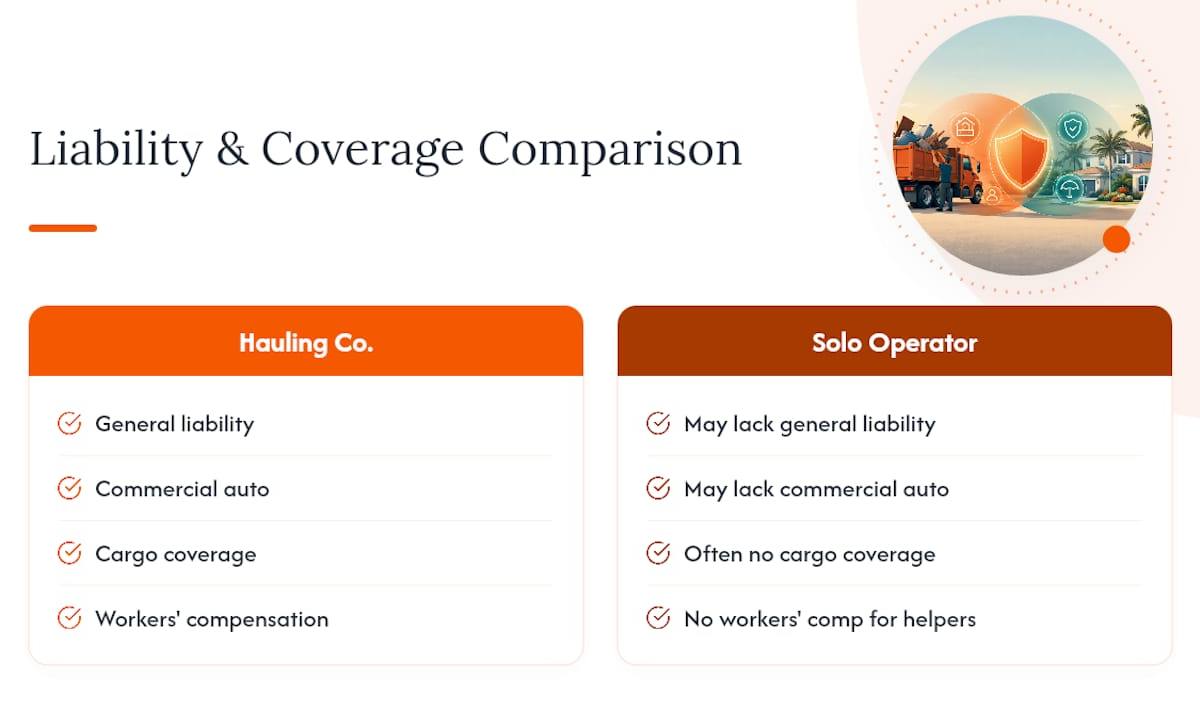
The practical takeaway: don’t assume “insured” means the same thing for every type of provider. A solo contractor advertising low prices may be personally liable in a way that leaves you exposed if their coverage doesn’t extend to whoever they bring along. Ask the same COI and Additional Insured questions regardless of whether you’re hiring one person or a full crew, and treat vague answers about employee status as a warning sign.
What Should Snowbirds Watch for With Seasonal Hauling?
Seasonal residents face a liability gap that full-time homeowners don’t: nobody’s watching the property when the job happens. If you’re hiring movers or a junk removal crew to prep your Southwest Florida home before you fly in for the season, you’re often trusting the entire verification process to a property manager, a neighbor, or a phone call from out of state.
That distance creates real risk. You can’t personally check a COI at the door, confirm Additional Insured wording, or photograph damage in real time. If a hauler shows up without proper coverage and something goes wrong, resolving it from another state or country takes longer and costs more in back and forth.
The fix is procedural: request the COI and Additional Insured documentation by email before the job is scheduled, not on arrival day. Give your property manager explicit written authority to reject an uninsured crew rather than leaving it to their judgment on the spot. If you’re opening or closing a seasonal home and coordinating multiple services (junk removal, furniture delivery, a cleanout) in a single window, verify insurance for every provider separately. Bundled arrangements sometimes blur who’s actually liable if damage happens during a multi-service visit.
What Do Hauling Insurance Policies Typically Exclude?
Insurance policies protect against specific risks, not every possible bad outcome, and the exclusions matter as much as the coverage.
General liability policies commonly exclude damage from pre-existing conditions. If a floor was already scratched, insurers won’t pay to “repair” damage that predates the move. Cargo coverage often excludes items packed by the owner rather than the crew, sometimes called a “customer-packed” exclusion, so boxes you packed yourself may not be covered the same way as items the hauler wrapped and loaded.
Interstate moves fall under different rules entirely. The Federal Motor Carrier Safety Administration sets separate minimum insurance requirements for carriers crossing state lines, which are typically higher than what a local residential hauler carries. If you’re moving a snowbird property between two states, don’t assume your local hauler’s coverage automatically applies.
Cargo limits also cap recoverable value per shipment, meaning a single high-value item can exceed the policy’s per-load ceiling even when the hauler is fully insured. And workers’ compensation typically only covers classified employees, not day-labor helpers picked up informally, which circles back to why confirming crew classification matters before the truck arrives.
A Local Publisher’s Note on Insurance Friction
Some providers have built their booking process around common problems like property managers and HOAs rejecting trucks at the gate over missing paperwork. These providers may offer COIs with Additional Insured language on request and communicate directly with building staff when timing is tight, sometimes on the same day.
Whoever you book with, ask for the COI and Additional Insured wording before move day, not after the truck is already in the driveway. A five-minute email saves everyone a wasted trip.
— Mark
Need an Insured Hauler in Southwest Florida? Here’s Where to Start
Fixmovehaul handles junk removal, furniture delivery, and moving help across Naples, Bonita Springs, Estero, and the rest of Southwest Florida, and Certificates of Insurance with Additional Insured naming are available on request, not buried behind a callback chain. You deal directly with a local operator, not a national dispatcher, which means the person confirming your COI timing is the same person scheduling your truck.

If you’re prepping a property before flying in for the season, coordinating a listing for a realtor client, or just need a couch out of the house before the weekend, request a quote and ask for the COI when you book. Check current pricing and service bundles on the pricing page, or go straight to booking a job that needs insured hands on-site.
Sources
State insurance requirements vary, and a licensed agent can give binding advice specific to your situation. For broader context, the Federal Motor Carrier Safety Administration publishes interstate carrier requirements, while industry guides on moving business insurance and junk removal insurance costs outline typical local policy limits and pricing.
- Moving Business Insurance Requirements (2026)
- Junk Removal Insurance: What You Actually Need and What It Costs in 2026 - Service Anchor
- COI Playbook 2026 | Moving Certificate of Insurance Complete Guide | Muscleman Moving
- The Complete Guide to Moving Company Insurance | Elromco
FAQ
What insurance should a hauling company have?
At minimum, expect general liability (often $1M per occurrence), commercial auto, cargo coverage, and workers’ compensation if the crew includes employees. Ask for a Certificate of Insurance listing all four before booking.
Are movers insured for damage they cause?
Yes, through general liability for property damage and cargo insurance for the items being transported, though payout amount depends on which valuation option was selected. Released value pays based on weight, while Full Value Protection pays closer to actual worth.
How much does Fix Move Haul charge for hauling services?
Junk removal and hauling starts from $99, furniture delivery and pickup from $79, and moving help from $79, with full pricing details on the pricing page.
What is a Certificate of Insurance and why do I need one?
A COI is a document listing a provider’s insurance policies, limits, and effective dates, and it’s the standard proof buildings and HOAs require before granting access. It should also show your name under Additional Insured if the job happens inside a managed property.
What should I do if a hauler damages my property?
Photograph the damage immediately, record the crew names and job ticket number, and contact the provider’s operations line to start a claim. Keep your COI, valuation selection, and photos ready since the insurer will request all of them during the investigation.