How to Hang a Heavy Mirror Safely on Any Wall
How to Hang a Heavy Mirror Safely on Any Wall
For most heavy mirrors, the safest bet is mounting into wall studs with a French cleat or a pair of heavy-duty stud screws. If you can’t hit studs, snap toggles or toggle bolts rated for the load are your backup, and mirror clips work well for framed pieces on masonry or tile. Anything over 100 pounds, oddly shaped, or headed above a fireplace mantel is a strong candidate for professional installation. Whatever method you choose, always rate your hardware well above the mirror’s actual weight and use at least two fasteners. A single point of failure on a 60-pound piece of glass isn’t a risk worth taking.
Key Takeaways
Hanging a heavy mirror safely comes down to mounting into studs whenever possible, using two rated fasteners, and matching hardware to an honest weight estimate.
| Point | Details |
|---|---|
| Weigh it first | Use the scale method to get an accurate weight before choosing any hardware. |
| Studs beat drywall alone | A French cleat or lag screws into two studs handles most mirrors over 50 lbs. |
| Match hardware to wall type | Use toggle bolts for hollow drywall, masonry anchors for tile or brick. |
| Always use two fasteners | Redundancy prevents single-point failure and keeps the mirror level over time. |
| Call a pro for heavy or awkward jobs | Fixmovehaul offers same-day mirror mounting and hardware assessment across Southwest Florida. |
Where to Learn More About Safe Mirror Installation
- The Spruce: cleat diagrams and wire-versus-cleat comparisons
- This Old House: plaster wall techniques and fastener redundancy
- True Value Hardware: molly bolt and toggle bolt installation specs
- 3M: no-drill hanger weight capacities
- The Toolbox Pro: typical professional pricing ranges
Table of Contents
- Tools and Materials You Need Before You Start
- How Much Does Your Mirror Actually Weigh?
- Which Mounting Method Fits Your Wall?
- Step-by-Step: Two Reliable Ways to Hang a Heavy Mirror
- Common Mistakes That Cause Mirrors to Fall
- When Should You Call a Professional Instead?
- Frequently Asked Questions
- Sources
Tools and Materials You Need Before You Start
Gather everything first. Running to the hardware store mid-project with a mirror leaning against your wall is how scratches and cracked frames happen.
Tools: stud finder, drill with a mixed bit set, 4-foot level, tape measure, pencil, and a helper (or a lift strap for solo jobs on mirrors over 40 pounds).
Hardware, by situation:
- French cleat, metal or wood, for large frame-backed mirrors
- Heavy-duty D-rings and lag screws for stud mounting
- Toggle bolts or snap toggles for hollow drywall without stud access
- Masonry anchors for brick or concrete
- Braided stainless steel wire for lighter mirrors under roughly 25 pounds
Safety items: work gloves, safety glasses, furniture pads for the frame edges, and a second set of hands. Pro Tip: Check the weight rating printed on toggle bolt and anchor packaging before you buy. A mismatch between screw length and stud depth is one of the most common reasons hardware pulls loose within the first year.
How Much Does Your Mirror Actually Weigh?
You can’t pick the right hardware without an honest weight estimate, and eyeballing it is a mistake most people make once. Framed mirrors over 3 feet often run 40 to 80 pounds; large floor mirrors and heavy antique frames can top 100.
Pro Tip: Stand on a bathroom scale holding the mirror, note the number, then weigh yourself alone and subtract. It takes 30 seconds and gives you a real figure instead of a guess.
Once you have a weight, build in a margin:
- Under 20 lbs: standard picture hooks or wire, rated to at least 30 lbs
- 20 to 50 lbs: toggle bolts or D-rings rated to 75 lbs minimum
- 50 to 100 lbs: French cleat or lag screws into studs, rated well above 150 lbs
- Over 100 lbs: stud mounting only, or a professional install
Frame depth matters too. A deep, heavy frame shifts the center of gravity forward, which puts more torque on your top fasteners than a thin, flat mirror of the same weight.
Which Mounting Method Fits Your Wall?
Your wall type decides your hardware more than your mirror’s weight does. Here’s how the main wall types break down.
Solid studs behind drywall are the gold standard. A French cleat bolted into two or more studs, or a pair of heavy-duty lag screws through D-rings, handles almost anything you’ll hang in a residential home. Metal cleats interlock and stay flush, which eliminates the slow drift and tilt you get with wire over time.
Hollow drywall without stud access calls for toggle bolts or snap toggles. These anchors spread load across the back of the drywall panel instead of relying on the panel’s surface strength, and they can support 40 to 75 pounds depending on the model.
Plaster walls behave differently than drywall. They’re often harder to drill into cleanly, so toggle bolts with picture hooks are the recommended approach, and using two fasteners for redundancy matters even more here.
Tile and masonry need masonry anchors rated for the substrate, drilled with a carbide bit. Mirror clips are a strong option here too, especially for frameless or beveled mirrors where you don’t want visible hardware.
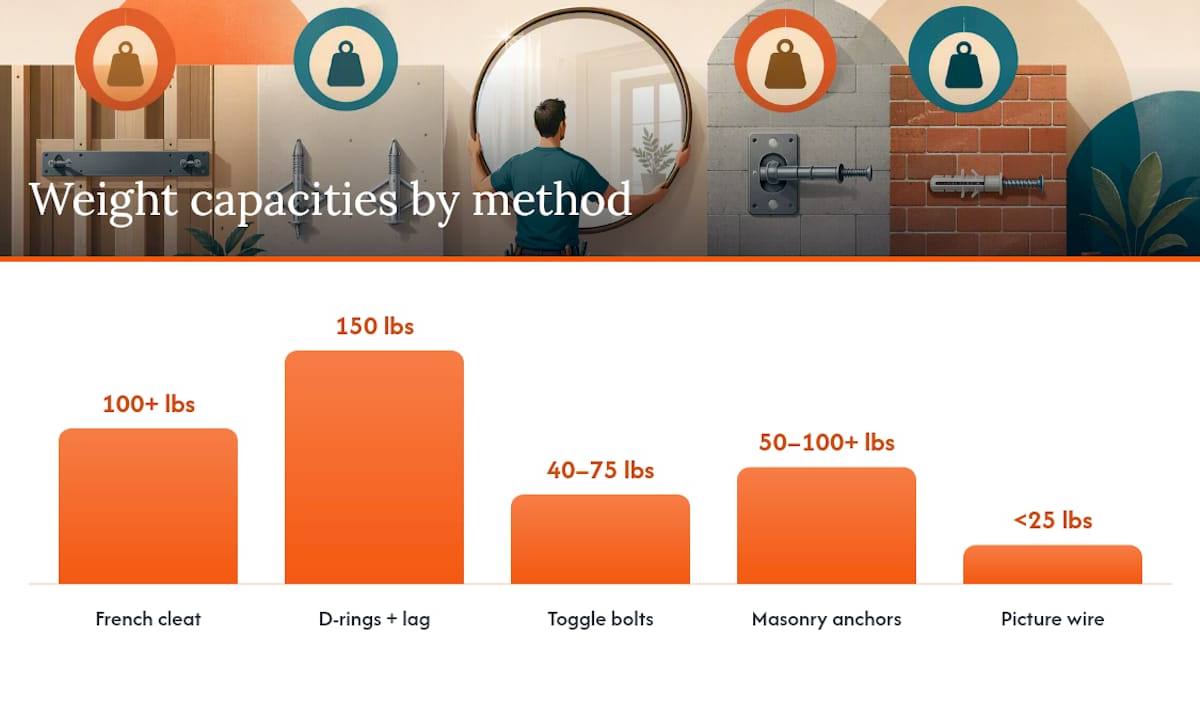
Here’s how the common methods compare:
| Method | Best for | Difficulty | Weight capacity |
|---|---|---|---|
| French cleat | Large framed mirrors, stud walls | Moderate | 100+ lbs |
| D-rings + lag screws | Framed mirrors, stud walls | Easy to moderate | Up to 150 lbs |
| Toggle bolts / snap toggles | Hollow drywall, no studs | Moderate | 40 to 75 lbs |
| Mirror clips | Frameless or beveled mirrors, tile/masonry | Moderate | Varies by clip rating |
| Masonry anchors | Brick, concrete, tile backer | Harder | 50 to 100+ lbs |
| Picture wire | Small, light mirrors | Easy | Under 25 lbs |
Wire offers the most flexibility for adjusting a mirror’s tilt after hanging, but it’s also the method most prone to stretching and drift. Cleats sacrifice that adjustability for a flush, stable mount that doesn’t move once it’s set.
Step-by-Step: Two Reliable Ways to Hang a Heavy Mirror
Both methods below start the same way. Find your studs with a stud finder, mark their centers, then measure and mark where the top of the mirror will sit. Use a level to draw a horizontal reference line across your marks before you drill anything.
Method 1: French cleat
- Attach the mirror-side cleat piece to the back of the frame with screws long enough to bite securely without poking through the front.
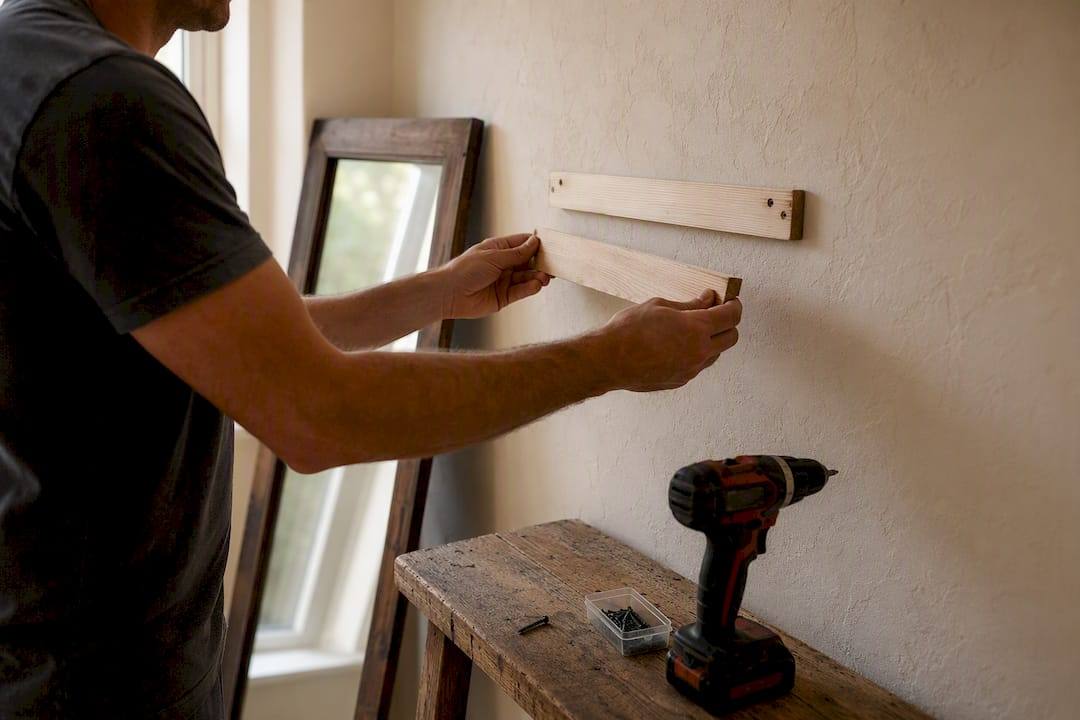
- Mount the wall-side cleat across at least two studs, screwed in level along your reference line.
- Lift the mirror and hook the cleat pieces together. They should engage with an audible, solid seat.
- Check level again, then add a small block or bumper at the bottom corners to stop the mirror from swinging out at the base.
Method 2: D-rings and stud screws
- Attach heavy-duty D-rings to the frame at roughly one-quarter down from the top, pre-drilling pilot holes to avoid splitting the wood.
- Drive lag screws into the marked stud centers, leaving about a quarter inch of screw head exposed if you’re hanging directly on the screws rather than wire.
- Loop braided stainless steel wire between the D-rings, or lift the mirror directly onto the exposed screw heads.
- Level the mirror and adjust wire tension evenly on both sides.
Pro Tip: For anything over 60 pounds, use three points of contact instead of two. A third screw at the bottom center of the frame stops the mirror from pivoting forward off the wall, which is the failure mode that actually causes injuries.
Common Mistakes That Cause Mirrors to Fall
The failures that send mirrors crashing down almost never come from bad luck. They come from a handful of repeatable mistakes.
- Relying on drywall screws alone. They’re brittle and weren’t designed as hanging fasteners, and they shear under sustained weight.
- Using a single wire point on a mirror over 30 pounds instead of two anchors.
- Skipping the stud finder and eyeballing “close enough.”
- Ignoring bottom support on tall, top-heavy frames, which lets them tip forward over time.
- Hanging a heavy mirror solo, without a spotter to steady it while you secure the final fastener.
After installation, check the fasteners for tightness after the first week, watch for hairline cracks or crumbling drywall around the anchor points, and re-check level every six months in humid climates where wood frames can shift slightly. If you ever see the mirror sitting even a few degrees off from where you hung it, treat that as an early warning sign, not a cosmetic annoyance.
When Should You Call a Professional Instead?
Some jobs are genuinely better left to someone with the tools, hardware, and second pair of hands already lined up, especially when dealing with oversized interior door installation challenges. Call a pro if:
- The mirror weighs more than 100 pounds
- It’s an odd shape, frameless, or beveled with no clear mounting point
- You’re placing it high, over a fireplace, or in a stairwell
- Your wall is tile, stone, or masonry and you don’t have a hammer drill
- You don’t have a helper and can’t safely lift and hold the mirror alone
A handyman typically charges $100 to $200 to hang a single large mirror, depending on weight and wall type, with pricing rising for reinforcement work or masonry drilling. A good pro will weigh the mirror, assess your wall, supply or recommend the right anchors, reinforce studs if needed, and clean up afterward. Fixmovehaul handles exactly this kind of job across Southwest Florida, alongside related work like furniture assembly and installation for homeowners who’d rather not spend a Saturday drilling into plaster.
What I’ve Learned Watching These Jobs Go Wrong
The mirrors that fail almost never fail because someone used the wrong anchor. They fail because someone measured once, trusted it, and skipped the second check. Frame depth is the sneaky variable: a deep, heavy frame changes where your cleat needs to sit relative to the mirror’s true center of gravity, and that shift is easy to miss on a first attempt. Redundancy, that second fastener you didn’t think you needed, is what actually saves your drywall six months later.
A Faster, Safer Option: Let Fixmovehaul Handle the Install
If you’d rather skip the stud finder and the ladder, Fixmovehaul offers on-demand mirror mounting and installation across Naples, Bonita Springs, and the rest of Southwest Florida, often with same-day availability.

A booking includes a quick hardware assessment based on your mirror’s weight and wall type, secure mounting with properly rated anchors, and cleanup when the job’s done. If you just picked up a new mirror from Home Depot or Lowe’s, Fixmovehaul’s pickup and delivery service can bring it home and mount it in the same visit, so you skip the round trip and the guesswork entirely. Book a visit and get it hung right the first time.
Frequently Asked Questions
What is the safest way to hang a heavy mirror? Mounting into wall studs with a French cleat or heavy-duty D-rings and lag screws is the safest approach for most mirrors over 40 pounds. It distributes weight into the wall’s structural framing rather than the drywall surface alone.
How much weight can a toggle bolt hold on drywall? Most snap toggles and toggle bolts hold between 40 and 75 pounds per anchor, depending on the model and drywall thickness. Always use two for a mirror, even if one alone meets the rated weight.
Can I hang a heavy mirror without finding a stud? Yes, using toggle bolts or snap toggles rated for your mirror’s weight, or mirror clips for framed and beveled pieces. Stud mounting remains the stronger option for anything approaching 75 to 100 pounds.
Is picture wire strong enough for a heavy mirror? Braided stainless steel wire works for mirrors up to roughly 25 to 30 pounds, but heavier pieces are better served by a cleat or direct D-ring mounting, since wire can stretch and let the mirror tilt over time.
How much does it cost to have a mirror professionally hung? Expect to pay $100 to $200 for a single large mirror, with costs rising for masonry walls or reinforcement work.
Sources
- How to hang a heavy mirror — This Old House
- How to Hang a Heavy Mirror — The Spruce
- How to Hang a Mirror or Heavy Picture — True Value Hardware
- How to hang heavy mirrors & frames without nails — 3M
- How Much Does a Handyman Charge to Hang Pictures and Mirrors? — The Toolbox Pro