Estate Cleanout Checklist: A Step-by-Step Guide for Executors

Estate Cleanout Checklist: A Step-by-Step Guide for Executors
Confirm your legal authority, secure the property, and gather the death certificate and will before you move a single box. From there, the process runs in order: inventory every room, sort into keep, donate, sell, or trash, get high-value items appraised, then dispose and clean. Expect several weeks of work, and know that hiring help for the physical labor is a normal, smart move, not a shortcut.
TL;DR:
- The estate cleanout process typically takes several weeks for a standard home, but can extend beyond two months if there is hoarding, collectibles, or family disputes.
- Confirm legal authority with court documents before securing, photographing, or removing any property or valuables to avoid conflicts and liability.
- Use a detailed inventory system with photos and a four-category sorting method to prevent items from being overlooked or misplaced during the process.
- Professional appraisals are recommended for high-value items like art, jewelry, and antiques to accurately determine worth and avoid undervaluing or overpricing assets.
- Appropriate disposal and donation channels, including hazardous waste handling and charity pickups, are essential to legal compliance and responsible estate clearing.
Table of Contents
- What Does an Estate Cleanout Actually Involve?
- Before You Touch Anything: Confirm Authority and Secure the Property
- How Do You Inventory and Sort an Entire House?
- Which Items Need a Professional Appraisal?
- Estate Sale, Auction, Consignment, or Buyout: Which Liquidation Path Fits?
- Donations, Recycling, and Safe Disposal of What’s Left
- Dumpsters, Junk Removal Crews, and How to Get an Accurate Quote
- Closing Out the Cleanout: Cleaning, Accounting, and Final Turnover
- Fix. Move. Haul.'s Perspective on What Executors Actually Need
- Get Help With Your Estate Cleanout in Southwest Florida
- Where to Go for Official Disposal and Donation Guidance
- Sources
What Does an Estate Cleanout Actually Involve?
An estate cleanout is the process of clearing a deceased person’s home of its contents so the property can move through probate, sale, or transfer to heirs. It sounds like a moving job. It’s actually a legal and financial task disguised as one, because every item you touch may need to be accounted for in the estate’s final record.
If you’re the executor or administrator, you have a fiduciary duty to the beneficiaries. That means documenting what existed, where it went, and what it was worth, not just hauling things to the curb. Skipping this step is how family disputes start, and it’s how executors end up personally liable for missing or undervalued assets.
A few things shape how long this takes:
- A typical 2 to 3 bedroom home takes several weeks to fully clear, sort, and document, depending on how much help you have.
- Homes with a lot of collectibles, paperwork, or hoarding-level clutter can stretch past two months.
- Family disagreements or delayed probate approval add time you can’t fully control.
Build in more time than feels necessary. Grief slows decisions down, and rushing an estate cleanout checklist is how mistakes happen.
Before You Touch Anything: Confirm Authority and Secure the Property
Nothing in the house belongs to you yet, even if you’re the named executor. Move too fast without the right paperwork and you risk conflicts with other heirs or the court.
Start with these steps, in order:
- Confirm your legal authority. You need Letters Testamentary or a court appointment before you can legally act on the estate’s behalf. If the will is unclear or contested, talk to a probate attorney before doing anything else.
- Order certified copies of the death certificate. Request multiple certified copies. Banks, insurers, the DMV, and utility companies will each want their own original.
- Locate the will or trust, deeds, vehicle titles, insurance policies, and recent bank and investment statements. These documents drive everything that follows, including who has claim to what.
- Secure the property immediately. Change or rekey the locks, forward the mail through USPS, and notify the homeowner’s insurance carrier that the property is now vacant. An unoccupied home with the same locks and a mail pileup is an open invitation to theft.
- Photograph the entire property before anyone removes anything. This protects you if a family member later claims something is missing.
- Pull small valuables out first. Jewelry, cash, firearms, small safes, and spare keys should come out of the house early and go somewhere secure, before a parade of family members and cleanout crews start moving through the rooms.
Pro Tip: Keep a single folder, physical or digital, with every death certificate copy, the will, and a running log of who you’ve contacted. You will use this folder more than any other document during the entire cleanout.
If you’re at all unsure whether you have the legal standing to authorize a locksmith or sign a disposal contract, a short call to a probate attorney is worth more than the hour it takes.
How Do You Inventory and Sort an Entire House?
Every room needs a photo, a log entry, and a decision. That’s the whole system, repeated dozens or hundreds of times.
Set up your inventory spreadsheet first. Columns should include: item description, room, condition, maker or markings (for furniture, art, and collectibles), estimated value, and disposition (keep, donate, sell, trash). Photograph each item or grouping before it moves, and number the photos to match spreadsheet rows. This kind of documented, photo-backed inventory is exactly what reduces probate disputes later and gives you a paper trail if an insurance claim ever comes up.

Work room by room, not category by category. Jumping between rooms to chase similar items sounds efficient but it’s how things get missed.
Use a four-category system for every single item:
- Keep — items designated for specific heirs or family use, tagged immediately with the recipient’s name.
- Donate — usable goods with no resale value worth the effort of selling.
- Sell — items worth listing individually, through an estate sale, auction, or online.
- Trash — genuinely unusable items, including anything damaged beyond repair or expired.
Color-coded stickers or labeled boxes for each category keep the sorting visible and prevent the same item from getting moved twice. Check the obvious hiding spots too: under mattresses, inside coat pockets, taped to drawer bottoms, and in freezer bags. Older generations hid cash and documents in strange places more often than you’d expect.
If the will names specific bequests (“my sister gets the piano”), pull those items aside and label them before the general sort begins. This avoids the awkward moment of a sold item turning up as something someone else was legally owed.
Pro Tip: Schedule one family walk-through, set a firm deadline for claims (a week is reasonable), and require signed receipts for anything family members take. A receipt with a date, item description, and signature is the cheapest insurance you’ll buy against a future dispute.
Which Items Need a Professional Appraisal?
Some things in the house are worth more than they look, and guessing wrong costs the estate money either way. Underprice a painting and you shortchange the heirs. Overestimate a coin collection and you delay the sale while buyers balk.
Categories that typically warrant a professional appraisal:
- Fine art, original prints, and sculpture
- Jewelry, especially anything with gemstones or unmarked gold
- Coin and stamp collections
- Antique furniture with unclear provenance
- Musical instruments, particularly stringed instruments and pianos
- Firearms, especially antiques or collector models
Look for appraisers with credentials from the ISA (International Society of Appraisers) or ASA (American Society of Appraisers), and confirm they follow USPAP (Uniform Standards of Professional Appraisal Practice). A proper appraisal report should include the item’s description, condition, valuation method, comparable sales data, and the appraiser’s signature and credentials, not just a number on a page.
Appraisal costs vary by item type and complexity, so ask for a written estimate before committing, and clarify whether the fee is flat or based on a percentage of appraised value (the latter is a conflict of interest some professional bodies discourage). For less unusual items, auction house estimates or dealer consignment offers can substitute for a formal appraisal when you just need a reasonable sense of value before deciding whether to sell.
Estate Sale, Auction, Consignment, or Buyout: Which Liquidation Path Fits?
The right liquidation method depends on how much time you have and how much net return matters versus how fast you need the house empty.
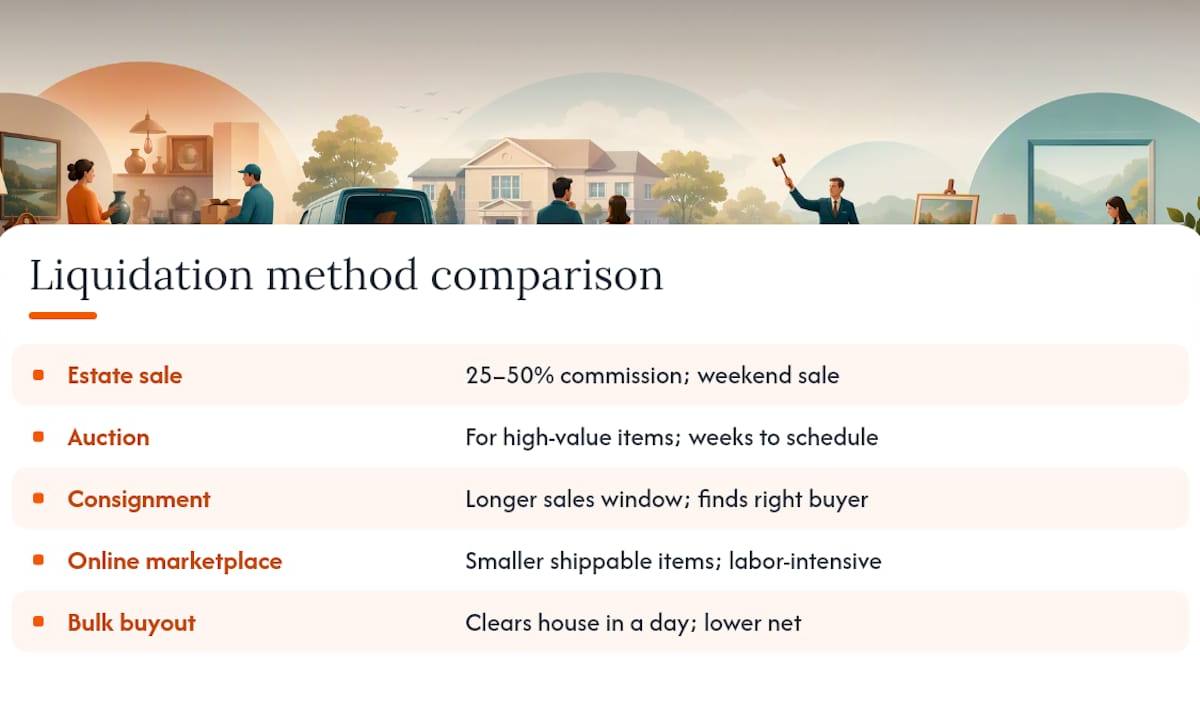
Estate sale companies typically charge 25 to 50 percent commission and handle staging, pricing, and the sale itself over a weekend. This works well for houses with a broad mix of furniture and household goods but leaves you dependent on foot traffic and weather.
Auction houses suit higher-value, specialized items (art, coins, certain furniture) and can reach buyers an estate sale never would, though they take weeks to schedule and typically hold a percentage as commission.
Consignment spreads sales over a longer window through a shop or dealer, useful for furniture and decor that needs the right buyer rather than a quick sale.
Online marketplaces work for smaller, shippable items and let family members handle sales directly, but they’re labor intensive per item.
Bulk buyout companies purchase the entire remaining contents for a flat sum. You net less per item, but you clear the house in a day, which matters when a closing date is looming.
Before signing any estate-sale or consignment contract, check the commission rate, whether there’s a holdback period before you’re paid, and how quickly proceeds get remitted. Keep every receipt, buyer record, and fee statement. Probate accounting will ask for exactly this level of detail.
Donations, Recycling, and Safe Disposal of What’s Left
Not everything gets sold, and not everything belongs in a dumpster. Sorting this correctly protects you legally and keeps usable goods out of a landfill.
For furniture, working appliances, and general household goods, Goodwill’s locator tool finds nearby drop-off centers, and the Habitat for Humanity ReStore network accepts building materials and furniture to fund local housing projects. If you’re clearing a large volume of items and don’t want to make multiple trips, DonationTown schedules pickups from local charities so you’re not calling five organizations separately. For working electronics, Tech for Troops redirects usable tech to veterans instead of the trash.
Some categories need special handling:
- Electronics, batteries, mattresses, and tires usually require drop-off at designated recycling centers, and some charge a small handling fee.
- Paint, pesticides, motor oil, and other household hazardous waste cannot go in regular trash. The EPA’s household hazardous waste guidance confirms most communities run dedicated HHW collection events for exactly this.
- Unused medications should go through an FDA-recommended drug take-back program, or follow the FDA’s specific guidance if no take-back site is nearby.
Keep every donation receipt. The estate’s accounting should note what left the house as a donation, its estimated value, and where it went, the same rigor you’d apply to a sale.
Dumpsters, Junk Removal Crews, and How to Get an Accurate Quote
Once sorting is done, someone has to physically haul the trash and unsellable leftovers away, and this is where a lot of executors underestimate cost and time.
- Decide between a dumpster rental and a junk removal crew. A dumpster gives you flexibility to fill it over several days but needs driveway space and sometimes a street permit. A crew clears everything in a single visit, which suits executors juggling out-of-town travel or a tight closing date.
- Book the dumpster or crew only after the sort is mostly complete. Booking too early means paying to store items you haven’t decided about yet.
- Give vendors real numbers when requesting quotes: square footage, an approximate item count, whether there’s a working elevator or stairs only, and any unusually heavy pieces like pianos or safes.
- Sequence the work. Line up appraisers first, then sale or donation pickups, then the final haul-away, so nothing valuable gets swept into a dumpster by mistake.
- Ask vendors directly about fees for stairs, long carries, or disposal surcharges on mattresses and electronics before you book, not after the truck arrives.
A single truckload junk removal job for a smaller home costs far less than a full 10 to 15 yard dumpster rental for a heavily furnished house, so match the option to what’s actually left after donations and sales are handled.
Closing Out the Cleanout: Cleaning, Accounting, and Final Turnover
The house isn’t done until it’s empty, clean, and the paperwork matches what actually happened inside it.
- Do a final walkthrough and handle basic cleaning and minor repairs, patched nail holes, a fresh coat of paint if the home is being sold, and a deep clean of kitchens and bathrooms.
- Deposit every dollar from sales, auctions, or buyouts directly into the estate account, never a personal one, and use those funds to pay outstanding debts and expenses before distributing anything to heirs.
- Prepare the final accounting for the probate court, matching your inventory spreadsheet, sale receipts, donation records, and disposal costs against the estate’s ledger.
- Keep photos, inventories, and receipts for at least three years after the estate closes, longer if the estate was contested or unusually complex.
- Hand off keys, cancel or transfer utilities, and notify the realtor or new occupant that the property is ready for the next step.
Fix. Move. Haul.'s Perspective on What Executors Actually Need
Most estate cleanout checklists assume the executor has unlimited weekends and a truck. In practice, Fix. Move. Haul. sees grieving families trying to sort a lifetime of belongings between work shifts and out-of-state flights. That’s the real bottleneck, not knowledge of the steps.
On-site, a cleanout crew typically handles the physical labor: loading, hauling, donation drop-offs, and disposal, while the executor focuses on documentation and decisions only they can make. Same-day scheduling matters more here than in a typical move, because families often need the house cleared before a specific closing date or before travel plans force them back home.
— Mark
Get Help With Your Estate Cleanout in Southwest Florida
If you’re managing an estate in Naples, Bonita Springs, Estero, or elsewhere in Southwest Florida, Fix. Move. Haul. handles the physical side of the checklist so you can focus on probate paperwork instead of moving furniture in the Florida heat. Fix. Move. Haul. is the alternative to hiring a general moving company for this specific job: crews who show up same day, quote a flat price before they start, and handle sorting, donation drop-offs, and full haul-away in a single visit instead of stringing the job out over weeks.

On a typical visit, you get an on-site estimate, a crew that loads and removes everything you’ve marked for donation or trash, and proper disposal that keeps items out of the wrong waste stream. Most single-home cleanouts wrap up within a day. If you also need the house prepped for listing afterward, realtor and listing prep services can handle that next step. Start with a junk removal quote for your property and get a haul-away date on the calendar.
Where to Go for Official Disposal and Donation Guidance
For hazardous materials, check the EPA’s household hazardous waste guidance and FDA drug disposal guidance. For donations, use Goodwill’s locator, Habitat ReStore, or DonationTown to schedule pickups. For a broader downsizing framework, the senior downsizing checklist is a solid companion reference.
Sources
- Household hazardous waste (HHW) | US EPA
- Disposal of Unused Medicines: What You Should Know | FDA
- Goodwill locator
- DonationTown: Schedule pickups from local charities